Are AI UGC ads legal? FTC rules and likeness rights
None of the six texts below bans AI actors in ads. We read each on 24 September 2026. Five govern an ad’s claims and disclosures; the sixth guards a real person’s likeness.
| Rule | From | What the text governs |
|---|---|---|
| FTC rule, 16 CFR 465.2 Federal Register, 22 Aug 2024 | 21 Oct 2024 | Fake or false consumer testimonials |
| FTC Endorsement Guides, 16 CFR Part 255 eCFR, revised 26 Jul 2023, guidance | 26 Jul 2023 | Endorsements; people shown as customers (255.2(c)) |
| New York, General Business Law 396-b S8420-A, signed 11 Dec 2025, start on our count | 9 Jun 2026 | Disclosure of a synthetic performer |
| California, Business and Professions Code 17610 SB 1050, approved 16 Sep 2026, no date in the text, start on our count | 1 Jan 2027 | Disclosure when a synthetic performer is prominent |
| EU AI Act, Article 50(4) EUR-Lex, 12 Jul 2024 | 2 Aug 2026 | Disclosure of deep fakes by deployers |
| California, Civil Code 3344 Leginfo, amended by Stats. 2025, ch. 590, in force before the amendment | 1 Jan 2026 | A real person’s likeness used in ads without prior consent |
Scroll sideways for all 3 columns
When does an AI actor ad count as a fake testimonial?
On our reading, when viewers are likely to take the AI actor for a customer it is not.
The FTC rule defines a consumer testimonial (16 CFR 465.1(f)) as a message “that consumers are likely to believe reflects the opinions, beliefs, or experiences of a consumer who has purchased, used, or otherwise had experience with a product, service, or business”.
Section 465.2(a) makes it a violation “for a business to write, create, or sell” a testimonial that “materially misrepresents, expressly or by implication”. That covers whether the testimonialist exists (a)(1), used or otherwise had experience with the product (a)(2), or their experience with it (a)(3).
The FTC’s announcement of 14 August 2024 gives “AI-generated fake reviews” as its example of a review by “someone who does not exist”.
Section 465.2(b) reaches a business that disseminates, or causes the dissemination of, a testimonial “about the business or one of the products or services it sells” that it “knew or should have known” materially misrepresented those points. Paragraph (a) has no such product link, so on our reading it also reaches the agency or freelancer who writes the script.
A first-person claim from either kind of AI actor falls within 465.2, on our reading, under different paragraphs. A fully synthetic face is a testimonialist who does not exist, (a)(1). A licensed replica is a real, paid person who, unless they used or otherwise had experience with your product, falls under (a)(2).
The FTC’s announcement also says the rule lets it “seek civil penalties against knowing violators”. The ceiling is $53,088 per violation (16 CFR 1.98(d)).
The FTC’s Endorsement Guides draw the presenter line (255.0, Example 6). An actor calling a machine the best “that I have ever tried” endorses it “Even if the actor is reading from a script”. One who describes the machine and its price does not: nothing leads viewers “to believe that the actor is expressing their own views about the machine”.
The Guides are the FTC’s “administrative interpretations” of the law (255.0(a)). “Whether a particular endorsement or testimonial is deceptive will depend on the specific factual circumstances of the advertisement at issue.” On these texts, what decides is whether the actor claims use or voices an opinion as their own.
| Script line | Where it sits on the texts |
|---|---|
| A first-person use or result claim, such as “I’ve used this for three weeks” | Within 465.2(a)(1) or (a)(2), by actor type, and (a)(3) for a result claim, on our reading |
| An opinion given as the presenter’s own | An endorsement under 255.0, Example 6(i), even when scripted |
| Features, use and price, read by a presenter | No endorsement under 255.0, Example 6(ii) |
| A narrated demonstration where nobody claims use | No testimonialist in the 465.1(f) sense, on our reading |
| Real customers’ words voiced by an AI actor | Unclear: 255.2(c) asks for actual consumers “in both the audio and video”, or a disclosure |
Scroll sideways for all 2 columns
Section 255.2(c) gives a disclosure route. Ads with endorsements by people represented, “expressly or by implication”, as “actual consumers” “should utilize actual consumers in both the audio and video, or clearly and conspicuously disclose that the persons in such advertisements are not actual consumers of the advertised product.” Part 465 has no matching disclosure clause.
The Guides’ hidden-camera example (255.2, Example 6) is the nearest to a UGC-style ad. With unnamed speakers, “the net impression conveyed to consumers may well be that these are actual customers. If actors have been employed, this fact should be clearly and conspicuously disclosed.”
Do you have to disclose an AI actor?
Under the FTC’s Guides, when the ad presents the actor as an “actual consumer” (255.2(c)). The three disclosure laws below turn instead on what kind of actor it is, and they point different ways.
A paid human creator falls under another clause. Under 255.5(a), a connection to the seller “that might materially affect the weight or credibility of the endorsement, and that connection is not reasonably expected by the audience”, “must be disclosed clearly and conspicuously”. Such connections “can include monetary payment or the provision of free or discounted products”.
New York’s S8420-A has required a conspicuous disclosure of a synthetic performer, one “not recognizable as any identifiable natural performer”, since 9 June 2026 on our count.
It binds a business that deals in the advertised product and “for any commercial purpose produces or creates” the ad, where it has “actual knowledge”. Whether it also reaches that business’s agency or freelancer is unclear (question 6).
California’s SB 1050 makes it unlawful to “create and cause to be published” an ad that “prominently includes a synthetic performer without a clear and conspicuous disclosure”. Its text names no start date. Under the state constitution (article IV, section 8(c)(1)), it starts on 1 January 2027, on our count.
The EU AI Act’s Article 50(4), applying since 2 August 2026, makes deployers of the AI system that generates a deep fake disclose it.
Article 3(60) defines a deep fake as content that “resembles existing persons, objects, places, entities or events and would falsely appear to a person to be authentic or truthful”. Whether an AI actor ad meets that test is unclear.
New York and California describe a performer “not recognizable” as any real person. On our reading, a fully synthetic face fits those two definitions, and a real performer’s replica sits closer to the EU’s.
AI disclosure in advertising, platform by platform quotes each law’s exemptions, and New York’s and the EU’s penalties. It also quotes the Commission’s draft guidelines, which list two AI UGC formats as deep fakes.
TikTok’s ads policy (last updated April 2026) allows AI-generated ads that “Apply the AIGC label” or carry “a clear disclaimer, caption, watermark, or sticker of your own”. If TikTok finds undisclosed AI content, the ad “will be rejected or restricted”.
TikTok’s AI-generated content label for ads covers Spark Ads and the labels TikTok adds on its own.
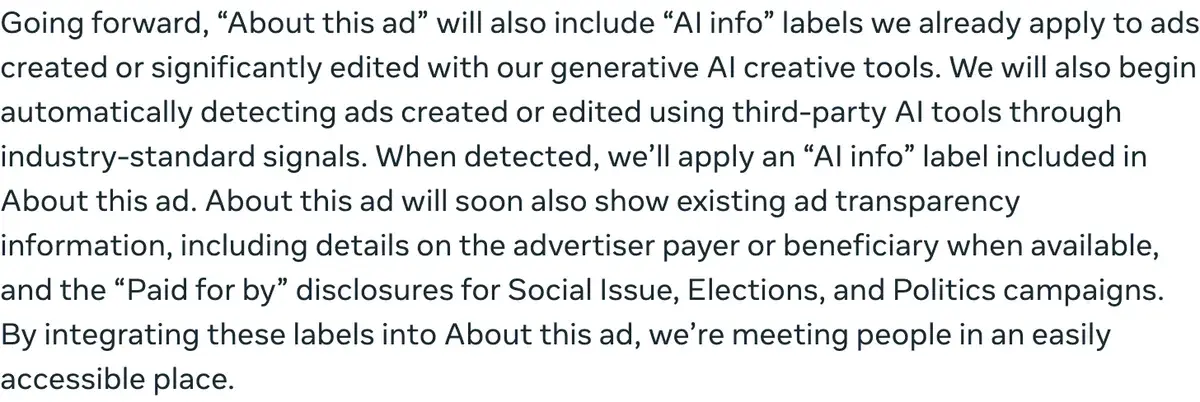
Meta labels ads made with its own generative tools, and its update of 1 June 2026 said it would “begin automatically detecting ads created or edited using third-party AI tools”. Meta’s AI disclosure rules has the detail.
Likeness: the actor may be a real person who can withdraw
Arcads’ and Maxfusion’s terms describe their actors as real creators who can withdraw (clauses below), and Synthesia’s policy calls a stock avatar’s performer “the real-life actor”. On Arcads and Maxfusion, a withdrawal can pull your live ads.
California’s Civil Code 3344(a)(1) makes anyone who “knowingly uses another’s name, voice, signature, photograph, or likeness” for advertising “without that person’s prior consent” liable for damages. On our reading, the vendor’s licence is how that consent reaches you. Whether a withdrawal ends it for ads already live is unclear.
New York’s counterpart, Civil Rights Law section 50, makes a misdemeanour of using “for advertising purposes, or for the purposes of trade, the name, portrait, picture, likeness, or voice of any living person without having first obtained the written consent of such person, or if a minor of such minor’s parent or guardian”.
Arcads’ terms (in force from 22 September 2026, 13.3.2) say FRESHR, the company behind Arcads, “may ask the Client to delete any Videos from all supports where they are used, in the event of a withdrawal request made by the Creator”. The deadline is “the timeframe requested by FRESHR”.
HeyGen puts the same duty on custom avatars in its moderation policy (effective 25 July 2024, 2.1): “You are responsible for honoring any request by or on behalf of an Actor to remove content depicting the Actor wherever you have published such depictions.”
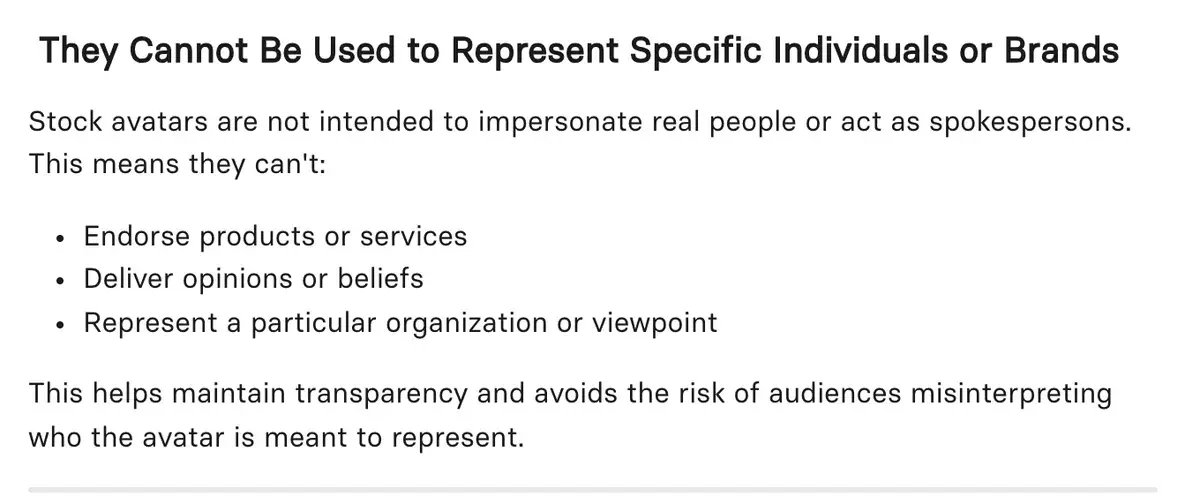
Synthesia’s Acceptable Use Policy (last updated 23 February 2024) bars stock avatars from “promoted”, “boosted”, or “paid” social ads “absent written express consent from Synthesia”. A stock avatar used so viewers think “the real-life actor personally holds, endorses, or actually has your stated opinions, characteristics or conditions” is allowed “only on enterprise Service plans”.
Synthesia’s help centre (updated 22 July 2026) is stricter. Stock avatars are for content “Free from personal opinions, endorsements, or sensitive claims”, and it names no plan exception. On our reading, a stock avatar voicing your opinion breaks both documents on other plans; on enterprise, they disagree.
Captions’ Prompt to Video article (modified 17 August 2026) calls its actors “completely virtual and free from licensing restrictions”. If so, no performer can withdraw, but on our reading these are the actors New York’s and California’s definitions describe.
Captions’ own terms split by product. In the app, avatars are Mirage Content (terms 1.3 and 2.1, 4 September 2025), and 3.1(xiv) bars “any commercial use of the Services including the Mirage Content except as authorized hereunder without our prior written consent”. On our reading, an ad using app actors needs that consent.
The Captions on Web terms (29 September 2025, 1.1) allow avatar output “for advertising or other purposes”.
AI UGC meaning tells a licensed replica from a synthetic character, and both from AI edits of a filmed take.
Contract clauses that put a price on misuse
Of the six tools below, only Maxfusion and Arcads put a fixed sum on misuse. The other four can end your licence or account instead.
| Tool | What a breach costs |
|---|---|
| Arcads Terms 13.3.1 and 13.3.2, 22 Sep 2026 | Licence ends (13.3.1). Actor videos: 500,000 euros per breach unremedied 30 days after notice, unclear for the ad-claim bars (13.3.2) |
| Maxfusion Terms 13.3, 19 Jul 2026 | 500,000 euros per violation, takedown on demand |
| MakeUGC Terms 5(f), 17 Nov 2025; Fair Use Policy 7 and 8, 11 Jul 2025 | Licences can be revoked, the subscription ended without refund, and a report made to law enforcement or regulators |
| Creatify Moderation Policy, undated; terms 6.2, 23 Sep 2024 | All rights “revert to Creatify” |
| HeyGen Terms 2 and 5, 23 Jul 2026 | Account can be ended; after an end for a breach, outputs must be deleted |
| Captions Mirage AUP, 4 Sep 2025; terms 1.4, 4 Sep 2025 | The output licence can end without notice |
Scroll sideways for all 2 columns
All six bars concern what an ad claims. HeyGen, MakeUGC and Maxfusion also require the AI disclosure the law asks for. Captions’ web terms (29 September 2025, 1.2) ask you to “disclose that AI was used” and that outputs are ads, “as and when appropriate”.
| Tool | What the terms bar |
|---|---|
| Arcads | “misleading or deceptive advertising” |
| Maxfusion | Any video used “for deceptive advertising” or “contrary to applicable advertising-platform rules”; must meet AI disclosure and labelling rules, EU AI Act Article 50 included (15) |
| MakeUGC | Output where legally required AI disclosure is “omitted”; fabricated testimonials |
| Creatify | “Fraudulent, deceptive practices” |
| HeyGen | Presenting output as “entirely human generated”; must “proactively disclose” AI use where the law requires |
| Captions | Claims that do not reflect “your honest views and experiences” |
Scroll sideways for all 2 columns
Arcads’ 13.3.2 lump sum applies “in addition to the general provisions”. It is due “In the event of non-compliance with the conditions and/or Restrictions of the applicable license”. Clause 13.3.1 calls its whole list “Restrictions”, the bar on “misleading or deceptive advertising” included. Whether the sum covers those bars for actor videos is unclear.
Arcads’ 13.3.1 also bars videos in content that “infringes the rules of ads platforms”, “infringes the rules of influence” or “requires the addition of compulsory information (e.g. sponsored content)”. TikTok rejects or restricts undisclosed AI ads (above), so on our reading an actor video with no label or disclaimer falls within the first bar.
Whether a label the law requires counts as “compulsory information” is unclear (question 2 below). Suppose it does, and New York’s or California’s law reaches a licensed replica (question 1). Then an actor video carrying that label falls within the bar, and the 13.3.2 penalty could follow if it covers 13.3.1.
So an Arcads actor video on TikTok falls within 13.3.1 without a label, on our reading, and may with one (unclear, question 2).
Under Maxfusion’s terms (19 July 2026, 13.3), each prohibited use “incurs liquidated damages” of 500,000 euros “per violation”. The prohibited uses include “deceptive advertising” and any video used “contrary to applicable advertising-platform rules”. On our reading, the same unlabelled actor video on TikTok falls within that last bar too.
Maxfusion’s terms set no period to fix a breach. For unauthorised use of a Video Model its 500,000 euros are “payable on demand and without prior notice” (13.2).
MakeUGC’s Fair Use Policy says the platform generates “avatar-led testimonials” (section 1), then forbids using outputs to “fabricate testimonials” (section 7). On our reading, an avatar claiming use nobody had is what section 7 bars.
Creatify’s policy adds that “Changes are effective immediately upon posting”. On our reading, a live ad has to meet each new version from the day it is posted.
The AI UGC hub sets these tools side by side on price and ad rights. The rights matrix quotes each plan’s clauses for Arcads and Maxfusion.
Questions to take to a lawyer
- Do New York’s “natural performer” and California’s “natural person” tests cover a licensed replica of a real actor, or only a fully synthetic one?
- Would a legally required AI label, or TikTok’s AIGC label, count as “compulsory information” under Arcads’ 13.3.1, which also bars content that “infringes the rules of ads platforms”? And does 13.3.2’s lump sum apply to a 13.3.1 breach?
- Does a clear disclosure that the speaker is not an actual consumer (255.2(c)) keep a first-person AI script outside 465.2?
- How far do Arcads’ “all supports” and Maxfusion’s 48-hour clauses reach: a client’s ad accounts, archived ads, affiliates’ reposts?
- Is a replica of a real actor a deep fake under Article 3(60) when viewers do not know the person?
- Does a freelancer who makes an ad but does not run it “create and cause to be published” it under California’s law? Under New York’s, does the law’s “agent or employee thereof” bring an agency or freelancer that makes the ad for the business into the disclosure duty?
Sources
- eCFR, US Government Publishing Office: 16 CFR 465.2, Fake or false consumer reviews, consumer testimonials, or celebrity testimonials, paragraphs (a) and (b), each with (1) to (3), the business that writes or creates a testimonial and the business that disseminates one. Checked
- eCFR, US Government Publishing Office: 16 CFR 465.1, Definitions, (f) consumer testimonial; (o) testimonialist. Checked
- Federal Register: Trade Regulation Rule on the Use of Consumer Reviews and Testimonials (89 FR 68034), published 22 August 2024, effective 21 October 2024. Checked
- Federal Trade Commission: Federal Trade Commission Announces Final Rule Banning Fake Reviews and Testimonials, press release of 14 August 2024, naming
AI-generated fake reviews
and civil penalties against knowing violators. Checked - eCFR, US Government Publishing Office: 16 CFR 1.98, Adjustment of civil monetary penalty amounts, (d), FTC Act section 5(m)(1)(A), for penalties assessed after 17 January 2025. Checked
- eCFR, US Government Publishing Office: 16 CFR Part 255, Guides Concerning the Use of Endorsements and Testimonials in Advertising, 255.0(a) and (b), Example 6 on a scripted actor; 255.2(c) on
actual consumers
and 255.2 Example 6, the hidden-camera ad; 255.5(a) on material connections; revised by 88 FR 48102, 26 July 2023. Checked - New York State Assembly: New York S8420-A (chapter 617 of 2025), General Business Law section 396-b, signed 11 December 2025; subdivision 1(c) definition, subdivision 2 definition of
person
, subdivision 3 disclosure; section 3 effective date. Checked - California Legislative Information: California SB 1050 (chapter 246 of 2026), Business and Professions Code section 17610, approved 16 September 2026; 17610(a)(6) definition, (b) duty; no operative date in the chaptered text. Checked
- California Legislative Information: California Constitution, article IV, section 8, 8(c)(1), a regular-session statute takes effect on 1 January after a 90-day period from enactment. Checked
- California Legislative Information: California Civil Code section 3344, (a)(1), use of another’s likeness in advertising without prior consent; as amended by Stats. 2025, ch. 590, effective 1 January 2026. Checked
- New York State Senate: New York Civil Rights Law section 50, Right of privacy, use of a living person’s name, portrait, picture, likeness or voice in advertising without written consent. Checked
- EUR-Lex, Publications Office of the European Union: Regulation (EU) 2024/1689 (AI Act), Article 50 and Article 3(60), Article 50(4) on deep fakes; Article 3(60) definition of a deep fake; Article 50 applies from 2 August 2026. Checked
- AI Act Explorer (Future of Life Institute): EU AI Act, Article 50 (AI Act Explorer), unofficial reading aid, with the Article 3(60) definition inline. Checked
- TikTok: TikTok ads policy: Misleading and false content, section
Edited media and AI-generated content (AIGC)
; last updated April 2026. Checked - Meta: Expanding GenAI Transparency for Meta’s Ads Products, 3 February 2025, updated 1 June 2026, on third-party AI tools and
About this ad
. Checked - FRESHR SAS (Arcads): Arcads terms and conditions, in force from 22 September 2026; clause 8.1 (Creators), clauses 13.3.1 and 13.3.2. Checked
- Maxfusion AI s.r.o.: Maxfusion terms, last updated 19 July 2026; clauses 13.2 and 13.3, clause 15 on AI disclosure and labelling. Checked
- Cinnamon Technology Limited (MakeUGC): MakeUGC terms of service, effective 17 November 2025; clause 5(f). Checked
- MakeUGC: MakeUGC Fair Use Policy, effective 11 July 2025; sections 1, 7 and 8. Checked
- Creatify: Creatify Moderation Policy, undated; prohibited content and
Policy Updates
. Checked - Creatify: Creatify terms, effective 23 September 2024; section 6.2, rights revert on a breach. Checked
- HeyGen: HeyGen terms, last updated 23 July 2026; section 2 on misleading use and AI disclosure, section 5 on termination. Checked
- HeyGen: HeyGen moderation policy, effective 25 July 2024; 2.1 on custom avatars and removal requests. Checked
- Synthesia: Synthesia Acceptable Use Policy, last updated 23 February 2024; stock avatars in paid social; stock avatars that imply the actor’s own opinions. Checked
- Synthesia: Why can’t I use stock avatars for my content? (Synthesia Knowledge Base), modified 22 July 2026; stock avatars only for content
Free from personal opinions, endorsements, or sensitive claims
. Checked - Mirage (Captions): Create talking videos from text prompts (Captions help), modified 17 August 2026;
completely virtual
actors. Checked - Mirage: Mirage Acceptable Use Policy, effective 4 September 2025; honest views and deceptive reviews. Checked
- Mirage: Captions terms, effective 4 September 2025; 1.3 and 2.1, avatars as Mirage Content; 1.4, licence to output ends on a policy breach; 3.1(xiv), commercial use of Mirage Content. Checked
- Mirage: Captions on Web Terms of Service, effective 29 September 2025; 1.1, avatar output for advertising; 1.2, disclosure of AI use and of advertisements. Checked
What changed on this page
- Cut repeats: the intro’s second paragraph, the Arcads paragraph that restated its breach-table row, and the “When each text changed” table, whose dates the six-rules table gives.
- Added the FTC’s civil penalty ceiling (16 CFR 1.98(d)) and Captions’ app and web terms on commercial use of its actors. Whether Arcads’ lump sum covers the 13.3.1 bars is now marked unclear. MakeUGC’s enforcement list now matches its section 8. New York’s and California’s statute detail moved to AI disclosure in advertising, platform by platform.
- Written. Every law, rule, platform policy and vendor clause quoted here was read at the source linked beside it on 24 September 2026.

Alexander Bleu
Alexander Bleu is a creative strategist and copywriter with ten years in content and SEO. He writes and edits short-form ads, works in English and French, and reads the pricing and terms pages behind every tool on this site before anything is written about it.
Related pages
- Category Best AI UGC generators for ads
16 AI UGC and avatar tools compared on list price per video and ad-use terms, checked 24 September 2026. No tool here has run on the bench yet.
- Profile Arcads for UGC ads
Arcads shows no price list; its help centre lists 800 credits per actor minute, “always rounded up”. What it makes and its ad terms, checked 24 September 2026.
- Profile HeyGen for UGC ads
HeyGen’s free-plan videos may not be used in ads, and a 30-second video costs 2 to 24 credits by avatar model. Plans, terms and bans, checked 24 September 2026.
-
 Profile Synthesia for ads
Synthesia bars its stock avatars from paid social ads without written consent. What that leaves for ads, plan costs and terms, checked 24 September 2026.
- Profile Creatify for UGC ads
Creatify bills avatar video in 15-second blocks, so a 30-second ad uses 10 credits. Its ad terms and 20 latest Trustpilot reviews, read 24 September 2026.
-
 Guide Meta’s AI disclosure rules for Facebook and Instagram ads
Meta labels some AI-made Facebook and Instagram ads itself. It asks you to disclose AI only in political and social issue ads. Checked 24 September 2026.


