AI UGC meaning: what is AI UGC?
AI UGC is ad video made or edited with AI to look like a customer or creator filmed it. We separate two things the term covers. One is AI actors standing in for the creator, sold by Arcads, Creatify and HeyGen. The other is AI edits of a real creator’s filmed take, such as Wireflow’s person or product swaps.
In the table below, only the two kinds a person films can involve a real customer. TikTok’s ads policy asks for an AI label on AI actors and, on our reading, on edited takes where AI swaps the person.
| Term | A real customer? | On screen | Made by | TikTok AI label |
|---|---|---|---|---|
| UGC | Only when a customer films it | The person who filmed it | A customer, or a creator paid to film | Only after AI edits beyond minor ones |
| AIGC | No | Whatever the model generates | An AI model, from a prompt | Yes for fully AI-made images, video or audio |
| AI UGC, AI actor | No | A synthetic actor or a licensed replica | An AI tool, from your script | Yes |
| AI UGC, edited take | Only when the creator is one | The creator, or a person swapped in | A creator films; AI swaps parts | Yes when AI swaps the person, on our reading |
Scroll sideways for all 5 columns
UGC, AIGC and AI UGC: three terms, and two meanings of AI UGC
UGC stands for user-generated content and AIGC for AI-generated content. AI UGC has no settled full form. Hedra’s guide expands it as “AI-Generated User Content”, and D-ID’s as “AI-Assisted User-Generated Content”.
In ads, UGC can also mean a creator paid to film in a customer’s style. AIGC is anything a model generates. AI UGC sits between them, and Hedra’s guide (12 February 2026) pictures the style as “vertical video ads featuring AI characters delivering product reviews in a casual, direct-to-camera style”.
Vendor definitions pull two ways. Hedra’s definition calls AI UGC “content produced by artificial intelligence tools but intentionally designed to look and feel like authentic, creator-made video, imagery, or audio”. D-ID’s (published 4 February 2025, updated 18 September 2026) says it “enables users to enhance, optimize, and scale their own creations”.
We keep the two senses apart because, on our reading, different documents govern each. For an AI actor, the vendor’s terms and avatar rules apply. For an edited take, what the filmed creator agreed to and the swap tool’s terms apply.
AI actors are presenters a tool generates from your script. Arcads builds its actors from footage of real creators (terms clause 8.1, in force from 22 September 2026). HeyGen can also build a custom avatar of you. Captions’ help centre (17 August 2026) calls its actors “completely virtual”.
AI-edited takes start with a real person on camera. Wireflow’s homepage puts it as “Film the pitch once. Wireflow swaps the person, the look or the product on the same take.”
Wireflow’s terms (clause 6, last updated 18 February 2026) ban creating deepfakes of real people. Whether a person swap on a filmed take counts as one is unclear, since no clause mentions swaps. Wireflow’s row in AI commercial use, tool by tool quotes its commercial-use clause.
AI UGC examples: what it looks like in an ad
Each example below is a vendor’s page about its own product, so each shows that vendor’s claim. Of the four pages, only Wireflow’s shows the edited-take sense.
| Vendor page | What it shows | Meaning |
|---|---|---|
| HeyGen, UGC video ads | AI avatars HeyGen says “look native to TikTok and Instagram” | AI actor |
| Arcads, AI UGC video | Ads for named apps laid out as feed posts marked “Sponsored”, with view and revenue figures the page does not source | AI actor |
| Creatify Studio examples | Clips “Produced by the Studio team for real client campaigns”, filed under UGC and five other formats, each card tagged “AI GENERATED” | AI ads in several formats |
| Wireflow homepage | One eight-second take, then the same take with a new creator, outfit or product | Edited take |
Scroll sideways for all 3 columns
In an ad, a label is the sign to look for. On TikTok that means its AIGC label or the advertiser’s own disclaimer, caption, watermark or sticker. On Meta, it means an “AI info” label, usually under “About this ad” in the ad’s three-dot menu (platform labels below). An unlabelled ad can still be AI UGC.
AI influencers: licensed replica or synthetic character
An AI influencer in an ad is either a real person’s licensed likeness or a character no person stands behind.
Two of the vendors here let the person behind a replica ask for its videos to come down. Arcads’ terms (13.3.2) cover a withdrawal request by the creator behind an actor. Arcads may then ask you to delete the videos you made with that actor wherever they run. Each day of delay makes you liable for 100 euros.
HeyGen’s moderation policy (2.1, 25 July 2024) makes you remove a custom avatar’s content wherever you published it if the person asks.
Synthesia’s Acceptable Use Policy (23 February 2024) calls the person behind a stock avatar “the real-life actor”. It bars stock avatars from promoted, boosted or paid social ads without Synthesia’s written express consent.
A synthetic character has nobody to withdraw consent. Captions’ actors are one example.
Are AI UGC ads legal? reads New York’s and California’s synthetic performer laws as covering such characters. Each calls for a disclosure in some ads with one. That guide quotes their conditions and dates, and covers consent and withdrawal clause by clause.
Is an AI UGC ad a fake customer?
Not by itself, on our reading. It becomes one once the ad claims, or leads viewers to believe, that the actor is a customer or used the product.
Three avatar vendors, on our reading, bar the pretence AI UGC invites: that a real person made or vouches for it. HeyGen’s terms and Captions’ policy forbid presenting output as solely human-made. Synthesia’s help centre keeps stock avatars from endorsing products, though its Acceptable Use Policy allows implied endorsements on enterprise plans. We read all three on 26 September 2026.
HeyGen’s UGC ads page sells “authentic UGC video ads using AI avatars that look and feel like real creator content”. Its terms (section 2, last updated 23 July 2026) bar using output “in a misleading way, including, without limitation, representing that the User Output is entirely human generated”.
The same section adds a duty. If you distribute output to others and the law requires it, you “must proactively disclose” that AI made it.
Captions’ Acceptable Use Policy (effective 4 September 2025) bars using the service “to misrepresent the provenance of generated content by claiming it was created solely by a human”. It also bars using the service “to create deceptive comments or reviews”. Nor may your input contain “claims that do not reflect your honest views and experiences”.
Captions’ terms (1.4, effective 4 September 2025) add that if you breach that policy, Mirage, the company behind Captions, “may, without notice, terminate your license in and to your Output”.
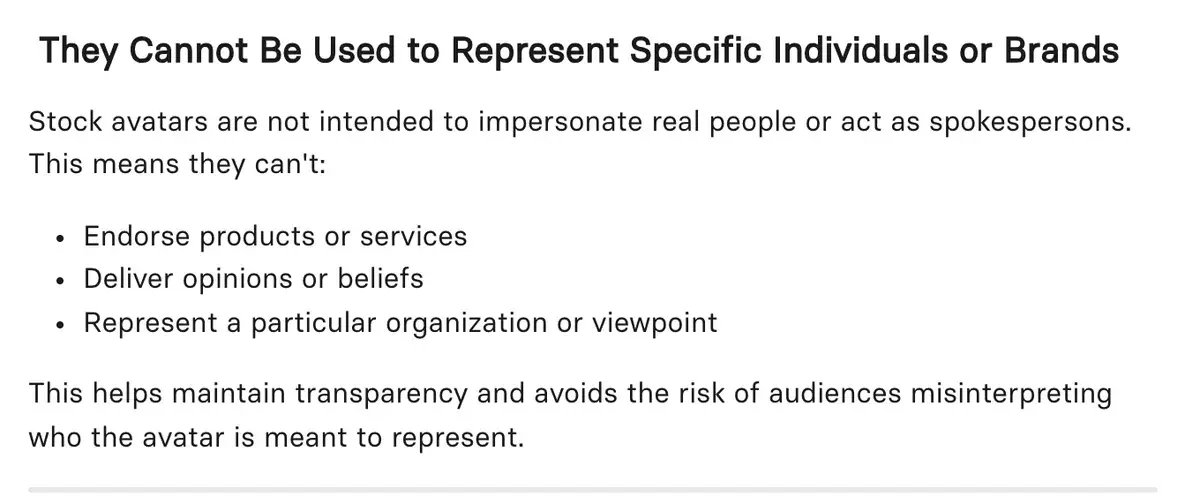
Synthesia’s help centre (22 July 2026) keeps stock avatars to content “Free from personal opinions, endorsements, or sensitive claims”. Its Acceptable Use Policy (23 February 2024) allows a stock avatar to imply the actor “personally holds, endorses, or actually has your stated opinions” on enterprise plans only.
On those plans the two documents disagree, on our reading. Promoted, boosted or paid social ads with a stock avatar still need Synthesia’s written consent.
The FTC’s rule, 16 CFR 465.2(a), makes it a violation “for a business to write, create, or sell” a fake testimonial. That covers one that “materially misrepresents, expressly or by implication” that its giver exists (a)(1), or used or otherwise had experience with the product (a)(2).
Are AI UGC ads legal? reads it as reaching an AI actor who claims to have used the product.
On our reading, what the ad says or implies decides. An AI actor reading out features and a price claims no use. The same actor saying it has used the product for three weeks claims a use that never happened. The rule’s text does not say whether a customer’s look and setting alone imply use.
Do Meta and TikTok label AI UGC?
TikTok asks the advertiser to label it. Meta said on 1 June 2026 it would label AI ads it detects through industry-standard signals.
TikTok’s ads policy (last updated April 2026) allows AI-made or much-altered media if you “Apply the AIGC label” or add “a clear disclaimer, caption, watermark, or sticker of your own”. Undisclosed AI found by TikTok means the ad “will be rejected or restricted” (TikTok’s AI-generated content label for ads).
The policy’s examples of significant change include showing the primary subject “doing something they didn’t actually do” and making them “say something they didn’t actually say”. On our reading, that reaches an edited take where AI swaps the person or changes the words. Lighting adjustments and background removal are among its examples of minor edits.
Meta’s update of 1 June 2026 said it “will also begin automatically detecting ads created or edited using third-party AI tools through industry-standard signals”. Meta’s AI disclosure rules and AI disclosure in advertising, platform by platform cover the cases where the duty is yours.
What the evidence says, and where one ad is priced
AI UGC vs human UGC: what the evidence says grades 12 public reports. None publishes a randomised split with its method. The three that ran the same hooks on both sides, by their authors’ account, favour human UGC per ad.
AI UGC price per ad prices one 30-second ad at list price, if every credit is used. It covers each AI UGC tool in our price data that publishes a price and a rate per length of avatar video.
Sources
- Hedra: What Is AI UGC? Guide to AI-Generated User Content, dated 12 February 2026; the opening definition and the section on AI UGC against traditional UGC and AIGC; Hedra sells AI video generation. Checked
- D-ID: What Are The Differences Between UGC, AIGC, and AI UGC?, published 4 February 2025, modified 18 September 2026; the section AI-Assisted User-Generated Content; D-ID sells AI avatars. Checked
- FRESHR SAS (Arcads): Arcads terms and conditions, in force from 22 September 2026; clause 8.1 on Creators and Video Models, clause 13.3.2 on withdrawal requests. Checked
- Mirage (Captions): Prompt to Video: Create Talking Videos from Text Prompts (Captions Help Center), modified 17 August 2026; the commercial use question in its FAQ. Checked
- Wireflow: Wireflow, One take. Every version of the ad., homepage, undated; the eight-second take shown with a new creator, outfit and product. Checked
- Wireflow: Wireflow terms of service, last updated 18 February 2026; clause 6 on acceptable use, deepfakes of real people among the barred uses. Checked
- HeyGen: UGC Video Ads, AI Ad Creator for TikTok and Instagram, undated; the opening line and the section The HeyGen Solution. Checked
- Arcads: AI UGC Video, undated; the example ads shown as feed posts with view and revenue figures. Checked
- Creatify: Creatify Studio, High-Converting Video Ads, Done for You, undated; the examples page of the Studio service and its example cards. Checked
- HeyGen: HeyGen moderation policy, effective 25 July 2024; section 2.1 on custom avatars, consent and removal. Checked
- HeyGen: HeyGen terms of service, last updated 23 July 2026; section 2 on misleading use and AI disclosure. Checked
- Mirage (Captions): Mirage Acceptable Use Policy, effective 4 September 2025; uses of the Services and Input the policy bars, deceptive comments or reviews among them. Checked
- Mirage (Captions): Captions, Terms and Conditions, effective 4 September 2025; clause 1.4 on breach of the Acceptable Use Policy. Checked
- Synthesia: Why can’t I use stock avatars for my content? (Synthesia Knowledge Base), dated 22 July 2026; permitted content for stock avatars. Checked
- Synthesia: Synthesia Acceptable Use Policy, last updated 23 February 2024; stock avatars that imply the real-life actor holds your opinions, enterprise plans only; stock avatars in promoted, boosted or paid social advertising. Checked
- eCFR, US Government Publishing Office: 16 CFR 465.2, Fake or false consumer reviews, consumer testimonials, or celebrity testimonials, paragraph (a), with (1) and (2). Checked
- TikTok: TikTok ads policy: Misleading and false content, last updated April 2026; section on edited media and AI-generated content (AIGC). Checked
- Meta: Expanding GenAI Transparency for Meta’s Ads Products, 3 February 2025, updated 1 June 2026; AI info labels in About this ad, within the three-dot menu. Checked
What changed on this page
- Page written.

Alexander Bleu
Alexander Bleu is a creative strategist and copywriter with ten years in content and SEO. He writes and edits short-form ads, works in English and French, and reads the pricing and terms pages behind every tool on this site before anything is written about it.
Related pages
- Category Best AI UGC generators for ads
16 AI UGC and avatar tools compared on list price per video and ad-use terms, checked 24 September 2026. No tool here has run on the bench yet.
- Best list Free AI UGC video generators
Of 11 AI UGC tools, 2 allow commercial use of free output with no free-plan exception in terms or pricing; 4 bar a paid social ad. Checked 24 September 2026.
-
 Compare HeyGen vs Synthesia for ads
Synthesia bars stock avatars from paid social without written consent; HeyGen’s self-serve paid plans allow them, with conditions. Checked 24 September 2026.
- Calculator AI ad cost calculator
Pick a tool, an ad length and how many takes you keep to see what one usable AI ad costs to make, billing rounding included. Prices checked 24 September 2026.


