Meta’s generative AI ad terms, 30 October 2026
On 30 October 2026 Meta rewrites its Self-Serve Ad Terms and Commercial Terms, and folds the Ad Creative Generative AI Terms and “Product Catalog Terms” into them. The new texts drop the sentence barring off-Meta use of AI ad output.
| Topic | Until 29 October 2026 | From 30 October 2026 |
|---|---|---|
| Generative AI rules: where they sit | A separate document, the Ad Creative Generative AI Terms | Inside the Self-Serve Ad Terms, which “incorporate” them |
| Product catalogue rules: where they sit | “Product Catalog Terms”, last modified 13 February 2015 | Inside the Meta Commercial Terms |
| Meta AI output used off Meta | “unauthorized and a violation of these Terms” | No sentence on it in either new text |
| Licence on what you upload to Meta’s AI | “perpetual, worldwide, non-exclusive, fully paid and royalty-free” | The Terms of Service licence, which “will end when your content is deleted from our systems”, with the exceptions that section lists |
| Automated campaign set-up features | “These features are optional” | Sentence removed; you review ads “even when you use our automated features” |
| Watermarks on AI output | Kept on Ad Creative AI output | Kept on any AI-made Ad Creative or Content |
| Website crawling | Meta may “access, index, cache, analyze or crawl” your URLs, for uses that include “research and training” | Adds “create test credentials” and “collect, retrieve”; content may be used to “research, train” |
| Prepaid Service Credits | Usable “at any time” | Usable for three years after you buy them, or longer where the law requires |
Scroll sideways for all 3 columns

What did Meta announce for 30 October 2026?
Meta announced that four of its advertising documents change on 30 October 2026, in banners on each page. The Ad Creative Generative AI Terms say: “We’re updating the Self-Serve Ad Terms to incorporate the Ad Creative Generative AI Terms.” The “Product Catalog Terms” (Wayback capture of 5 October 2026) say the Meta Commercial Terms incorporate them on the same date.
The two documents that carry on are rewritten. The new Self-Serve Ad Terms replace the version in force since 22 August 2025 (both Wayback captures of 5 October 2026). The new Commercial Terms add an “AI Features” section that the live version lacks.
Meta asks for no signature. Both new texts say continued use means acceptance, and the Commercial Terms add: “If you do not agree to the updated terms, you may stop all access or use of our Products for business or commercial purposes.”
What do the Ad Creative Generative AI Terms grant Meta?
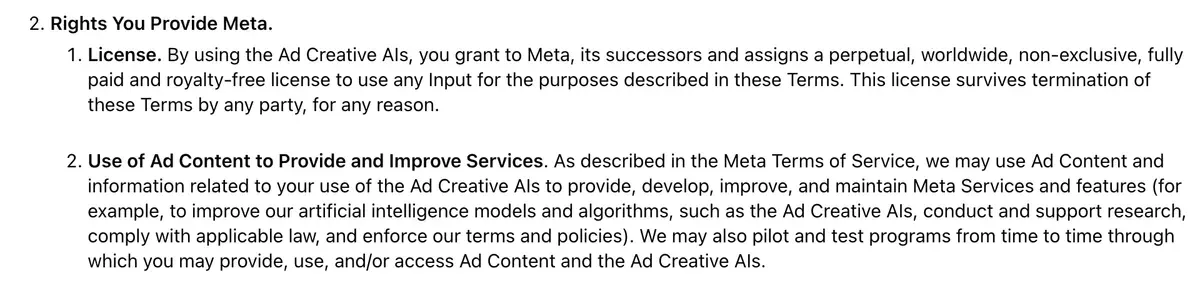
The Ad Creative Generative AI Terms (effective 6 May 2024) grant Meta “a perpetual, worldwide, non-exclusive, fully paid and royalty-free license to use any Input”, and the licence “survives termination”. Input is any text, image, video or document you give Meta’s ad creative AI tools.
The same terms keep Meta’s rights in Output, the images and text the tools generate. They allow Output “anywhere on Meta Company Products” and state: “Use or publication of Output outside of Meta’s platforms is unauthorized and a violation of these Terms.”
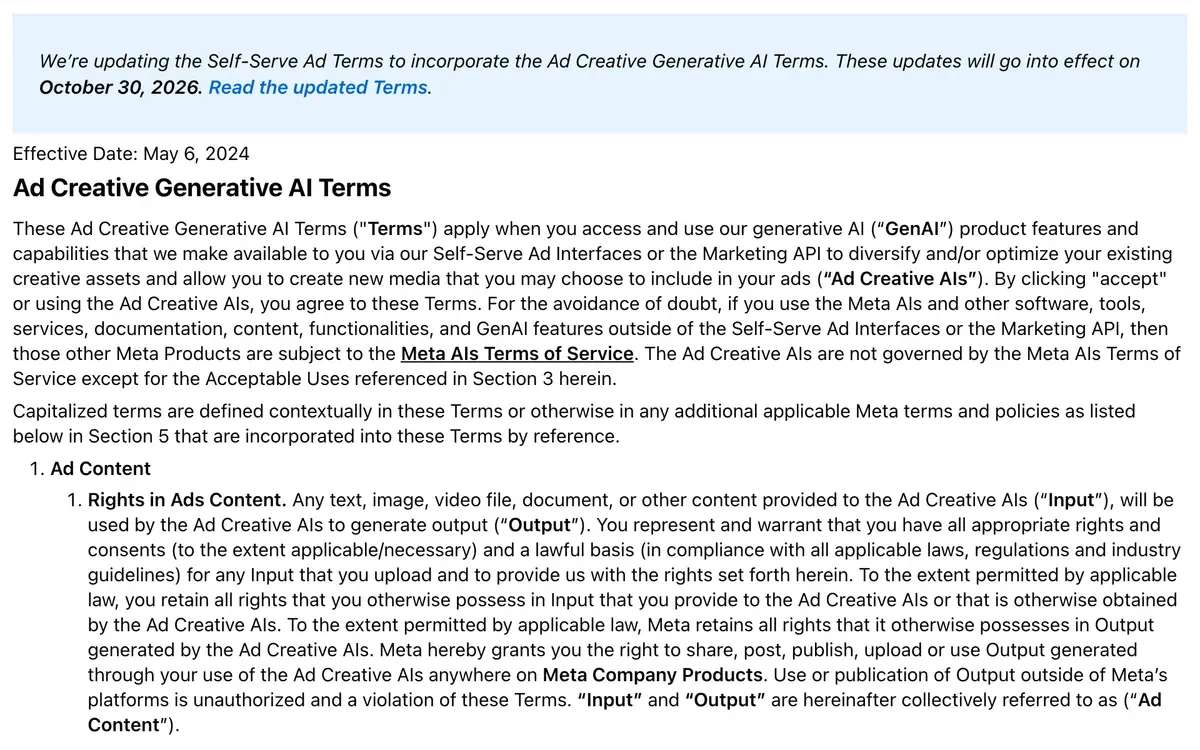
Meta may also use Ad Content “to improve our artificial intelligence models and algorithms”. You “must not misrepresent Output as human-generated”, and you must not remove “any watermark or content-authenticating metadata”.
From 30 October 2026, the new Self-Serve Ad Terms deem Ad Creative “Content” under the Commercial Terms. The Commercial Terms grant the licence “As described in ‘The permissions you give us’ section” of the Terms of Service. That licence is “non-exclusive, transferable, sub-licensable, royalty-free, and worldwide”, and “will end when your content is deleted from our systems”, with the exceptions that section lists.
Neither new text uses the word “perpetual”. Neither says whether Meta keeps rights in AI output, or whether that output can run off Meta. Our Advantage+ creative guide and the rights matrix row record the off-Meta bar in force today. That bar also covers publishing the output in a comparison on another site.
What does not change for advertisers?
Responsibility for each ad stays with the advertiser under both versions of the Self-Serve Ad Terms. The new text adds that this covers “reviewing, approving or removing” ads, “even when you use our automated features”.
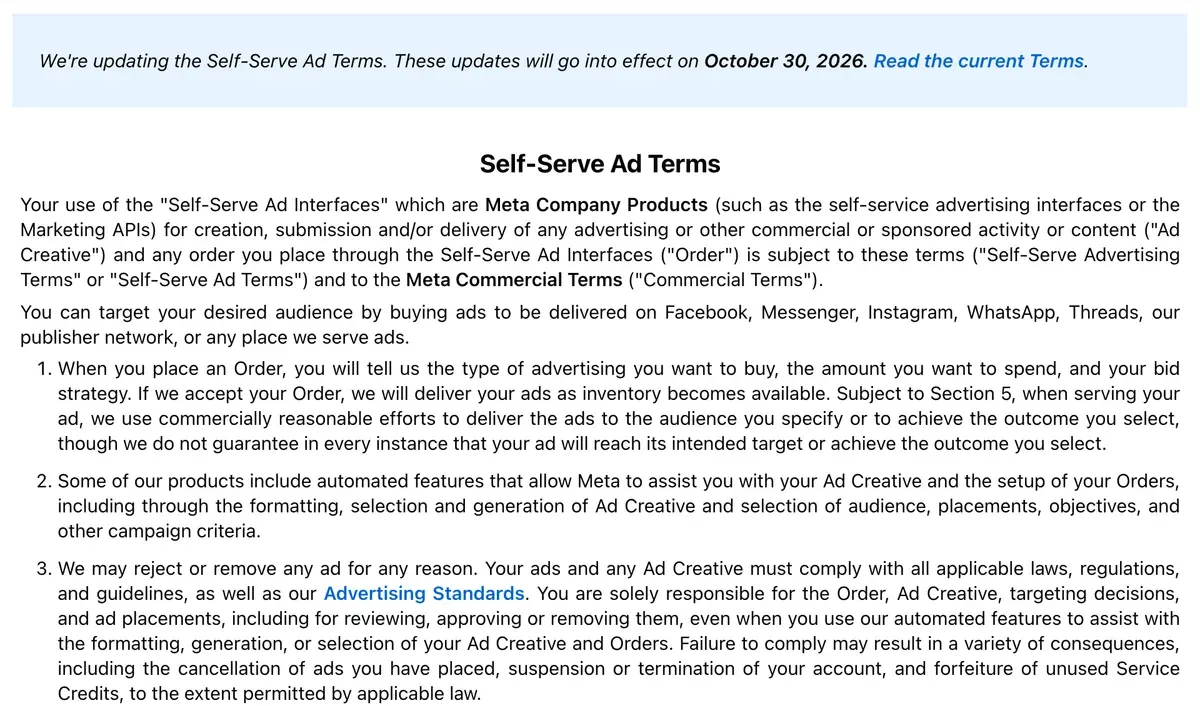
These Self-Serve Ad Terms clauses carry over, word for word unless marked:
- “We may reject or remove any ad for any reason.” (s.3 in both)
- An agency placing ads for a client must “have permission to place those ads” and binds the advertiser to the terms (s.13 in both).
- Meta Platforms, Inc. contracts with advertisers in the United States and Canada, and Meta Platforms Ireland Limited with everyone else (Contracting party, s.15, becomes s.17).
- Ads about social issues, elections or politics stay viewable for seven years after the order ends (s.9; “the ad content and creative” becomes “the ad and creative”).
- Past-due amounts accrue interest at 1 per cent a month or the lawful maximum, whichever is less (s.4).
AI info labels sit outside these terms, in Meta’s help pages, and neither version changes them: Meta’s AI disclosure rules.
Who is affected by Meta’s 30 October terms update?
Every advertiser who keeps using Ads Manager after 30 October 2026 accepts the new texts, by their own wording. Three groups have more to read.
Advantage+ creative users
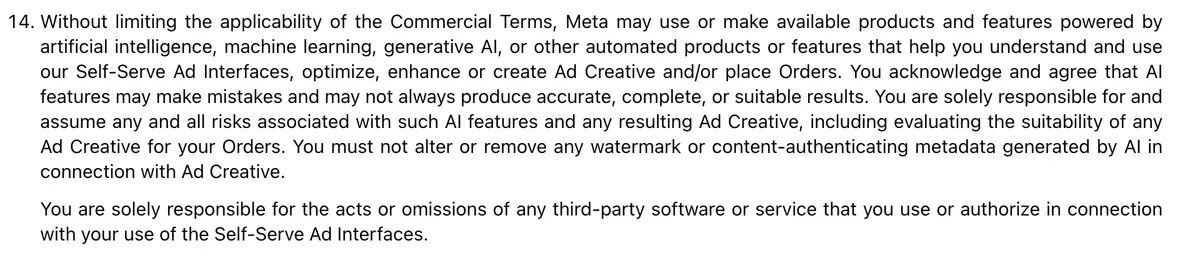
Generated backgrounds, text variations and animations become “Ad Creative” under the Self-Serve Ad Terms. The new text keeps the watermark rule and makes you responsible for evaluating “the suitability of any Ad Creative”.
Agencies
The Commercial Terms extend the content licence to Content “you or someone on your behalf (such as your agency that places an ad for you)” makes available. An agency warrants it can bind each client to the terms.
Brands using AI avatars or licensed footage
The Commercial Terms ask you to warrant “permission to display, distribute, create derivative works, and deliver your Content”. Stock footage and avatar licences set their own limits. Synthesia’s Acceptable Use Policy, for one, bars stock avatars from paid social ads without its written consent (AI UGC legal guide).
What to do before 30 October 2026
- Send the four documents, with the 30 October date, to whoever accepted Meta’s terms for the business.
- Save copies of the texts in force today, because Meta’s update banner says the new terms take effect on 30 October 2026.
- Stop uploading personal information to Meta’s AI tools. The Ad Creative Generative AI Terms already bar “any Personal Information as part of any Input”, and the Commercial Terms bar health, financial and biometric data.
- Check every licence behind your inputs. Footage, music, avatars and client assets need rights that cover display, distribution and derivative works on Meta.
- Keep AI watermarks and content-credential metadata on exports. Both new texts forbid removing “content-authenticating metadata generated by AI”.
- Spend prepaid Service Credits within three years of buying them.
- Review which automated features run on each campaign. The new Self-Serve Ad Terms drop the line calling them “optional”.
Third-party generators and their paid-ads terms, tool by tool: AI Facebook ad generators.
Questions about Meta’s 30 October 2026 terms update
What is Meta’s update effective October 30, 2026?
It rewrites the Self-Serve Ad Terms and the Meta Commercial Terms, and folds the Ad Creative Generative AI Terms and the “Product Catalog Terms” into them.
Do I have to accept Meta’s new advertising terms?
No signature is needed. Placing ads after 30 October 2026 counts as acceptance, and the alternative the Commercial Terms name is to stop business use of Meta’s products.
Can I use Advantage+ creative output on TikTok after 30 October 2026?
The new texts do not say. They drop the sentence that called off-Meta use “unauthorized” and add no sentence allowing it.
Does Meta train AI on my ads and website?
Yes. The Ad Creative Generative AI Terms let Meta use Ad Content “to improve our artificial intelligence models and algorithms”. For your website, the Self-Serve Ad Terms in force (s.6) let Meta crawl your URLs for “research and training”. From 30 October the Commercial Terms (“Licenses & Rights You Provide Meta”) let Meta use content from those pages to “research, train”.
Sources
- Meta: Ad Creative Generative AI Terms (effective 6 May 2024), sections Rights in Ads Content, Misrepresentation, License, Use of Ad Content and No Personal Information, with the banner on the 30 October 2026 change; read on the live page and on the Wayback Machine capture of 4 October 2026. Checked
- Meta: Self-Serve Ad Terms in force (effective 22 August 2025), Wayback Machine capture of 5 October 2026, compared line by line with the 30 October 2026 text. Checked
- Meta: Self-Serve Ad Terms from 30 October 2026, the preview page Meta links from its update banner; Wayback Machine capture of 5 October 2026. Checked
- Meta: Meta Commercial Terms from 30 October 2026, sections Licenses and Rights You Provide Meta, AI Features, Updates and Incorporation of Supplemental Terms; Wayback Machine capture of 5 October 2026. Checked
- Meta: Meta Commercial Terms in force, the live page carries the banner on the 30 October 2026 update and has no AI Features section. Checked
- Meta: Product Catalog Terms (last modified 13 February 2015), banner: the Commercial Terms incorporate these terms from 30 October 2026; Wayback Machine capture of 5 October 2026. Checked
- Meta: Meta Terms of Service (effective 1 January 2025), The permissions you give us: the content licence and when it ends. Checked
What changed on this page
- Page written.

Alexandre S.
Alexandre S. is a creative ad strategist and copywriter with ten years' experience in digital marketing across multiple channels.
Related pages
-
 Guide AI disclosure in advertising, platform by platform
Where a platform or a law asks you to disclose AI in an ad, each rule quoted with its date. Meta, TikTok, YouTube, New York, California and the EU.
-
 Best list Best AI tools for Meta ads
AI tools for Facebook and Instagram ads, split into making the ad and running the campaign, with prices and ad terms checked 23 to 26 September 2026.
-
 Category AI static ad generators
Ad tools resell image models at up to 27 times the maker’s price, if every credit is used. 18 static ad tools on price and ad rights, checked 25 September 2026.


