

HeyGen vs Synthesia for ads
Verdict: HeyGen or Synthesia
For stock-avatar ads on paid social, HeyGen; Synthesia only with a consenting person’s personal avatar or Synthesia’s written consent. Synthesia’s Acceptable Use Policy bars stock avatars from “promoted”, “boosted”, or “paid” social ads without it; HeyGen’s terms set no such limit on self-serve paid plans, beyond category bans and legally required AI disclosure (prices checked ).
On HeyGen Creator at $29 a month, a 30-second ad costs $0.10 to $1.16 by avatar model, pro rata, if every credit is used, or from $0.19 by the whole minute.
 HeyGen
- Best for
- Localising one ad script into many languages, cheap avatar minutes for talking-head ads, and founder or spokesperson clones on a paid plan.
- Not for
- Anyone planning to run ads made on the free plan, which the terms forbid, and advertisers of alcohol, online gambling or weapons, which the moderation policy bans.
 Synthesia
- Best for
- Explainer, onboarding and product-education videos and their localisation. For paid social, only with a personal avatar of someone who has consented.
- Not for
- UGC-style paid social with stock avatars: the Acceptable Use Policy bans them in
promoted
,boosted
, orpaid
advertising on social media without Synthesia’s written consent. Stock avatars may not endorse products either.
| HeyGen | Synthesia | |
|---|---|---|
| Where they differ | ||
| Cost per output at list price | $0.10 to $1.16 per 30-second video if every credit is used; pro rata ($0.19 if billed by the whole minute) | $1.45 per 30-second video if every credit is used |
| Stock avatars in paid social ads | Allowed on Creator, Pro and Business, with conditions | Barred without Synthesia’s written consent |
| Cheapest plan whose videos can run as ads | Creator (Free output is barred, terms s.4) | Starter, if it includes a personal avatar |
| Billing for part minutes | No rounding rule published | By the second |
| Own or spokesperson avatar | 1 digital twin on Creator | Unclear on Starter: 3 (table, help centre), none (card) or 1 (FAQ) |
| Translation languages | 175 on paid plans, 30+ on Free | 70+, or 140+ on Enterprise |
| Unused credits or minutes | Roll over one month on monthly plans | Lapse at the end of each period |
| After you cancel | Moves to Free; the help centre says videos and avatars are kept | Access to the account and its videos ends |
| The same on both | ||
| Monthly from (USD) | Both: $29 | |
Can you run stock avatars in paid social ads?
On HeyGen’s Creator, Pro and Business plans, yes, with conditions; on Synthesia, only with its written consent, on any plan.
Synthesia’s Acceptable Use Policy, last updated 23 February 2024, prohibits this:
Incorporating a Stock Avatar in content for “promoted”, “boosted”, or “paid” advertising on any social media platform or similar media, absent written express consent from Synthesia
For a custom avatar, the same clause goes on, “you may do so only with appropriate consent from the individual.” On our reading, “boosted” also catches an organic post you promote later. The policy names no way to ask for that consent.
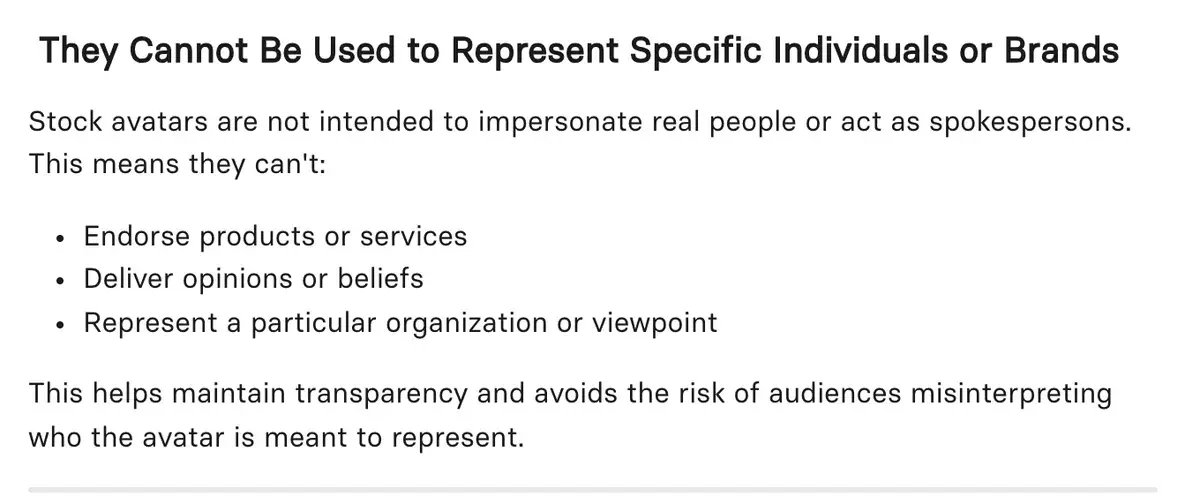
On testimonial-style scripts, Synthesia’s documents disagree, so the point is unclear. The policy bars a stock avatar that makes viewers think the actor “personally holds, endorses, or actually has your stated opinions”, which it allows “only on enterprise Service plans”. The help centre (22 July 2026) names no exception: stock avatars “can’t” “Endorse products or services”.
Are AI UGC ads legal? reads the FTC’s fake-testimonial rule as reaching an avatar that claims to have used the product, on either tool.
The same help article limits stock avatars to content that is “Neutral in tone” and “Fact-based and educational”. A script with “References to real people, companies, or current events” may not be eligible.
Synthesia’s policy also bars “Using the Services to promote or advertise age restricted goods, services or venues, including alcohol, tobacco, vaping products, psychoactive substances, firearms, gambling, sex toys, escort services and dating services”. It names no avatar or plan exception.
The help centre sends age-restricted “internal sales, packaging, distribution, logistics, education, or liability content” to a personal or studio avatar. It does not mention ads, so on our reading the policy’s ban still covers them.
HeyGen’s terms (last updated 23 July 2026) leave Creator, Pro and Business output free for “commercial purposes” (s.3). Its stock avatars page answers “Yes, on eligible paid plans” and adds: “You can use HeyGen videos for ads, marketing, social media, and client work.” The yes has conditions:
- Section 2 bars “representing that the User Output is entirely human generated” and, “to the extent required by applicable law”, requires you to disclose AI use. Which laws ask: AI ad disclosure rules.
- The moderation policy (3.1, effective 25 July 2024) bars “Promotion of goods and services related to commercial sex( Prostitution), Weapons/ ammunition, alcohol, online gambling, trade of endangered species, body parts and fluids, hazmat goods.”
- Section 4 bars Free-plan output from “advertising” and “client work”.
- Religious content and educational content that may show nudity or sex are “Conditional content” (moderation policy 3.2): “Such content can be created using custom avatars only.”
Plan by plan: HeyGen and Synthesia in the AI commercial use matrix.
Which costs less for a 30-second ad?
Monthly and pro rata, HeyGen Creator undercuts Synthesia Starter on every avatar model below, if every credit is used. Creator lists at $29 a month and Starter at $29 a month (HeyGen pricing page, Synthesia pricing page).
By the whole minute, Avatar IV with a Video Look and Avatar V cost more than monthly Starter. Billed yearly, the answer turns on the avatar model and on which Synthesia price holds (below the table).
| Plan, billing and avatar | List price (USD a month) | Pro rata (USD) | Whole minute (USD) |
|---|---|---|---|
| HeyGen Creator monthly, Avatar III Video Look | $29 | $0.10 | $0.19 |
| HeyGen Creator monthly, Avatar IV Video Look | $29 | $0.75 | $1.50 |
| HeyGen Creator monthly, Avatar V | $29 | $1.16 | $2.32 |
| HeyGen Creator yearly, Avatar III Video Look | $24 | $0.08 | $0.16 |
| HeyGen Creator yearly, Avatar IV Video Look | $24 | $0.62 | $1.24 |
| HeyGen Creator yearly, Avatar V | $24 | $0.96 | $1.92 |
| Synthesia Starter monthly | $29 | $1.45 | Not applicable |
| Synthesia Starter yearly, by the card | $18 | $0.90 | Not applicable |
| Synthesia Creator monthly | $89 | $1.48 | Not applicable |
Scroll sideways for all 4 columns
Synthesia’s pricing page meters by the second, so its pro rata figures are by the second and its rows have no whole-minute figure. A 59-second video leaves “9:01 minutes” of Starter’s 10.
HeyGen’s rows use the per-minute rates in its credits article (17 September 2026), which also says “HeyGen will show the credit cost in-product before you generate”. Yearly plans get their credits month by month (plans article).
The rows leave out Photo Looks and Custom Expressive Motion. That Avatar IV option adds 40 credits a minute, lifting a monthly 30-second ad to $1.72, above monthly Starter.
For ads without Synthesia’s consent, the fair match is a HeyGen stock avatar against a Synthesia personal avatar. Synthesia’s FAQ ties that avatar to yearly plans and quotes $264 a year for Starter, against the card’s $216.
If the FAQ is right, yearly Starter costs $0.90 a 30-second ad by the card, or $1.10 by the FAQ, if every minute is used. Both are under Avatar V’s $1.16 on monthly Creator. On yearly Creator, Avatar V’s $0.96 sits between them.
Every plan and length: HeyGen pricing and Synthesia pricing; your own volumes: the cost per AI ad calculator.
Can you make an ad with your own face or a spokesperson’s?
Yes on both, with the person’s consent: one digital twin on HeyGen Creator, an unclear count on Synthesia Starter.
HeyGen Creator includes “1 Custom Digital Twin (Video Avatar)”, its plans article (24 September 2026) says. The Free plan’s one custom avatar cannot appear in ads (terms s.4).
The person shown must give “explicit consent”, and “You are responsible for honoring any request by or on behalf of an Actor to remove content depicting the Actor wherever you have published such depictions” (moderation policy 2.1). On our reading, one request can pull every live ad with that face.
Synthesia’s personal avatar needs a consent video that “must be recorded live and must include the on-screen passcode”, recorded by the person shown (help centre). Such avatars “can mention brands” (help centre).
How many Starter includes is unclear. The pricing page’s compare plans table lists “3 personal avatars”, and the personal avatar help article (22 July 2026) agrees: “Starter: 3 free avatars”.
But the Starter card lists none, and the FAQ says “One custom personal avatar is included with the annual Starter and Creator plans.” Ask Synthesia before buying monthly Starter for ads; the Synthesia profile covers the rest of the process.
Which reaches more languages with one ad?
HeyGen, on each pricing page’s own count: 175 against Synthesia’s 70+ below Enterprise.
HeyGen’s compare plans table lists “175 languages & dialects” for video translation on every paid plan and 30+ on Free. Synthesia’s pricing page gives presenters “160+ languages & voices” on every plan, but its translation lists “70+ languages” below Enterprise and 140+ on it.
Dubbing one 30-second ad also costs less on HeyGen Creator than on monthly Synthesia Starter, if every credit is used. The figures below assume part minutes count pro rata, which neither page states. On Creator at $29 a month, lip-synced translation in Speed mode takes 6 credits a minute: $0.15 (credits article).
On Synthesia Starter at $29 a month, 1,200 credits make 48 minutes of dubbing, so a 30-second dub costs $0.30 without lip sync. Lip sync “Uses 2× credits when enabled”, so a lip-synced 30-second dub costs $0.60 (pricing page).
What happens to your ads and avatars when you cancel?
HeyGen’s help centre says your videos and avatars are kept; on Synthesia, access to them ends with the billing period.
HeyGen’s pricing FAQ says a cancelled account “moves to the Free plan” when the cycle ends, and “Unused credits do not carry over.” Its plans article says “All of your avatars, videos, and projects will still be accessible when you’re ready to sign back up.” Monthly credits roll over “for one more month” while you pay.
On our reading, the Free plan’s ad bar (s.4) covers output “generated under a Free Plan”, so ads made while paying stay usable. Section 5 of the terms is the exception: if HeyGen ends your account over a breach, “you must cease use of and delete any Outputs”, which on our reading includes live ads.
Synthesia’s billing article (10 September 2026) says “Once the billing period ends, you lose access to Synthesia and all videos in your account”, so export finished ads first.
The Customer Terms (20 July 2026) add that “Avatars cannot be exported” (Data Portability and Deletion).
Neither refunds a period already paid: HeyGen’s payments are “non-refundable, except where required by law” (s.7(d)), and Synthesia’s “fees paid are non-refundable” except as its Contract states (Payment Terms).
Synthesia’s terms also ask for renewal notice “at least thirty (30) days” before the term ends, while its billing article says to cancel “before your renewal date”. Neither page says how the two fit.
What Trustpilot reviews raise about each
Both profiles counted the 20 latest Trustpilot reviews on 24 September 2026. The samples cover different spans, so we set the counts side by side without comparing them.
HeyGen’s 20 were posted on 22 and 23 September 2026, 17 of them marked “Invited” (asked for by the company). Of the 20, 11 praise the product or its ease of use. Among the complaints, 3 dispute a charge and 2 report slow or poor output (HeyGen profile).
Synthesia’s 20 were posted 6 May to 14 September 2026. Of the 20, 5 report a video rejected by moderation, one made with the reviewer’s own custom avatar. Another 5 praise a Synthesia webinar, and 3 say their minutes lapsed monthly or ran out (Synthesia profile).
If neither fits
At list price, if every credit is used, Creatify costs more per 30-second ad than any figure in the cost table above. JoggAI costs less than most.
 Creatify Creatify | JoggAI | |
|---|---|---|
| Cost per output at list price | $3.90 per 30-second video if every credit is used | $0.12 to $0.24 per 30-second video if every credit is used; pro rata |
| Monthly from (USD) | $39 | $29 |
If you want an ad launcher beside the avatars, Creatify’s pricing page lists one. The version we read did not say which plans include it. On our reading its terms (s.6.3) leave unclear whether its AI actors count as licensed “Community Assets”.
Creatify bills avatar video in 15-second blocks, rounded up (help centre), so a 16-second ad costs as much as a 30-second one (pricing page). More in the Creatify profile.
If you want one credit balance for the web app and the API, JoggAI’s pricing page lists “Credits Sharing: API/MCP & Platform” on each plan card. Its plans sit in the price tracker.
JoggAI’s Starter card puts 144,000 credits at about 1,440 minutes of avatar video, about 100 credits a minute. The table’s low end assumes that rate pro rata, and the high end billing by the whole minute. JoggAI’s pricing page publishes no rounding rule.
Other avatar tools by job: HeyGen alternatives and AI UGC tools.
Questions buyers ask about HeyGen and Synthesia
Can I use a Synthesia stock avatar in an ad I never boost?
On our reading, the paid-ads clause does not reach a post you never boost. But below Enterprise a stock avatar may not endorse your product. The help centre (22 July 2026) also keeps stock avatars off brands and names no plan exception (what the clauses say).
Do HeyGen or Synthesia videos carry a watermark?
HeyGen’s Free videos do; watermark removal starts on Creator. Synthesia lists downloads and logo removal from Starter, so a Basic video cannot be downloaded for an ad (HeyGen pricing, Synthesia pricing).
Can I move my avatar from Synthesia to HeyGen?
No. Synthesia’s Customer Terms say “Avatars cannot be exported”, so the person would record a new digital twin on HeyGen, with fresh consent under its moderation policy 2.1.
Sources
- HeyGen: HeyGen pricing, plan cards, the compare plans table (custom video avatars, 175 translation languages on paid plans) and the FAQ on rollover and cancelling; re-read on 26 September 2026 with no price change. Checked
- HeyGen help centre: How to use credits on HeyGen, updated 17 September 2026; credits a minute by avatar model and Look, and video translation at 4, 6 or 10 credits a minute. Checked
- HeyGen help centre: HeyGen credit-based pricing plans and subscriptions explained, updated 24 September 2026; one custom digital twin on Creator, credits allocated monthly on yearly plans, rollover, cancelling, and avatars and videos kept after cancelling. Checked
- HeyGen: HeyGen Terms of Service, last updated 23 July 2026; sections 2, 3, 4, 5 and 7(d). Checked
- HeyGen: HeyGen Content Moderation Policy, effective 25 July 2024; 2.1 consent and removal requests, 3.1 restricted goods and services, 3.2 conditional content. Checked
- HeyGen: HeyGen stock avatars, no date shown; the FAQ answer on commercial use, ads included, on eligible paid plans. Checked
- Synthesia: Synthesia pricing, plan cards, the compare plans table (personal avatars, presenter and dubbing languages, lip sync at double credits) and the FAQ (yearly prices, one personal avatar on annual plans, no rollover); re-read on 26 September 2026 with no price change. Checked
- Synthesia: Acceptable Use Policy, last updated 23 February 2024; the stock avatar advertising clause, the endorsement clause and the ban on advertising age restricted goods. Checked
- Synthesia: Customer Terms of Service, effective 20 July 2026; Payment Terms, Auto-Renewal, Data Portability and Deletion. Checked
- Synthesia help centre: Why can’t I use stock avatars for my content?, updated 22 July 2026; what stock avatars may cover and cannot do, age-restricted content, and brand mentions with personal avatars. Checked
- Synthesia help centre: How do I create my personal avatar from a video?, updated 22 July 2026; 3 personal avatars on Starter, and the live consent recording with its on-screen passcode. Checked
- Synthesia help centre: How do I manage my Synthesia plan and billing?, updated 10 September 2026; stopping a renewal, and losing access to videos when the billing period ends. Checked
- Trustpilot: HeyGen reviews, the 20 most recent reviews as counted for the HeyGen profile on 24 September 2026. Checked
- Trustpilot: Synthesia reviews, the 20 most recent reviews as counted for the Synthesia profile on 24 September 2026. Checked
- Creatify: Creatify pricing, Starter’s monthly price; re-read on 26 September 2026 with no change. Checked
- Creatify help centre: Credit usage, billing and validity, updated 19 August 2026; 5 credits per 15 seconds of avatar video, rounded up. Checked
- Creatify: Creatify Terms of Service, effective 23 September 2024; section 6.3 on Community Assets. Checked
- JoggAI: JoggAI pricing, Starter’s monthly price and credits in the pricing FAQ; re-read on 26 September 2026 with no change. Checked
What changed on this page
- The verdict’s cost sentence is shorter: the pro rata range by avatar model, or from the whole-minute cost. The key table still says HeyGen publishes no rounding rule.
- Page written.

Alexander Bleu
Alexander Bleu is a creative strategist and copywriter with ten years in content and SEO. He writes and edits short-form ads, works in English and French, and reads the pricing and terms pages behind every tool on this site before anything is written about it.
Related pages
- Category Best AI UGC generators for ads
16 AI UGC and avatar tools compared on list price per video and ad-use terms, checked 24 September 2026. No tool here has run on the bench yet.
- Profile HeyGen for UGC ads
HeyGen’s free-plan videos may not be used in ads, and a 30-second video costs 2 to 24 credits by avatar model. Plans, terms and bans, checked 24 September 2026.
- Pricing HeyGen pricing
HeyGen Creator is $29 a month, so a 30-second ad costs $0.10 to $1.16 if all 600 credits are used. Free plan bars ads. Checked 24 September 2026.
- Alternatives HeyGen alternatives
Avatar tools that could replace HeyGen for ads, compared on cost per 30-second ad and whether paid social ads are allowed, prices checked 24 September 2026.
-
 Profile Synthesia for ads
Synthesia bars its stock avatars from paid social ads without written consent. What that leaves for ads, plan costs and terms, checked 24 September 2026.
- Pricing Synthesia pricing
Synthesia Starter: $29 a month for 10 minutes, $1.45 per 30 seconds if every minute is used. Paid social ads need a personal avatar. Checked 24 September 2026.


