Custom AI avatar tools for ads
Verdict on custom AI avatar tools
To clone yourself for ads, start with HeyGen for a 15-second setup or MakeUGC for UGC formats. HeyGen’s Creator plan, $29 a month, includes a digital twin, and MakeUGC’s custom avatars start on Growth, $79 a month (prices checked ). The catch is leaving: Synthesia’s avatars cannot be exported, and its billing help says your videos go when the period ends.
For a clone of yourself in UGC-style ads:  MakeUGC
Growth includes one custom avatar and Pro three, beside product-in-hand and B-roll; Starter includes none.
For a twin from one 15-second clip:  HeyGen
A 15-second clip plus a consent code read on camera; HeyGen says processing takes about 10 to 15 minutes, and Creator includes a twin slot.
For a presenter clone you can run in paid social:  Synthesia
Stock avatars need written consent for paid social; personal avatars, three on Starter, are the route around it.
For a twin made from a selfie:  Captions (Mirage)
Mirage says 10 seconds of footage is enough; AI Twin and custom actors start on Max.
For a founder clone behind an identity check:  Argil
Identity verification (KYC) comes before a User Avatar video is accepted (terms 5.2.3.1).
| Tool | Monthly from (USD) | Paid ads on the free plan | Paid ads on the cheapest paid plan | What it does | Official site |
|---|---|---|---|---|---|
 Arcads | Not published | No free plan | Allowed with conditions (every paid plan) | Script-to-video ads read by 1,000+ AI actors, plus Kling, Veo and Seedance clips in the same app. | Visit Arcads |
 Argil | $50 | Not rated | Allowed with conditions (Pro) | Avatar videos of you as a verified clone, or of generic actors hired by contract; now aimed at films, series and social. | Visit Argil |
 Captions (Mirage) | $9.99 | Unclear | Unclear (every paid plan) | Phone-first app making talking videos with Mirage actors it calls completely virtual, plus AI editing and dubbing. | Visit Captions |
 Creatify | $15 | Unclear | Allowed with conditions (Standard) | Avatar and product video ads from a URL or script, with batch variants, an ad launcher and a competitor ad tracker. | Visit Creatify |
 D-ID | $29 | Trial: Barred | Allowed with conditions (Pro) | Talking-avatar videos, video translation and real-time visual agents, with a contractual synthetic mark on every video. | Visit D-ID |
 HeyGen | $29 | Barred | Allowed with conditions (Creator) | Talking-avatar videos from text, photos or your own digital twin, with translation into 175+ languages. | Visit HeyGen |
 JoggAI | $29 | Allowed with conditions | Allowed with conditions (Starter) | Avatar videos, product avatars and URL-to-video ads, with one credit balance across the web app, API and MCP. | Visit JoggAI |
 MakeUGC | $59 | No free plan | Allowed with conditions (Starter) | UGC-style video ads with 1,000+ AI creators, B-roll and product-in-hand shots; API and MCP access on every plan. | Visit MakeUGC |
 Synthesia | $29 | Barred | Allowed with conditions (Starter) | Presenter-style avatar videos and dubbing in 160+ languages, built mainly for training and corporate video. | Visit Synthesia |
Scroll sideways for all 6 columns
Prices checked 21 Oct 2026. Arcads publishes no price list.

What each tool asks you to record
A custom avatar needs two things from the person: a sample of their face and voice, and proof that they agreed. The footage ranges from 10 seconds on Captions to 5 minutes on Synthesia, and Synthesia is the only one that takes about a business day.
| Tool | What you record | How consent is checked | Ready in |
|---|---|---|---|
| MakeUGC | “A short, well-lit clip” talking to camera, plus an optional voice recording | Policy 4a: signed consent for anyone else’s likeness | Not stated |
| HeyGen | A 15-second reference video | “Read a unique on-camera consent code” | About 10 to 15 minutes |
| Synthesia | One continuous take of 1 to 5 minutes (video avatar) | Consent recorded live by the person, with an on-screen passcode | About 1 business day |
| Captions | 10 seconds of footage, or a selfie | Terms 3.2: written consent of everyone in the input | “In moments” from a selfie |
| Argil | Not stated on argil.ai | Identity verification (KYC) before the avatar video is accepted | Not stated |
Scroll sideways for all 4 columns
The tools, one by one
 MakeUGC: your clone beside product-in-hand shots
MakeUGC’s custom avatar page lists three steps: upload a short video, add your voice if you want it, then type a script.
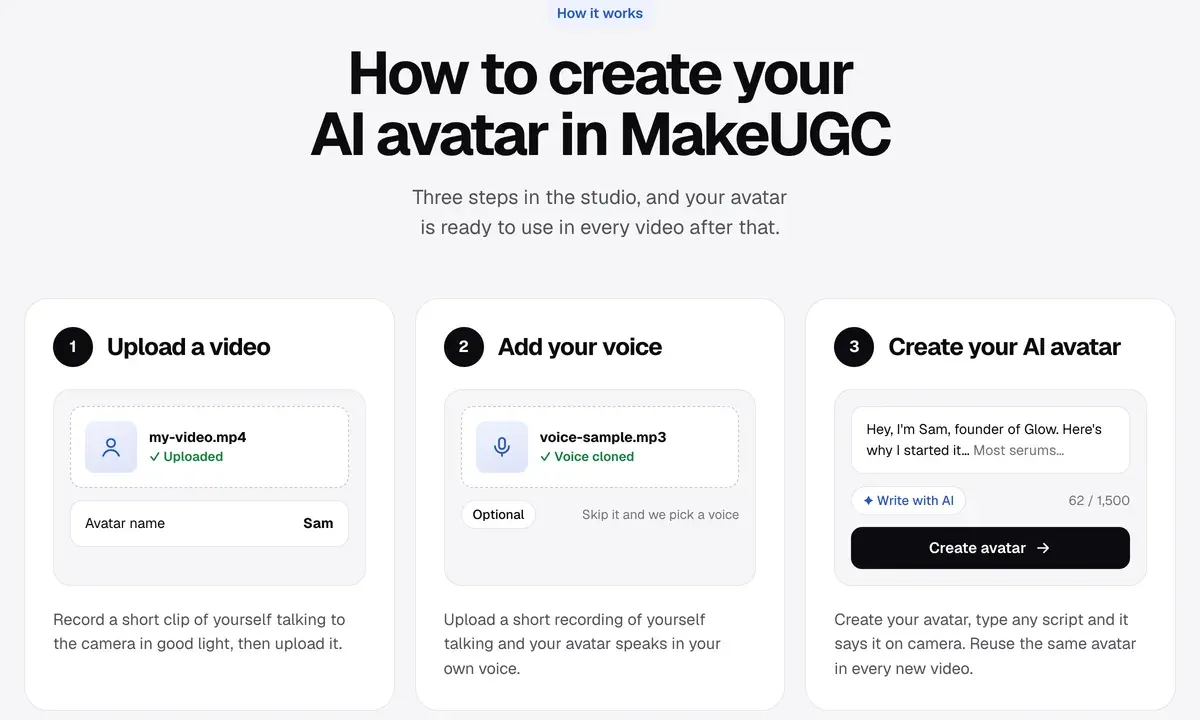
It states “Growth includes 1 custom AI avatar and Pro includes 3. Starter does not include custom avatars.” Pro costs $149 a month (MakeUGC pricing).
The same account makes product-in-hand video and B-roll (MakeUGC hub), so a founder clone and the product shots share one credit pool. MakeUGC’s API docs (read 21 October 2026) charge 100 credits per custom avatar.
The Custom Avatar Policy (4b) says MakeUGC “does not claim ownership over your Custom Avatar Content”, and grants MakeUGC a licence to it solely to provide the service. Users report charges after cancelling, and trial cancellations that need an email (17 of 29 sources: Trustpilot, Trustpilot).
- Best for
- Direct-response teams testing many UGC and B-roll variants, with Batch Mode and product-in-hand video on every plan and API access drawing on the same credits.
- Skip it if
- you want a clone on the entry plan: Starter includes no custom avatar, so the clone starts on Growth.
 HeyGen: a twin from a 15-second clip
HeyGen’s custom avatar page asks for “a 15-second reference video” and a consent code you read on camera.
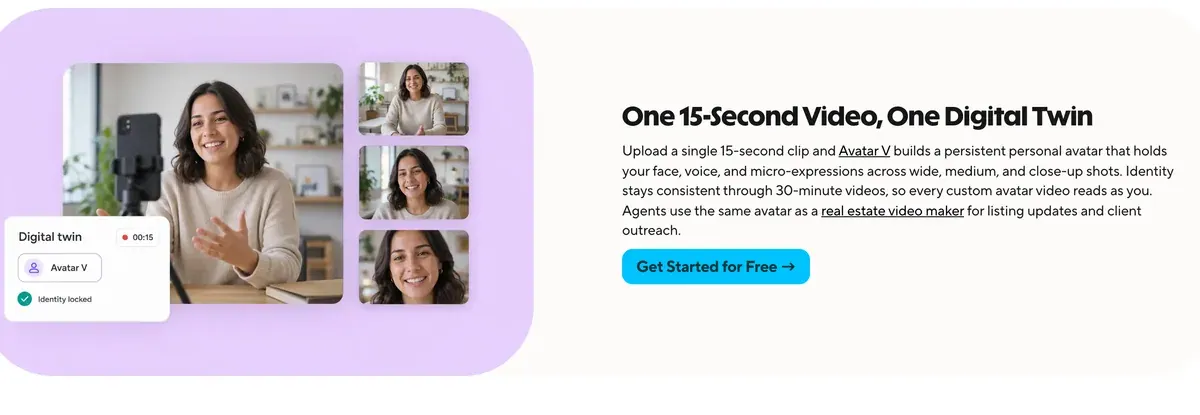
The same page says “Processing typically completes within about 10 to 15 minutes”.

The free plan includes one custom avatar, but terms s.4 bar free output from “advertising”. The help centre gives Creator, $29 a month, and Pro 1 or 5 twin slots, depending on region and account creation date. Business, $149 a month, gets 5 by default or 10 in some regions.
Users say avatars look real and lip sync lands, custom twins included (8 of 39: G2, Product Hunt). Others report a clone that came out stiff or unlike them (4 of 39: App Store, Product Hunt).
- Best for
- Localising one ad script into many languages, cheap avatar minutes for talking-head ads, and founder or spokesperson clones on a paid plan.
- Skip it if
- you plan to run ads from the free twin: terms s.4 bar free-plan output from advertising.
 Synthesia: the longest sample and a live consent take
Synthesia’s help centre asks for footage “Between 1 and 5 minutes in length” for a video avatar, and the consent clip “must be recorded live” with an on-screen passcode. Processing takes “about 1 business day”. Starter, $29 a month, includes three personal avatars and Pro five.
What is a custom avatar?
Personal Avatars Personal Avatars are available on Starter plans and above. Create a Personal Avatar from a single image. No filming required.
Studio Avatars Studio Avatars are a paid add-on filmed in a professional studio or submitted using a high-quality at-home setup. Processing typically takes 1 to 10 business days, depending on the recording method.
Consent We require explicit consent from the person whose likeness is used to create the avatar.
Hosting Avatars are hosted and managed within Synthesia and can’t be taken out of the platform on their own.
That consent route matters for ads. Synthesia’s Acceptable Use Policy bars stock avatars from paid social without its written consent, so a personal avatar is how a Synthesia ad runs. Users report viewers reading the avatars as AI, with learners tuning out of talking-head modules (19 of 69: r/elearning, r/instructionaldesign).
- Best for
- Explainer, onboarding and product-education videos and their localisation. For paid social, only with a personal avatar of someone who has consented.
- Skip it if
- you want to keep the avatar after you leave: the Customer Terms say avatars cannot be exported.
 Captions: a twin from a selfie
Captions’ AI Twin page says “Mirage Avatar X only needs 10 seconds of footage to make your twin”, and a selfie works too. It recommends video “For the highest-quality match”. AI Twin and custom actors start on Max, $24.99 a month (Captions pricing).
Terms 2.2 bar Mirage from commercialising your voice on its own without your written permission. Users report avatars that distort people and voices that sound robotic (6 of 36: Trustpilot, Trustpilot).
- Best for
- Business teams making avatar ads on Captions on web, whose terms name advertising, and phone creators captioning and editing their own footage.
- Skip it if
- you want testimonial-style scripts read by your twin: Mirage’s Acceptable Use Policy (Input) bars input that does not reflect your honest views.
 Argil: a clone behind an ID check
Argil runs “the compulsory in-depth identity verification process” before it accepts a User Avatar video (terms 5.2.3.1). Pro costs $50 a month. Under 12.2 your personality rights stay yours, while the intellectual property in the avatar sits with Argil, which grants you a licence to it “in the context of use of the Platform”.
Users say the clone looks and sounds like the person who trained it (5 of 15: Traksource, YouTube). Others report avatar creation failing on paid accounts (4 of 15: App Store, Trustpilot).
- Best for
- Founder-led and personal-brand videos where your own verified clone reads the script, with B-roll assembled in the same tool.
- Skip it if
- you want to take the avatar to another tool: terms 12.2 keep its intellectual property with Argil.
 Arcads: custom actors are generated faces
Arcads’ homepage offers to “create your own AI Avatar” and to “Generate a face” that holds your product. It describes no upload of your own face. Terms 8.1 cover cloning an actor’s voice onto your script, and 13.4 make you clear the personality rights of anyone in a video you upload.
Users report output below the examples in Arcads’ own ads, stiff custom actors among it (18 of 64: Trustpilot, r/FacebookAds).
- Best for
- Talking-actor ads close to a whole minute long, if billing rounds up to the minute as the help centre’s one example suggests.
- Skip it if
- you need a clone of yourself: Arcads documents generated actors and voice cloning, and no self-avatar from your footage.
 JoggAI, Creatify and D-ID: three custom avatars on one plan
JoggAI’s free plan includes one custom avatar and Starter, $29 a month, three. Its terms bar uploading images of people “without their consent”.
- Best for
- High-volume talking-avatar output on a small budget, and teams that want the same credits in the web app, the API and agent tools.
- Skip it if
- you want a refund if the clone disappoints: JoggAI’s terms make payments non-refundable except where the law requires.
Creatify’s Pro, $55 a month, lists three custom avatars beside 1,500 stock actors.
- Best for
- E-commerce teams making URL-to-video ads in volume who want an ad launcher for Meta, TikTok and AppLovin in the same tool.
- Skip it if
- you want a clone on the cheapest paid plan: Standard lists stock actors only, and custom avatars start on Pro.
D-ID’s Pro, $29 a month, includes three personal avatars and a commercial licence.
- Best for
- Talking-photo and presenter videos where an AI marker is acceptable, and teams building interactive agents on the same API minutes.
- Skip it if
- your ad must carry no AI marker: EULA 4.2 puts a synthetic mark on every animation.
Who owns the avatar, and what happens when you cancel
Ownership splits into two questions: who owns the avatar itself, and who owns the videos it made.
HeyGen’s Moderation Policy 2.1 says “you own the rights to photo, or custom avatars you create”. After cancelling, the account “moves to the Free plan”, and the help centre says your avatars “will still be accessible when you’re ready to sign back up”.
Synthesia’s Customer Terms (Ownership and Proprietary Rights) give the videos to your organisation, and the person shown owns none of them. A freelancer cloned inside a client’s account keeps no rights in those videos.
Synthesia’s avatars stay inside Synthesia, and its billing help article (10 September 2026) says “Once the billing period ends, you lose access to Synthesia and all videos in your account”. Download your ads before you cancel.
MakeUGC’s Custom Avatar Policy says nothing about the avatar after cancelling. Its terms page carries two versions of 3.2(a): one keeps your ownership of output “after your Subscription ends”, the other ties it to an active subscription. Both keep 7.3, “Termination does not affect your ownership rights to previously generated Output.”
Argil keeps the avatar’s intellectual property (12.2), and Captions’ twin page says a twin is built “for your own use”.
Using someone else’s face
HeyGen, Synthesia, MakeUGC, Captions, Argil and JoggAI each require the consent of anyone you clone who is not you.
HeyGen makes you honour a removal request from the person shown “wherever you have published such depictions” (Moderation Policy 2.1). Its consent take is the provided text, read exactly as written in under 30 seconds.
Recording your Consent Video
Text Use the provided consent text (read it exactly as written).
Length Keep the video under 30 seconds.
Quality Record in clear lighting and sound for the best results.
Formats Accepted formats: MP4, MOV, or WebM. Resolution: 480p to 4K. File size: up to 10 GB.
Synthesia lets you send a creator an invite link to record their avatar only on Enterprise. Argil asks companies for “written consents, and mandates” before using anyone’s photos (5.2.3.1).
Stock faces can be withdrawn too. When an Arcads actor withdraws consent, you delete the videos by Arcads’ deadline. Each day of delay costs 100 euros (Arcads terms).
The AI UGC legal guide covers likeness clauses, and AI ad disclosure rules cover New York’s synthetic performer law.
Clone or stock actor?
A clone pays off when your face is the brand: founder ads, personal-brand offers, a spokesperson viewers already know. A stock actor needs no consent take and comes on entry plans: MakeUGC’s Starter and Creatify’s Standard include no custom avatar.
On monthly billing, the cheapest paid plan with a clone is Captions Max, $24.99 a month; HeyGen’s Creator costs $29 a month, D-ID’s Pro $29 a month and MakeUGC’s Growth $79 a month.
Shared stock faces get recognisable, though: users report competitors running the same Arcads actors (3 of 64: r/dropshipping, YouTube). For a presenter who reads your script on camera, see AI spokesperson video generators.
Questions buyers ask about custom AI avatars
Can I make an AI avatar of myself for free?
Yes, on HeyGen and JoggAI, whose free plans include one custom avatar. HeyGen’s terms (s.4) bar free-plan output from advertising, so an ad needs a paid plan.
How much footage do I need to clone myself?
From 10 seconds on Captions to 1 to 5 minutes for a Synthesia video avatar. HeyGen asks for 15 seconds and MakeUGC for “a short video”; Captions also works from a selfie and Synthesia from a single image.
Can I clone a creator I hired?
Yes, if they agree. HeyGen and Synthesia need the person to record their own consent clip on camera. MakeUGC and Captions ask for signed or written consent for anyone else’s likeness, and Argil asks for written consents and mandates. On HeyGen they can later ask you to take the videos down, and you must honour it.
More pages for MakeUGC users, sorted by job, in the MakeUGC hub
Sources
- MakeUGC: MakeUGC Custom AI Avatar feature page, steps, recording advice, consent answer and plans with custom avatars. Checked
- MakeUGC: MakeUGC Custom Avatar Policy (effective 11 July 2025), sections 4a and 4b on consent and ownership, section 9 on removal. Checked
- MakeUGC: MakeUGC Terms of Service, 3.2(a) output ownership in two versions, 7.3 Effect of Termination. Checked
- MakeUGC: MakeUGC API docs, rate limits and credits, custom avatars use 100 credits per avatar. Checked
- HeyGen: HeyGen custom avatar page, 15-second reference video, on-camera consent code, processing time. Checked
- HeyGen: HeyGen Moderation Policy (effective 25 July 2024), section 2.1, ownership of custom avatars and removal requests from the person shown. Checked
- HeyGen help centre: HeyGen Credit-Based Pricing Plans & Subscriptions Explained, digital twin slots by plan, region and account date; avatars kept after cancelling. Checked
- Synthesia help centre: How do I create my personal avatar? (updated 22 July 2026), footage length, live consent with passcode, processing time, avatars by plan. Checked
- Synthesia: Synthesia Customer Terms (effective 20 July 2026), Ownership and Proprietary Rights (Customer Data), and Data Portability and Deletion: avatars cannot be exported. Checked
- Synthesia: Synthesia Acceptable Use Policy, stock avatars barred from paid social without written consent; custom avatars need the person’s consent. Checked
- Synthesia help centre: How do I manage my Synthesia plan and billing? (10 September 2026), access to videos ends with the billing period after cancelling. Checked
- Synthesia help centre: How do I use personal avatar requests in Synthesia? (24 July 2026), invite-link avatar requests on Enterprise plans only. Checked
- Captions (Mirage): Captions AI Twin page, 10 seconds of footage or a selfie, consent wording. Checked
- Mirage: Captions Terms (effective 4 September 2025), 1.3 digital twin, 2.2 voice, 3.2 written consent of people in the input. Checked
- Mirage: Mirage Acceptable Use Policy (effective 4 September 2025), Input: claims that do not reflect your honest views and experiences. Checked
- Argil: Argil General Terms, 5.2.3.1 identity verification and consent, 12.2 avatar intellectual property. Checked
- Arcads: Arcads homepage, create your own AI Avatar. Checked
- Arcads: Arcads Terms (in force from 22 September 2026), actor consent withdrawal, and 13.4 on personality rights. Checked
- JoggAI: JoggAI Terms of Use, no uploads of people without their consent; payments non-refundable except where the law requires. Checked
- D-ID: D-ID Studio End User License Agreement (July 2024), 4.2 synthetic mark on all animations. Checked

Alexandre S.
Alexandre S. is a creative ad strategist and copywriter with ten years' experience in digital marketing across multiple channels.
Related pages
-
 Category Best AI UGC generators for ads
16 AI UGC and avatar tools compared on list price per video and ad-use terms, checked 24 September 2026.
-
 Guide AI UGC meaning: what is AI UGC?
AI UGC is ad video made or edited with AI to look like a customer or creator filmed it. Its two meanings, and vendor terms on passing it off as human.
-
 Guide AI disclosure in advertising, platform by platform
Where a platform or a law asks you to disclose AI in an ad, each rule quoted with its date. Meta, TikTok, YouTube, New York, California and the EU.
-
 Data AI commercial use, tool by tool and plan by plan
Can a tool’s output run in your paid ads? Terms quoted with clause and date for each plan: allowed, conditional, barred or unclear. Checked 26 September 2026.


