Which AI ad tools ban benchmarks and comparisons?
Nine of the 77 AI ad tools whose terms we read on 12 October 2026 bar benchmarking by name. They are HeyGen, Luma, Canva, AdCreative.ai, The Brief, Pencil, Claid.ai, Jasper and Motion.
Vidu bars competitive analysis. Meta bars publishing Advantage+ creative output off its platforms. Google Cloud sets conditions on publishing Veo test results, Zeely bars publicly displaying its app’s content and Omneky bars demonstrating its service. The other 61 carry no such clause, and two sets of terms could not be read.
The table quotes all 14 clauses, benchmark bars first.
| Tool, document and date | The clause, as written |
|---|---|
| HeyGen Terms of Service s.2, 23 Jul 2026, bars benchmarks | “Access any portion of the services for benchmarking, comparative or competitive purposes” |
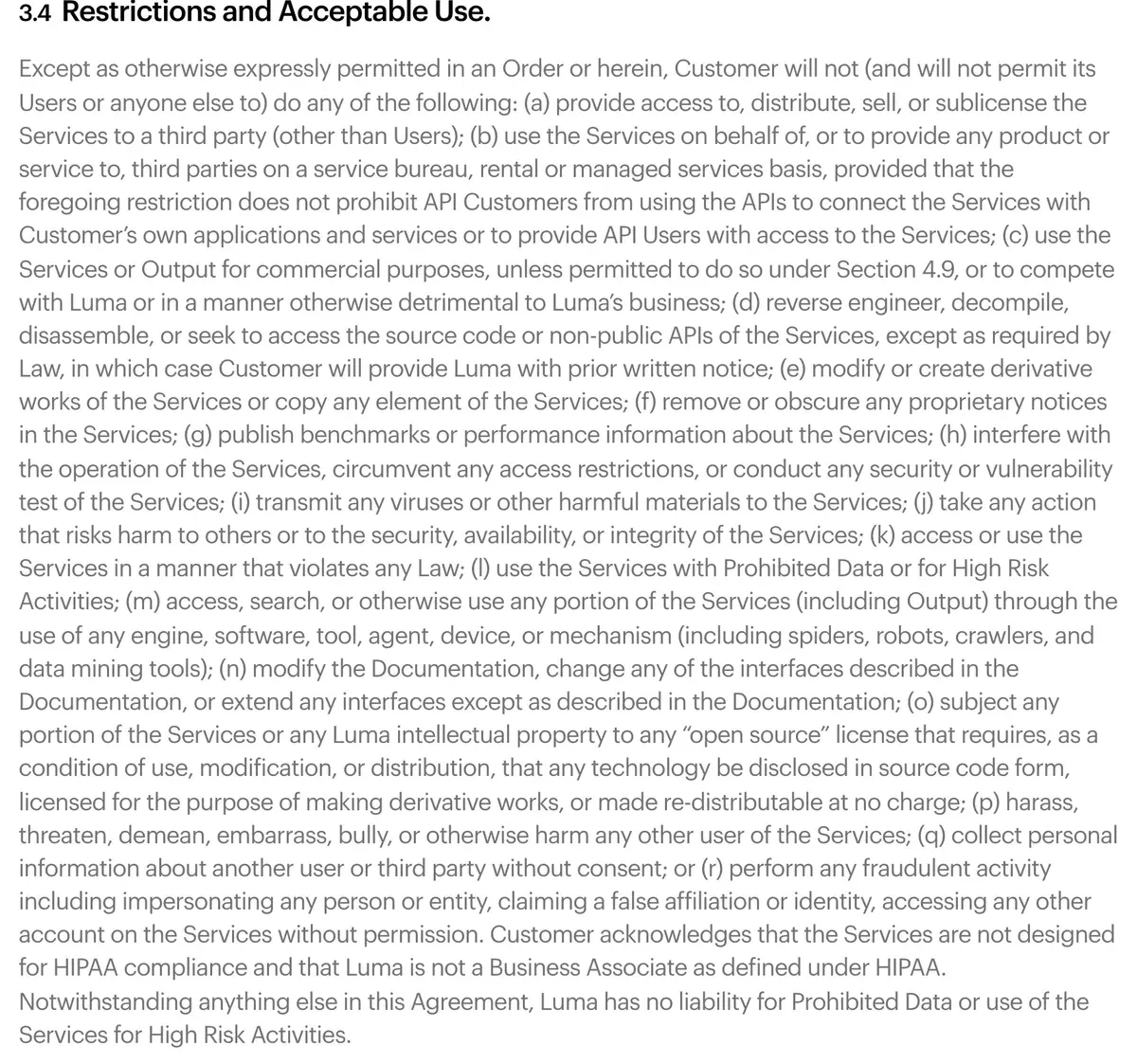
| Luma Terms of Service 3.4(g), 14 May 2026, bars benchmarks | “publish benchmarks or performance information about the Services” |
| Canva Terms of Use 2(e)(iii), 19 Aug 2026, bars benchmarks | “access the Service for purposes of performance benchmarking” |
| AdCreative.ai Subscriber terms 2.2(f), 19 Dec 2025, bars benchmarks | “use the Services for any competitive or benchmark purposes” |
| The Brief Acceptable Use Policy, 1 Oct 2025, bars benchmarks | “Use the Services for performance benchmarking or to build a competing product or service.” |
| Pencil Core terms 5.1(i), 22 Apr 2026, bars benchmarks | “engage in any competitive analysis or benchmarking of the Pencil Technology” |
| Claid.ai Terms and Conditions s.3, item e, 10 Aug 2023, bars benchmarks | “use or display our Services in competition with us, to develop competing products or services, for benchmarking or competitive analysis of our Services, or otherwise to our detriment or disadvantage” |
| Jasper Usage Policies v1.2, A(iv), 24 Aug 2024, bars benchmarks | “access any portion of the Services for the purpose of building a similar or competitive product or service, or monitor the Services for any benchmarking or competitive purpose” |
| Motion Terms of Service, preamble, 12 May 2026, bars benchmarks | “THE SERVICES MAY NOT BE ACCESSED FOR PURPOSES OF MONITORING THEIR AVAILABILITY, PERFORMANCE OR FUNCTIONALITY, OR FOR ANY OTHER BENCHMARKING OR COMPETITIVE PURPOSES.” |
| Vidu Terms of Service s.5, 3 Jul 2026, bars competitive analysis | “Using the Services for competitive analysis, developing competing products or services, or any purpose that may be detrimental to our business interests.” |
| Meta Advantage+ creative Generative AI Terms s.1, 6 May 2024, output off Meta | “Use or publication of Output outside of Meta’s platforms is unauthorized and a violation of these Terms.” |
| Google Veo Cloud Service Specific Terms s.7, 8 Oct 2026, conditions on publishing | “publicly disclose the results of such Tests only if (i) the public disclosure includes all necessary information to replicate the Tests, and (ii) Customer allows Google to conduct benchmark tests of Customer’s publicly available products or services and publicly disclose the results of such tests” |
| Zeely Terms of Service 6.2, 18 Sep 2026, public display | “Copying, publicly displaying, reproducing, or otherwise exploiting content or features of the App without prior written authorization.” |
| Omneky Terms of Service 1.3, 27 Aug 2025, demonstration | “shall not demonstrate, market, reuse, copy, modify, translate or create derivative works of the Services or any portion thereof” |
Scroll sideways for all 2 columns

What is a benchmarking clause?
A benchmarking clause bars users from testing a service against its rivals, or from publishing how it performs. Database software had them first. Oracle set up the original “DeWitt clause” after a 1982 benchmark by David DeWitt displeased Larry Ellison. Such a clause forbids publishing benchmarks the vendor has not sanctioned (Wikipedia).
The wordings differ in what they bar. Luma’s bars publishing results.
HeyGen’s bars accessing the services “for benchmarking, comparative or competitive purposes”.

Canva’s and Motion’s bar access for benchmarking too, Motion’s in capitals before section 1.

AdCreative.ai, The Brief, Pencil and Claid.ai bar using or analysing the service for it, and Jasper bars monitoring for it.

Of the 14, only Meta’s names a tool’s outputs.
Which tools have no such clause?
In 61 tools’ terms read on 12 October 2026 we found no clause that bars benchmarking or comparison. We searched each document for benchmark, competitive, comparative, performance information, publish results, reverse engineer and compete.
| Category | Tools |
|---|---|
| UGC, avatar and product video 18 tools | Arcads, Creatify, Synthesia, MakeUGC, JoggAI, Captions, Hedra, Argil, D-ID, Tagshop AI, CreateUGC, Nextify.ai, Maxfusion, Wireflow, Icon, Topview, Pippit, Amazon Ads Video Generator |
| Creative suites 12 tools | PromptWise, Higgsfield, Krea, invideo AI, LumiYing, OpenArt, Pika, Adobe Firefly, Leonardo.Ai, FLORA, ElevenLabs, Artlist |
| Video models 8 tools | Kling AI, Runway, Hailuo AI, Seedance, Wan, LTX Studio, Grok Imagine, PixVerse |
| Image ad tools 11 tools | Nano Banana, ChatGPT, Midjourney, Ideogram, Picsart, Predis.ai, Blaze, Photoroom, Flair.ai, Pixelcut, Pebblely |
| Copy, research and analytics 12 tools | Claude, Gemini, Anyword, Copy.ai, Foreplay, Atria, Superads, Segwise, Madgicx, Minea, AdSpy, PiPiAds |
Scroll sideways for all 2 columns
Twenty-four of them bar using the service, or its outputs, to build or run something that competes with it. None of those clauses names benchmarks or comparisons.
Higgsfield’s is typical: “(iii) use or access the Service or any Outputs to develop, modify, fine-tune, distill, or improve any products or services that compete with the Service” (Terms of Use, 26 July 2026).
Kling and ElevenLabs use the word benchmarking only for their own analysis of usage data.
Terms not readable
TikTok Symphony’s pages say its GenAI tools fall under “TikTok’s Creative GenAI terms”. No public URL for them turned up on 12 October 2026, and the ads policy address returned a login page.
Magnific’s general Terms of Use, dated June 2026, carry no benchmark clause. They now point to separate API Services and AI Products terms, and both pages answered 403.
On 24 September 2026 the API clause read: “Any such use for competitive, benchmarking, or replicative purposes shall require Magnific’s prior written authorization in the form of a specific license”. It reached API use only.
What changed since September 2026?
Every clause in the table reads word for word as it did on 23 and 24 September 2026. Five documents carry new dates and no new clause. Google Cloud’s terms date from 8 October 2026, with section 7 unchanged. Arcads dates its version 8 October, ElevenLabs 9 October, Maxfusion 28 September and Hedra 4 September.
Ten tools joined the register in this read, Foreplay and Madgicx among them, and none carries a clause.
Meta announces a change dated 30 October 2026. The 5 October 2026 capture carries the banner “We’re updating the Self-Serve Ad Terms to incorporate the Ad Creative Generative AI Terms. These updates will go into effect on October 30, 2026.”
The preview Self-Serve Ad Terms, effective 30 October 2026, do not contain the “outside of Meta’s platforms” sentence. Their AI paragraph bars using the features or their outputs “to develop models, algorithms, or systems to compete with Meta”.
What this means for published comparisons
Each clause names who it binds. HeyGen’s list opens “you may not”. Luma’s binds the customer, who “will not permit its Users or anyone else” to do the listed acts. Motion’s sentence covers any access to the service.
Three documents set out what is allowed. Luma’s API Terms of Use, dated 28 April 2026, require “prior written consent” for published benchmarks, “provided that Customer may conduct internal, non-published performance evaluations and security assessments of the APIs”.
Google Cloud’s section 7 lets a Cloud customer publish benchmark results, Veo’s included. The conditions: the disclosure holds all the information needed to replicate the tests, and the customer lets Google benchmark its public products in return.
Jasper’s Usage Policies except “uses that are expressly permitted”, for example in an Order Form.
Vidu’s clause names competitive analysis and no benchmark.

Its terms do not say whether a published side-by-side comparison counts as one. Zeely’s 6.2 does not say whether outputs count as “content or features of the App”.
Every adtestbench tool page synthesises public user reviews and the vendor’s own pricing and terms pages, as our method page sets out. Commercial-use terms by plan sit in the AI commercial use matrix, and the marks each tool leaves on its outputs on the watermarks page.
How was the register built?
Each tool’s current terms, plus any acceptable use policy it links, were read on 12 October 2026, 68 of them with curl. Where the live page refused, the newest Wayback Machine capture was read and its date recorded. That covers 9 tools: Canva, Meta, Adobe Firefly, Leonardo.Ai, Artlist, Grok Imagine, ChatGPT, Midjourney and Picsart.
The class names describe the words in each clause, nothing further.
A row keeps its tool slug as its anchor, so a link such as /data/benchmark-bans/#luma stays stable. Corrections show in this page’s list of changes and on updates and corrections.
How to cite this data
adtestbench, "Which AI ad tools ban benchmarks and comparisons?", https://adtestbench.com/data/benchmark-bans/, updated .
- CSV file /data/benchmark-bans.csv
Sources
- HeyGen: HeyGen Terms of Service, section 2, License to Use the Services, restrictions list; last updated 23 July 2026. Checked
- Luma AI: Luma Terms of Service, section 3.4(g), Restrictions and Acceptable Use; updated 14 May 2026. Checked
- Luma AI: Luma API Terms of Use, benchmarks and competitive analyses need prior written consent; internal, non-published evaluations allowed; 28 April 2026. Checked
- Canva: Canva Terms of Use, section 2(e)(iii); effective 19 August 2026; read in the Wayback Machine capture of 9 October 2026. Checked
- AdCreative.ai: AdCreative.ai Terms of Service for Online Subscribers, clause 2.2(f); updated 19 December 2025. Checked
- The Brief: The Brief Acceptable Use Policy, item Engage in Competitive Analysis; last updated 1 October 2025. Checked
- Pencil: Pencil Core Terms and Conditions, clause 5.1(i); the Pro terms carry the same words at 5.1(h); updated 22 April 2026. Checked
- Claid.ai: Claid.ai Terms and Conditions, section 3, Restrictions and Acceptable Use, item e; effective 10 August 2023. Checked
- Jasper: Jasper Usage Policies, version 1.2, A Platform Guidelines, item (iv); effective 24 August 2024. Checked
- Motion: Motion Terms of Service, preamble, in capitals, before section 1; last updated 12 May 2026. Checked
- Shengshu: Vidu Terms of Service, section 5, Prohibited Conduct and Content; last updated 3 July 2026. Checked
- Meta: Meta Ad Creative Generative AI Terms, section 1, Rights in Ads Content; effective 6 May 2024; read in the Wayback Machine capture of 5 October 2026, which carries the banner on the 30 October 2026 update. Checked
- Google Cloud: Google Cloud Service Specific Terms, General Service Terms, section 7, Benchmarking; last modified 8 October 2026. Checked
- Zeely: Zeely Terms of Service, section 6.2, Prohibited Conduct; 18 September 2026. Checked
- Omneky: Omneky Terms of Service, section 1.3, Restrictions; 27 August 2025. Checked
- Magnific: Magnific Terms of Use, general terms dated June 2026, no benchmark clause; the API Services and AI Products terms answered 403 on 12 October 2026. Checked
- Wikipedia: David DeWitt, origin of the DeWitt clause: Oracle, after a 1982 benchmark by David DeWitt. Checked
What changed on this page
- Page written: the terms of 77 AI ad tools read for benchmarking and comparison clauses, 14 clauses quoted.

Alexandre S.
Alexandre S. is a creative ad strategist and copywriter with ten years' experience in digital marketing across multiple channels.
Related pages
-
 Guide HeyGen’s terms and moderation policy for paid ads
What HeyGen’s terms and moderation policy allow in paid ads: commercial rights by plan, stock and custom avatars, banned content, takedowns. Checked 6 Oct 2026.
-
 Guide Meta’s generative AI ad terms, 30 October 2026
Meta folds its Ad Creative Generative AI Terms into the Self-Serve Ad Terms on 30 October 2026: what changes, the input licence, what to do. Checked 6 Oct 2026.
-
 Data How many ads are AI generated?
Meta, TikTok, Google and Amazon publish no share of their ads made with AI. Six published figures, what each counts and who measured it, checked 2 October 2026.
-
 Guide Are AI UGC ads legal? FTC rules and likeness rights
The FTC’s fake-testimonial rule reaches an AI actor who claims to have used the product. That rule and US state and EU laws, quoted with dates.


