AI actors for ads
Verdict on AI actors for ads
Pick an AI actor by its licence before its library size: four tools state 1,000 or more faces. Product in hand starts on MakeUGC’s Starter, $59 a month, prices checked , and on Creatify’s Pro. Synthesia’s stock avatars need written consent for paid social, and Arcads may ask you to delete videos after a creator withdraws.
For product-in-hand UGC ads from the entry plan:  MakeUGC
Starter lists product in hand and Batch Mode; the actor library grows from 300+ on Starter to 1,000+ on Pro.
For the largest stated library of avatars:  Creatify
Its avatar page lists 1,500+ avatars in 75+ languages (its FAQ lists 29); Standard gets 300, and product holding starts on Pro.
For stock actors filmed from real, consenting creators:  Arcads
If a creator withdraws, FRESHR may ask you to delete the videos, at 100 euros for each day late (13.3.2).
For a founder or spokesperson twin for paid ads:  HeyGen
Creator includes 1 digital twin; free-plan output may not be used in ads (terms section 4).
For an invented face with no performer behind it:  Higgsfield
Marketing Studio offers 40+ Soul 2.0 avatars or one written from a prompt, then a product from a link.
| Tool | Monthly from (USD) | Cost per output at list price if every credit is used | Paid ads on the cheapest paid plan | What it does | Official site |
|---|---|---|---|---|---|
 Arcads | Not published | Not computed | Allowed with conditions (every paid plan) | Script-to-video ads read by 1,000+ AI actors, plus Kling, Veo and Seedance clips in the same app. | Visit Arcads |
 Creatify | $15 | $2.73per 30-second video | Allowed with conditions (Standard) | Avatar and product video ads from a URL or script, with batch variants, an ad launcher and a competitor ad tracker. | Visit Creatify |
 HeyGen | $29 | $0.10 to $1.16per 30-second video, pro rata | Allowed with conditions (Creator) | Talking-avatar videos from text, photos or your own digital twin, with translation into 175+ languages. | Visit HeyGen |
 Higgsfield | $15 | Not computed | Allowed with conditions (Starter) | Multi-model studio with Seedance, Kling, Veo and its own Soul models, plus ad and UGC tools and an agent. | Visit Higgsfield |
 MakeUGC | $59 | $11.80per talking-actor video | Allowed with conditions (Starter) | UGC-style video ads with 1,000+ AI creators, B-roll and product-in-hand shots; API and MCP access on every plan. | Visit MakeUGC |
 Synthesia | $29 | $0.66 to $1.45per 30-second video | Allowed with conditions (Starter) | Presenter-style avatar videos and dubbing in 160+ languages, built mainly for training and corporate video. | Visit Synthesia |
Scroll sideways for all 6 columns
Prices checked 21 Oct 2026. Arcads publishes no price list.

What an AI actor is in an ad tool
An AI actor is a person on screen who reads your script without a shoot. Ad tools offer two kinds. A stock avatar is built from a real person who was paid to lend their face and voice. A fully synthetic face is invented by an image model, with nobody behind it.
The difference matters to you after the ad is live. A real performer can withdraw consent, and some vendors’ terms then make you take the ad down. A synthetic face cannot withdraw. New York has required a label on a synthetic performer in an ad since 9 June 2026, and California’s rule applies from 1 January 2027.
Some libraries mix both. Synthesia’s avatars page says its stock avatars are “built from either real actor performances or AI-generated identities”.
AI actor libraries by size
Creatify states the largest library, and three more tools state 1,000 or more faces.
| Tool | Stated library | Product in hand | Languages |
|---|---|---|---|
| Creatify | 1,500+ avatars (300 on Standard) | From Pro | 75+ (avatar page); FAQ lists 29 |
| HeyGen | 1,100+ stock avatars | Not listed on the pages read | 175+ on paid plans |
| MakeUGC | 1,000+ actors (300+ on Starter) | From Starter | 50+ |
| Arcads | 1,000+ actors | Listed, plan not stated | More than 30 |
| Synthesia | 240+ (125+ on Starter) | Not listed on the pages read | 160+ |
| Higgsfield | 40+ Soul 2.0 avatars, or one from a prompt | Product from a link or up to 5 images | Not stated |
Scroll sideways for all 4 columns
A bigger library has a cost of its own. Users report that shared stock faces are becoming recognisable, as competitors run the same ones (3 of 64 Arcads sources: r/dropshipping, YouTube).
 MakeUGC: 1,000+ AI-generated actors, product in hand from Starter
MakeUGC calls its talking actors “AI-generated people who speak your script on camera” on its talking actors page. The page lists “1,000+ realistic AI actors”. The pricing page splits them by plan: 300+ on Starter, 500+ on Growth and 1,000+ on Pro.
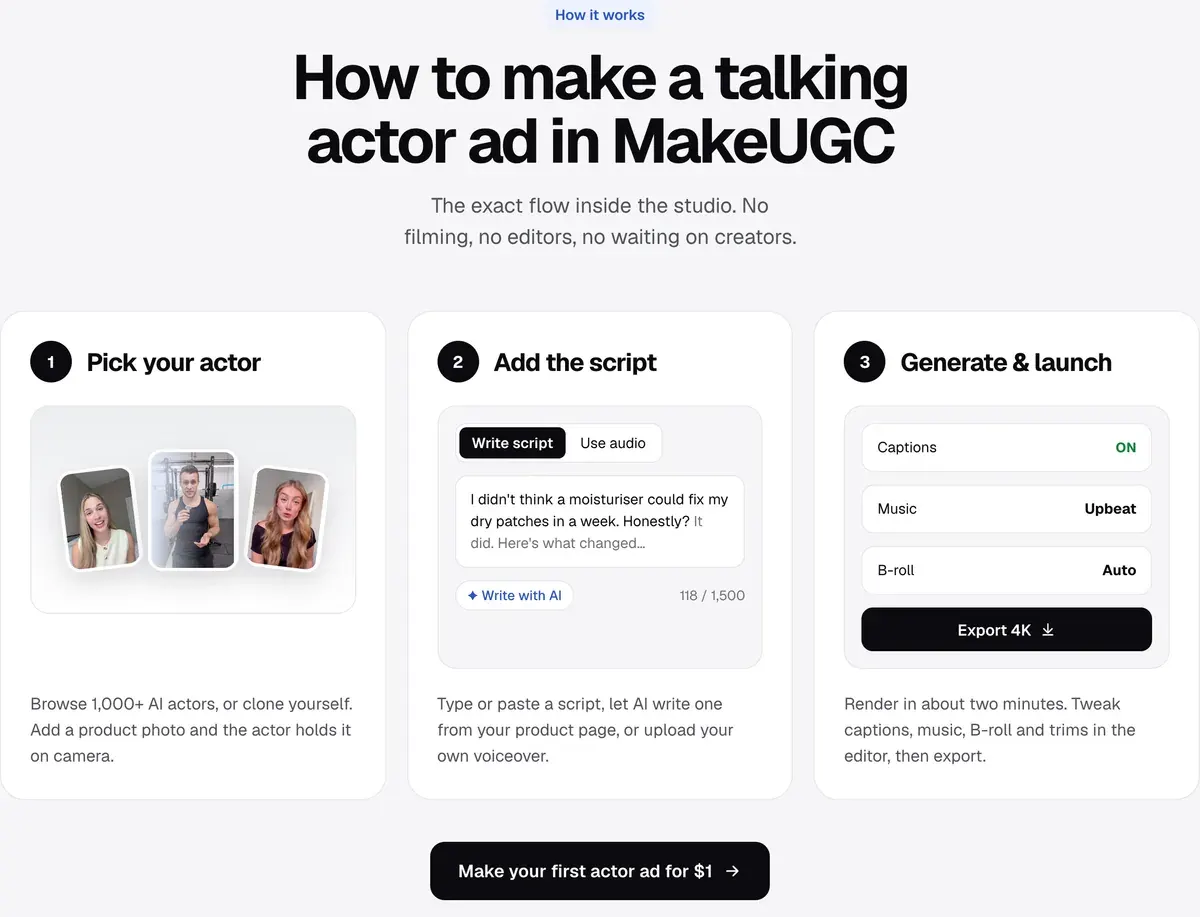
Product in hand sits on every plan, Starter included. The product page asks for one product photo, then the actor holds “your bottle, box or device”. Scripts can run in 50+ languages (languages page).
A custom avatar of you starts on Growth, which includes one, and Pro includes three (custom avatar page). Avatars of someone else need “their permission”. The Custom Avatar Policy (11 July 2025, section 6) bars “misrepresenting AI-generated avatars as real individuals”.
MakeUGC calls its actors AI-generated. Its terms (17 November 2025) have no clause that lets a stock actor take back consent or makes you delete a live ad. Users report lip sync that drifts and hands that move oddly, so clips need a check before launch (5 of 29 sources: YouTube, YouTube).
Plans and the cost per video: MakeUGC pricing. The full profile: MakeUGC. Every MakeUGC page on the site: MakeUGC hub.
- Best for
- Direct-response teams testing many UGC and B-roll variants, with Batch Mode and product-in-hand video on every plan and API access drawing on the same credits.
- Skip it if
- you need your own face as the actor on the entry plan: custom avatars start on Growth.
 Arcads: real creators who can withdraw
Arcads lists “1,000+ Captivating AI Actors” and an “Avatar holding your product” on its homepage, in more than 30 languages.
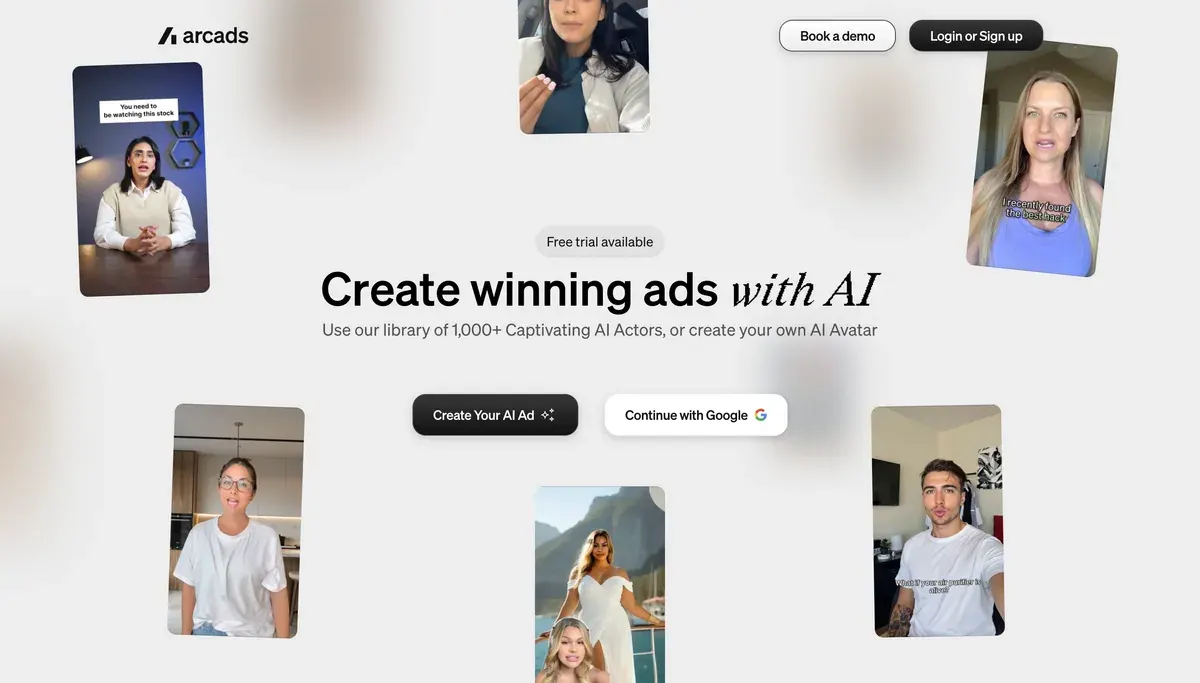
Its actors are real creators who licensed their likeness.

That licence can end. Terms 13.3.2 (in force from 22 September 2026) say FRESHR, the company behind Arcads, “may ask the Client to delete any Videos from all supports where they are used” after a creator’s withdrawal request. A late takedown costs “a hundred (100) euros per day of delay”. Arcads publishes no price (prices).
Users say its stock actors pass as creator content in the feed (16 of 64 sources: r/dropshipping, Trustpilot). Hands holding a real item remain the weak spot (4 of 64: r/dropshipping, Trustpilot).
The two side by side: Arcads vs MakeUGC.
- Best for
- Talking-actor ads close to a whole minute long, if billing rounds up to the minute as the help centre’s one example suggests.
- Skip it if
- an ad must stay live for a year whatever happens: a creator’s withdrawal lets FRESHR ask you to delete it (13.3.2).
 Creatify: 1,500+ avatars, product holding from Pro
Creatify’s avatar page lists “1,500+ realistic avatars” that lip-sync “in 75+ languages”, though its help-centre FAQ lists 29. The pricing page gives Standard, $15 a month, 300 of them and Pro, $55 a month, all 1,500.
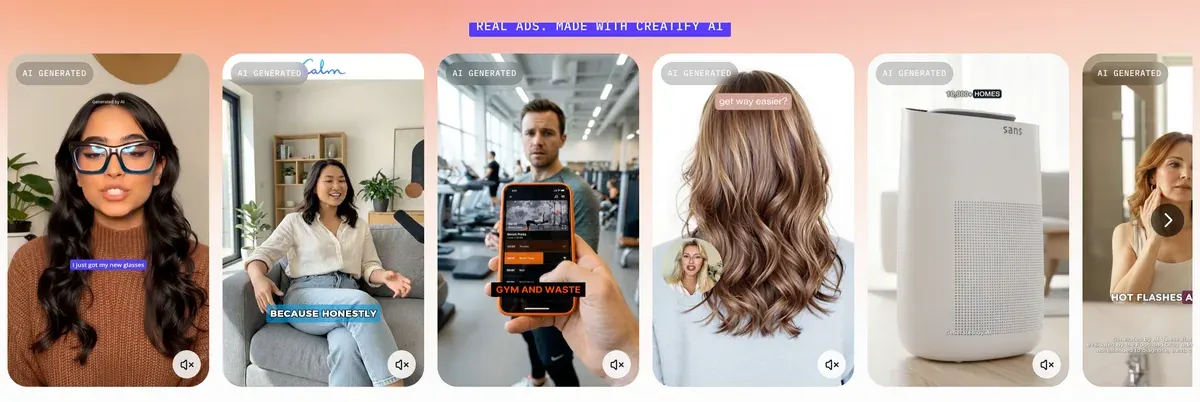
The same page’s FAQ puts product holding, branded clothing and custom backgrounds on “Pro plan and above”. It also says avatars “cannot be generated based on other real individuals without proper authorization”. It says nothing about a stock presenter withdrawing.
Users report a recognisable, templated look: fine at scroll speed, less so close up (6 of 61 sources: r/PPC, r/FacebookAds).
- Best for
- E-commerce teams making URL-to-video ads in volume who want an ad launcher for Meta, TikTok and AppLovin in the same tool.
- Skip it if
- you want actors holding your product on Standard: the avatar page puts product holding on Pro and above.
 HeyGen: 1,100+ stock avatars and a twin of you
HeyGen’s avatars page lists “1,100+ AI actors and presenters” and says stock avatars are “cleared for generated videos”.
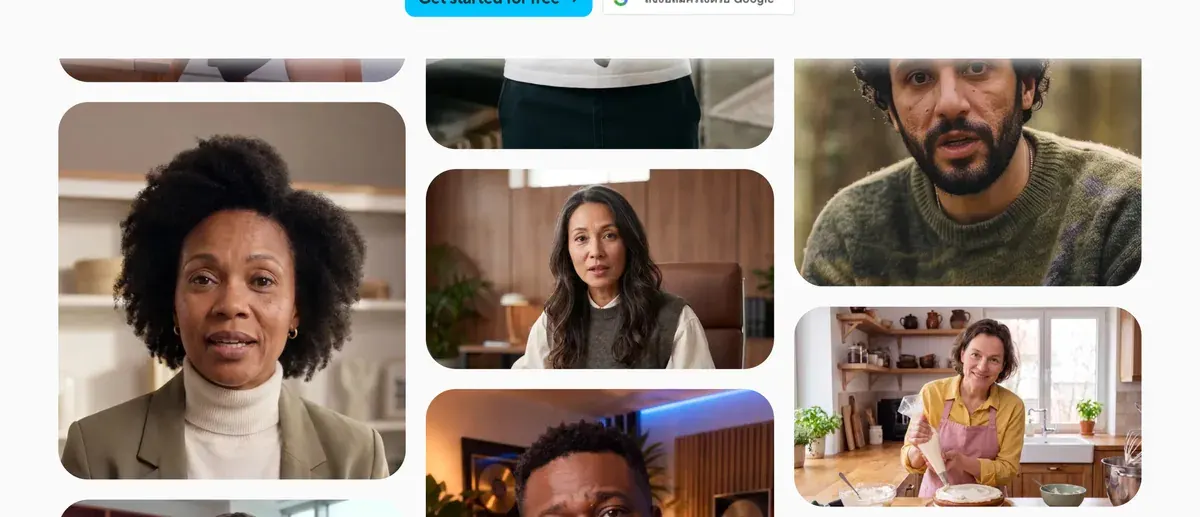
Paid plans speak 175+ languages (pricing). The Creator plan, $29 a month, includes one custom digital twin.
That twin is where the duty to remove sits. HeyGen’s moderation policy (2.1) makes you honour a removal request by the person shown “wherever you have published such depictions”. Free-plan output may not be used for “advertising” (terms, section 4).
Users report avatars and lip sync that land, digital twins included (8 of 39 sources, among them G2). Others say viewers spot the avatar and click-through fades within a week (3 of 39: r/PPC, r/FacebookAds).

Custom avatars of yourself: custom AI avatar tools. Presenter-style video: AI spokesperson video generators.
- Best for
- Localising one ad script into many languages, cheap avatar minutes for talking-head ads, and founder or spokesperson clones on a paid plan.
- Skip it if
- you plan to run free-plan videos as ads: terms section 4 bar free output from advertising.
 Synthesia: 240+ avatars, barred from paid social
Synthesia offers “240+ ready-made avatars” on its avatars page; Starter, $29 a month, gets 125+. None of them may appear in a paid social ad without Synthesia’s written consent.
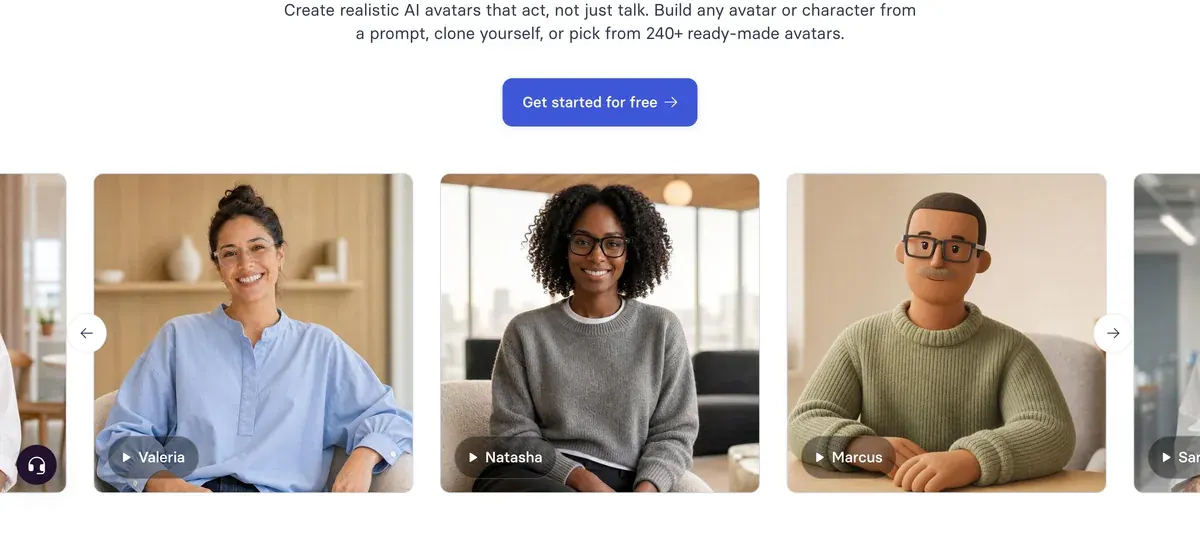
Its Acceptable Use Policy (23 February 2024) bars “Incorporating a Stock Avatar in content for promoted, boosted, or paid advertising on any social media platform” without Synthesia’s written consent.
Acceptable Use Policy
Paid advertising Incorporating a Stock Avatar in content for “promoted”, “boosted”, or “paid” advertising on any social media platform or similar media, absent written express consent from Synthesia.
Endorsements Using a Stock Avatar in a manner that is meant to, or is reasonably likely to, make viewers think the real-life actor personally holds, endorses, or actually has your stated opinions, characteristics or conditions ... in the case of Stock Avatars, you may do so only on enterprise Service plans.
A personal avatar of yourself is the route for paid social, after “a live on-camera consent recording”.
One clause works in your favour. The Customer Terms (20 July 2026) license stock avatars after the subscription “to the extent it has been incorporated in videos”. Users report that viewers read the avatars as AI (19 of 69 sources: r/elearning, r/instructionaldesign).
- Best for
- Explainer, onboarding and product-education videos and their localisation. For paid social, only with a personal avatar of someone who has consented.
- Skip it if
- your ad uses a stock avatar on paid social: the Acceptable Use Policy requires Synthesia’s written consent.
 Higgsfield: 40+ Soul avatars or one from a prompt
Higgsfield’s Marketing Studio offers “40+ ready-to-use avatars” or “a custom one from a text prompt”, both made by its Soul 2.0 image model (Marketing Automation page). You paste a product link, or add up to 5 images, and pick a format such as a product review or unboxing.
These faces are invented, so no performer can withdraw.
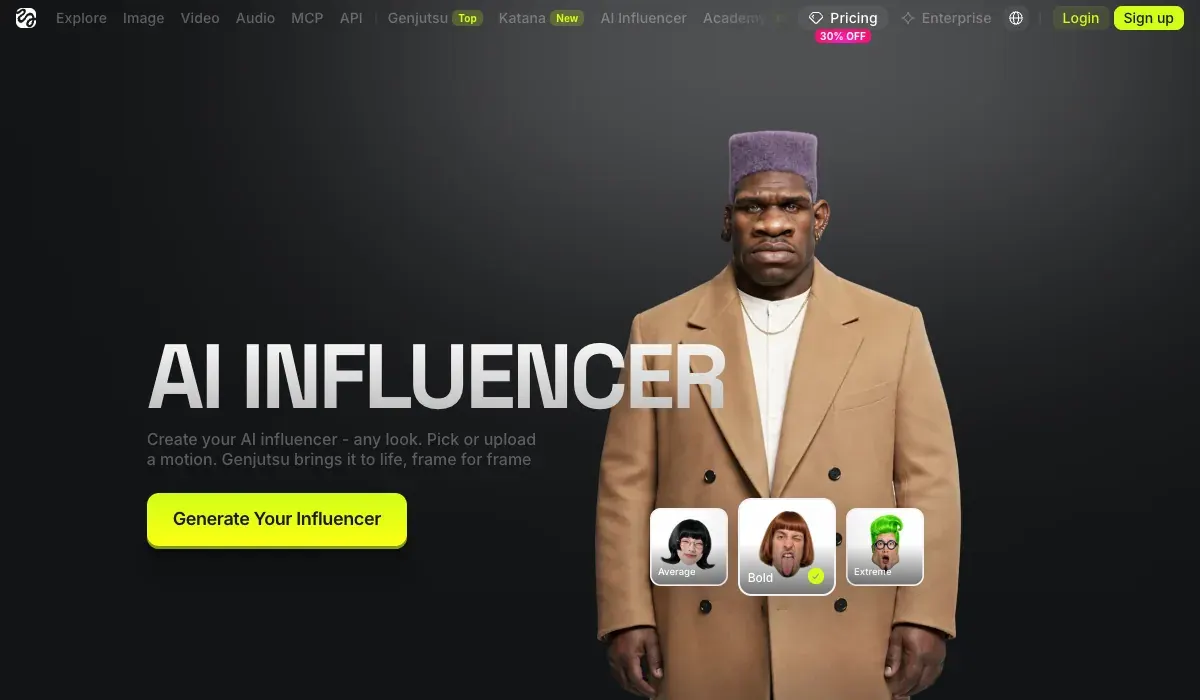
Two clauses still apply. Higgsfield’s terms 5.2(xi) bar presenting output as human-generated, and 4.4 let Higgsfield train on your inputs and outputs unless you hold an Enterprise Agreement.
Users single out characters and products that stay the same across shots (5 of 52 sources: YouTube, YouTube). Step by step: Higgsfield Marketing Studio. Against MakeUGC: Higgsfield vs MakeUGC.
- Best for
- One person in the web app who wants Kling, Veo and Seedance on one credit balance and pays for video in credits.
- Skip it if
- your brand cannot let ad outputs train a vendor’s models: terms 4.4 allow it below Enterprise.
AI actors in commercials: union consent and state labelling
If you cast union talent, SAG-AFTRA’s 2025 Commercials Contracts, approved by its National Board on 27 April 2025, require “Performer consent” before “any digital replica is created” (SAG-AFTRA, archive copy). Using a replica triggers “a 1.5x session fee”.
State law adds a label. New York’s S8420-A has required a conspicuous disclosure of a synthetic performer in ads since 9 June 2026. California’s SB 1050 adds one when a synthetic performer is prominent, from 1 January 2027.
What you do: keep the vendor’s licence terms with each ad, and label synthetic actors where those laws reach. Never script an actor as a real customer. The clauses and dates in full: AI UGC and the law.
Left out, and why
Maxfusion is out on its withdrawal terms. Its terms (19 July 2026, 13.3) give you 48 hours to delete videos after a creator withdraws, then 100 euros per video per day. That is the strictest takedown clause in this group.
Captions is out on rights clarity. Its help article calls its actors “completely virtual and free from licensing restrictions”. The web terms (1.2) allow ads if you disclose that AI was used. The app terms 3.1(xiv) bar commercial use of Mirage Content “except as authorized hereunder” without Mirage’s prior written consent.
Questions buyers ask about AI actors
Are AI actors real people?
Some are. Arcads’ actors are real creators who licensed their likeness, while MakeUGC calls its actors “AI-generated people” and Higgsfield’s come from a prompt.
Can I use AI actors in ads for free?
Not cleanly on any free plan read here. HeyGen’s terms bar free output from advertising, Synthesia’s free videos cannot be downloaded, and MakeUGC and Arcads have no free plan.
Creatify’s Free plan gives 300 actors and 10 credits a month with watermarked exports, and its terms say only that free users “have limited rights”. Which free plans allow ads: free AI UGC generators.
Do I have to label an AI actor in an ad?
In New York, yes, for a synthetic performer, since 9 June 2026; California follows from 1 January 2027. Meta and TikTok set their own label rules: AI disclosure in advertising.
More pages for MakeUGC users, sorted by job, in the MakeUGC hub
Sources
- MakeUGC: AI actors that sell your product, 1,000+ AI actors; talking actors described as AI-generated people; product photo held on camera. Checked
- MakeUGC: Put your product in their hands. Checked
- MakeUGC: Create your own AI avatar, Growth includes 1 custom avatar, Pro 3, Starter none; avatars of others only with their permission. Checked
- MakeUGC: Your ads in 50+ languages. Checked
- MakeUGC: MakeUGC pricing, actor counts per plan, product in hand on Starter. Checked
- MakeUGC: Custom Avatar Policy (effective 11 July 2025), sections 4 and 6. Checked
- Make Media Limited: MakeUGC Terms of Service (effective 17 November 2025), no clause on a stock actor withdrawing. Checked
- Arcads: Arcads homepage, 1,000+ AI actors, avatar holding your product, more than 30 languages. Checked
- FRESHR: Arcads Terms (in force from 22 September 2026), clause 13.3.2. Checked
- Creatify: AI Avatar Generator, 1,500+ avatars, 75+ languages (the help-centre FAQ of 20 September 2026 lists 29), product holding on Pro and above. Checked
- Creatify: Creatify pricing, 300 AI actors on Standard, 1,500 on Pro. Checked
- HeyGen: HeyGen AI avatars, 1,100+ stock avatars, digital twin built with consent. Checked
- HeyGen: HeyGen pricing, 175+ languages on paid plans; 1 custom digital twin on Creator. Checked
- HeyGen: HeyGen Moderation Policy (effective 25 July 2024), 2.1. Checked
- HeyGen: HeyGen Terms (last updated 23 July 2026), section 4. Checked
- Synthesia: Synthesia AI avatars, 240+ ready-made avatars from real actor performances or AI-generated identities; live consent recording for personal avatars. Checked
- Synthesia: Synthesia Acceptable Use Policy (last updated 23 February 2024). Checked
- Synthesia: Synthesia Customer Terms of Service (effective 20 July 2026). Checked
- Higgsfield: Marketing Automation, 40+ avatars on Soul 2.0 or a custom one from a text prompt; product import from a link or up to 5 images. Checked
- Higgsfield: Higgsfield Terms of Use (last updated 26 July 2026), 4.4 and 5.2(xi). Checked
- SAG-AFTRA (archive copy of 20 May 2025): SAG-AFTRA National Board approves Commercials Contracts deal (27 April 2025), the live page refused automated reads on 21 October 2026. Checked
- New York State Assembly: New York S8420-A (chapter 617 of 2025), General Business Law section 396-b. Checked
- California Legislative Information: California SB 1050 (chapter 246 of 2026), Business and Professions Code section 17610. Checked
- Maxfusion AI s.r.o.: Maxfusion terms (last updated 19 July 2026), clause 13.3. Checked
- Mirage (Captions): Create talking videos from text prompts (Captions help), modified 17 August 2026;
completely virtual
actors. Checked - Mirage US LLC: Captions on Web Terms (29 September 2025), 1.2. Checked
- Mirage US LLC: Captions Terms and Conditions (4 September 2025), 3.1(xiv). Checked

Alexandre S.
Alexandre S. is a creative ad strategist and copywriter with ten years' experience in digital marketing across multiple channels.
Related pages
-
 Category Best AI UGC generators for ads
16 AI UGC and avatar tools compared on list price per video and ad-use terms, checked 24 September 2026.
-
 Best list Free AI UGC video generators
Of 11 AI UGC tools, 2 allow commercial use of free output with no free-plan exception in terms or pricing; 4 bar a paid social ad. Checked 24 September 2026.
-
 Guide AI UGC meaning: what is AI UGC?
AI UGC is ad video made or edited with AI to look like a customer or creator filmed it. Its two meanings, and vendor terms on passing it off as human.
-
 Guide AI UGC vs human UGC: what the evidence says
Public comparisons of AI and human UGC ads, graded on how each was run and by whom. Most come from sellers or a single account. Checked 24 September 2026.


