UGC script template for ads
A UGC script is what a creator or an AI actor says to camera in an ad. The ad is made to look like a customer’s own video. Copy the template below and fill each bracket. At about 150 words a minute, 30 seconds holds about 75 spoken words.
UGC AD SCRIPT, 30 SECONDS (about 75 words)

HOOK      0 to 3 s    about 7 words    [the line that stops the scroll]
PROBLEM   3 to 8 s    about 12 words   [the moment your viewer knows too well]
PRODUCT   8 to 18 s   about 25 words   [what it is, in hand, and the one thing it fixes]
PROOF     18 to 24 s  about 15 words   [something shown on camera, or a review you can link]
OFFER     24 to 27 s  about 7 words    [your offer, word for word from the landing page]
CTA       27 to 30 s  about 7 words    [one action: tap, shop, download]

On screen: [text overlay for each beat, for viewers watching with sound off]
Shots:     [face to camera] [product close-up] [demo] [face to camera]
The words per beat come from one figure. VirtualSpeech, citing the National Center for Voice and Speech, puts average English conversation at “about 150 wpm” (VirtualSpeech, 20 August 2026). That is 2.5 words a second, so a 4-second beat holds about 10 words.

What goes in a UGC ad script?
Six beats, in the order above. Each one answers the question the viewer has at that second.
The hook earns the next two seconds. The problem tells the viewer the ad is about them. The product beat shows the item in someone’s hand and names one result. Proof is the beat a viewer can check: a demo on camera, or a review line with its source.
The offer and call to action close it. One offer, one action. A script that asks people to “follow, comment and shop” splits a three-second beat three ways.
Write the on-screen text too: a few words of overlay on each beat, for viewers watching on mute.
How long should a UGC script be?
As long as the ad, at 2.5 words a second (VirtualSpeech). Fifteen seconds holds about 37 words, 30 seconds about 75, and 45 seconds about 112.
| Ad length | Spoken words | Beats that fit |
|---|---|---|
| 15 seconds | about 37 | Hook, problem and product in one line, call to action |
| 30 seconds | about 75 | All six beats |
| 45 seconds | about 112 | All six, with a longer demo and a second proof point |
| 60 seconds | about 150 | All six, with an objection answered before the offer |
Scroll sideways for all 3 columns
Leave room. A pause after the hook, or a beat where the creator just shows the product, takes seconds with no words. Count your draft, then trim it a little below the figure in the table.
20 ad hooks by type
A hook is the first line or shot, the part that decides whether someone keeps watching. Each line below is written for this page, for made-up products; swap in yours.
| Hook type | Example lines | Use it when |
|---|---|---|
| Call-out | “Dog owners with a puller, this one’s for you.” · “If you work night shifts, keep watching.” | Your buyer is easy to name |
| Problem first | “My hair frizzes the second I step outside.” · “Every bill in our flat starts a group-chat argument.” | The pain is visible or familiar |
| Question | “Why does your iced coffee always taste watery?” · “Do you know what’s actually in your dog’s treats?” | The answer is your product’s reason to exist |
| Mistake | “Stop rinsing your pan under the cold tap.” · “You’re packing your suitcase the wrong way.” | You can show the right way next |
| Before and after | “This is my desk on Monday. This is Friday.” · “Same room, same light, one change.” | The change is visible on camera |
| First impression | “I’ve had this for ten seconds and I’m already confused.” · “Opening the one thing everyone keeps asking me about.” | Unboxing is part of the appeal, and a real creator who used it says it (not an AI actor) |
| Point of view | “POV: you finally found trainers that fit wide feet.” · “POV: your toddler eats the vegetables first.” | The outcome is a scene people want to be in |
| Number | “Two things nobody tells you about cold brew.” · “One setting I changed on my phone this week.” | You have specific tips to give |
| Objection | “I thought a harness was a harness.” · “I didn’t believe a jar could make better coffee.” | Buyers doubt the whole category, and a real creator who used it says it (not an AI actor) |
| Reaction or stitch | “Replying to the comment asking if this works on curly hair.” · “Someone asked why I carry this everywhere.” | You have real comments to answer |
Scroll sideways for all 3 columns
Two rules decide which hook ships. It must lead straight into the problem beat, or the viewer feels baited. And it must be true for your product: a first-person “I” hook spoken by an AI actor runs into the testimonial rules in the next section.
To generate hook variations in bulk, see AI hook generators.
Three UGC script examples (15, 30 and 45 seconds)
Each example is written in a presenter’s voice: it describes the product and never claims the speaker bought or used it. That keeps it usable by a human creator who has not tried the product and by an AI actor. Bracketed lines are for facts only you can supply.
15 seconds: a no-pull dog lead (35 words)
HOOK + PROBLEM  Dog owners, is every walk a tug of war?
PRODUCT         It clips to the chest, so a pull turns him back to you.
PROOF           Watch: he pulls, he turns. [demo clip]
CTA             Pick his size at the link.
At 15 seconds there is no room for an offer. The demo, a dog turning back on the lead, carries the proof.
30 seconds: a cold-brew jar (70 words)
HOOK      Why does your iced coffee always taste watery?
PROBLEM   Because hot coffee melts the ice the second you pour it.
PRODUCT   This jar makes cold brew instead. Grounds go in the mesh, water on top,
          and it sits in the fridge overnight.
PROOF     Look, it pours over ice and stays dark to the last sip.
OFFER     [Your offer, word for word from the landing page.]
CTA       Tap Shop now and make your first batch tonight.
45 seconds: a bill-splitting app (107 words)
HOOK      If you split bills with housemates, you know the group chat.
PROBLEM   Who paid for the internet? Who still owes for the bins?
PRODUCT   This app keeps one shared list instead. Add a bill once and it splits it,
          reminds each person and marks it paid when the money lands.
DEMO      Here's the home screen: who owes what, in one line each,
          without scrolling back through messages.
OBJECTION It works with any bank card, and nobody has to sign up before you add them.
PROOF     [A review line you can link, with its source.]
OFFER     [Your offer, word for word from the store page.]
CTA       Download it free and add your first bill tonight.
The 45-second script runs to 570 characters, brackets included, well under the 1,000-character ceiling some AI actors have.
UGC video examples shows eight ad formats these scripts fit, with a public example of each.
Writing a script for an AI actor
An AI actor reads exactly what you type, so punctuation becomes direction. Arcads’ pronunciation guide (updated 2 July 2026) sets these rules for its actors:
- Full stops “create longer breaks and a downward inflection”; commas give shorter ones.
- A break tag sets an exact pause, from 0 to 3 seconds.
- Acronyms are spelt out letter by letter, and brand names written as they sound, with the stressed syllable in capitals (“eNUFF”).
- One language per script: mixing them “can lead to inconsistencies in pronunciation”.
In this coaching session, two strategists from Motion, a creative analytics tool, rewrite an AI-written UGC script line by line.

Length has a ceiling too. Arcads warns that past 1,000 characters “You may notice a decline in quality, increased inconsistencies, and a more monotone voice”, and suggests generating the first part separately. Captions limits Prompt to Video audio to 30 seconds or 1,000 characters on desktop (Captions).
The FTC’s rule on fake testimonials bars a business from creating one that misrepresents, “expressly or by implication”, whether the speaker exists or used the product (16 CFR 465.2). A synthetic face saying “I’ve used this for a month” describes a person who does not exist.
The FTC’s Endorsement Guides (255.0, Example 6) say an actor who only describes a product and its price is not “expressing their own views”. That is why the examples above use a presenter’s voice.
Labels sit outside the script but follow from it:
TikTok requires disclosure for ads with “images, video, or audio that are completely AI-generated”, through its AIGC label or your own clear disclaimer. The cases are on TikTok’s AI-generated content label.
Mandatory disclaimers: AI-generated, synthetic, or manipulated media. This includes images, video, or audio that are completely AI-generated or real source material that has been significantly modified by AI.
Meta labels ads “AI info” when they are made with its own AI tools or detected as made with others. The duty is yours on political and social issue ads (Meta’s AI disclosure rules).
Going forward, “About this ad” will also include “AI info” labels we already apply to ads created or significantly edited with our generative AI creative tools. We will also begin automatically detecting ads created or edited using third-party AI tools through industry-standard signals. When detected, we’ll apply an “AI info” label included in About this ad.
New York’s General Business Law 396-b, from 9 June 2026, requires an ad that shows a synthetic performer to “conspicuously disclose” it (S8420-A).
Whether a finished ad meets these rules turns on its claims and where it runs: AI UGC and the law has the full set.
Which AI UGC tools take your script?
Every tool below turns a typed script into a talking-actor video. They differ in how long a video may be and how length is billed, which decides how you cut a script.
| Tool | Length rule the vendor states | Monthly from |
|---|---|---|
| Arcads | 800 credits a minute per actor; “Length is always rounded up” | No public price list |
| HeyGen | Creator videos up to 30 minutes; Free videos up to 1 minute, and Free bars ads | $29 a month |
| Creatify | Standard videos up to 2 minutes; Free makes two videos of up to 15 seconds | $15 a month |
| Captions | Prompt to Video audio up to 30 seconds or 1,000 characters | $24.99 a month |
| JoggAI | AvatarX videos up to 1 minute on Starter, 5 on Creator | $29 a month |
| MakeUGC | Product-in-hand videos on Omi-Human cost 100 or 200 credits by length | $59 a month |
Scroll sideways for all 3 columns
Prices checked .
Rounding changes the arithmetic. Arcads’ credits article gives one example: 1 minute 45 seconds bills as 2 minutes. Billed by the whole minute, a 45-second script costs the same 800 credits as a 60-second one.
Talking Actor Models
These models are priced either per minute and per actor:
Talking Actor – Arcads 1.0 → 800 credits per minute, per actor; Talking Actor – Audio-Driven → 800 credits per minute, per actor; Talking Actor – OmniHuman 1.5 → 800 credits per minute, per actor
Important: If you use multiple actors in the same video, credits are counted per actor; Length is always rounded up.
Example: A 2-minute video with 2 actors using OmniHuman 1.5 = 2 min × 2 actors = 3200 credits
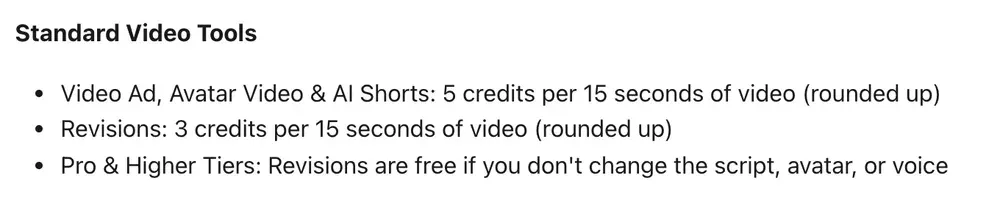
Creatify bills 5 credits per 15 seconds of video, rounded up, so a 16-second script costs as much as a 30-second one.
A per-video price, as on MakeUGC’s API, bills a 10-second hook the same 100 credits as a full 60-second script. Each extra hook you split off costs a whole video.
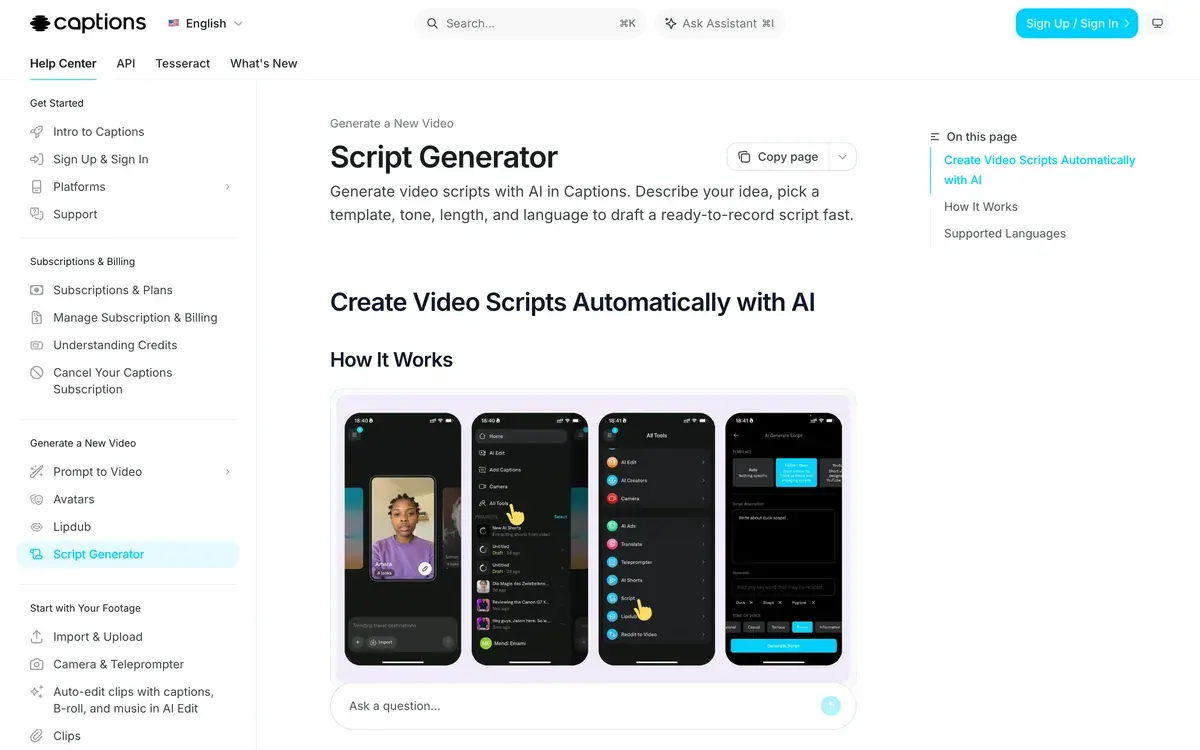
Prompts for the shots around the actor are on AI UGC prompts. Tools that write the script for you are on AI ad script generators. Captions has one built in: its Script Generator drafts a script from an idea, a template, a tone, a length and a language.
The whole workflow: how to make AI UGC ads.
To fill this layout from your own product and hook, the UGC prompt generator writes the timed script and an AI video prompt. Once the actor’s take exists, AI B-roll generators lists the tools that fill the cutaways.
Questions about UGC scripts
How long should a UGC script be?
About 75 spoken words for 30 seconds, at the average conversation rate of about 150 words a minute.
Can an AI actor say “I love this product”?
Not as its own experience: 16 CFR 465.2 bars testimonials that misrepresent whether the speaker exists or used the product.
Which hook works for a Meta ad?
The type that leads straight into your problem beat. Write two or three and test them against each other, one change per ad, as the creative testing framework sets out.
More pages for MakeUGC users, sorted by job, in the MakeUGC hub
Sources
- VirtualSpeech: Average speaking rate and words per minute, 20 August 2026; cites the National Center for Voice and Speech for an average English conversation rate of about 150 words a minute. Checked
- Arcads: Pronunciation guide (Arcads Help Center), updated 2 July 2026; pauses from punctuation, break tags of 0 to 3 seconds, spelling out acronyms, one language a script, quality falling on scripts over 1,000 characters. Checked
- TikTok Business Help Center: TikTok ads policy: misleading and false content, updated April 2026; the AI-generated content disclosure rule. Checked
- Meta: About AI disclosures for ads (Meta Business Help Center), automatic AI info labels and the political and social issue ad duty. Checked
- Federal Trade Commission, eCFR: 16 CFR 465.1 and 465.2, consumer reviews and testimonials, in force since 21 October 2024. Checked
- Federal Trade Commission, eCFR: Guides Concerning the Use of Endorsements and Testimonials in Advertising, 16 CFR 255, 255.0, Example 6, the actor reading a script. Checked
- New York State Assembly: New York S8420-A, General Business Law 396-b, synthetic performer disclosure in ads, from 9 June 2026. Checked
What changed on this page
- Updated for the 16 October 2026 price changes (Creatify’s new plan line-up): figures on this page follow.

Alexandre S.
Alexandre S. is a creative ad strategist and copywriter with ten years' experience in digital marketing across multiple channels.
Related pages
-
 Guide UGC ads: what they are and how brands run them
A UGC ad is a paid ad built on a customer’s or creator’s footage. The usage rights, platform permissions and FTC disclosure it needs, read 2 October 2026.
-
 Guide AI UGC vs human UGC: what the evidence says
Public comparisons of AI and human UGC ads, graded on how each was run and by whom. Most come from sellers or a single account. Checked 24 September 2026.
-
 Calculator AI vs human UGC cost calculator
Set an AI tool’s plan against a creator’s fee per video to see what a month of UGC ads costs each way. Plan prices from official pages, formula shown.


