AppLovin vs Meta ads
Meta shows your ad to people scrolling Facebook and Instagram. AppLovin shows a full-screen video to people between levels of mobile games such as Candy Crush and Sudoku. For a store, AppLovin sits beside Meta as a second channel, and the decision comes down to budget.
AppLovin’s FAQ asks for enough spend to reach at least 10 purchases a day. Meta’s learning phase page puts its bar at about 50 results a week per ad set. At a cost per purchase of $40, that is about $400 a day on AppLovin.
Add it when you can fund a test without shrinking Meta. Both channels run on video, and Creatify makes it in volume.
This table sets the two side by side. Placement and regions differ most.
| Question | Meta | AppLovin |
|---|---|---|
| Where ads run | Facebook and Instagram feeds, Stories and Reels | Full-screen inside mobile games |
| Who can join | Any business | Any business, since June 2026 |
| Lowest launch budget | Varies; Ads Manager warns you | $10 a day on one page, $15 on another |
| Budget the model wants | About 50 results a week per ad set | At least 10 purchases a day |
| Audience | You set it, or Advantage+ widens it | The model picks; you choose a strategy |
| Video | Several shapes | 9:16, up to 60 seconds, plus a page after it |
| Regions | Most countries | Not Western Europe |
| Awareness campaigns | Yes | No: ROAS, purchases or leads |
Scroll sideways for all 3 columns

Where do AppLovin ads run, and who sees them?
AppLovin ads run in mobile games, either between levels or as a video someone chooses to watch for a reward. AppLovin’s consumer brands page names Subway Surfers, Candy Crush, Sudoku, Solitaire and Words With Friends. It counts more than 1 billion players a day, and its FAQ puts the US at over 150 million daily.
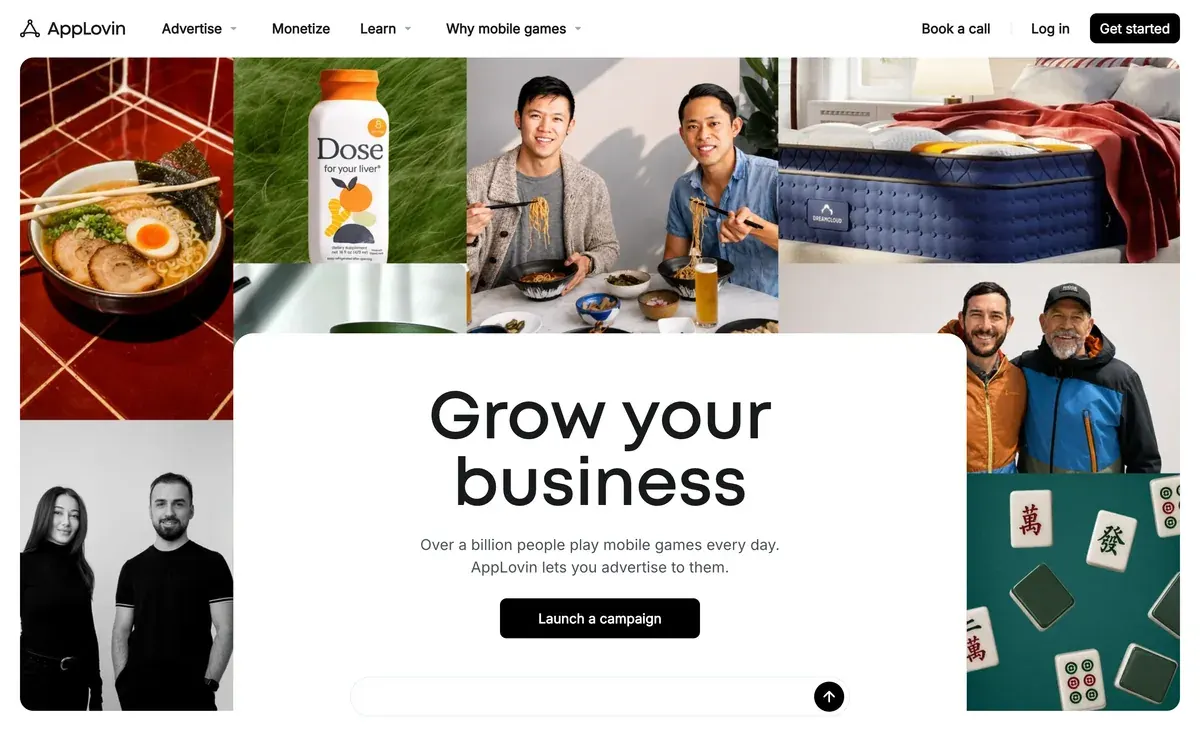
That audience is in a different mood from a Reels viewer. A game player is on a break between levels, and the ad fills the screen. AppLovin reports a median of 35 seconds of engagement, which is why it asks for longer video than Meta buyers usually cut.
Western Europe is the catch. AppLovin’s set-up guide tells web advertisers to target every region they ship to except Western Europe, which it lists as unsupported. The guide lists no countries, so check the campaign’s region list. Any buyers you cannot reach there stay on Meta.
AppLovin also has no awareness product. Its launch post says “We don’t do brand marketing”, and offers three ways to buy: return on ad spend, cost per purchaser and leads. If you want reach for a launch, that stays on Meta.
Joining is no longer the barrier. The same post opened the platform to any business on 22 June 2026, after eight months on referral codes.
AppLovin Ads is now open to all advertisers
Access. For 14 years, advertising with AppLovin required a relationship with our team. For the past eight months, it required a referral code. Starting today, it requires neither. Any business can sign up and reach our billion-plus daily active users.
Where ads run. More than a billion people play mobile games on our platform every day.
What budget does each one really need?
Each platform states a low floor, and the number that counts is the spend its model needs to learn. AppLovin’s pages say $10 a day and $15 a day in different places. Meta’s minimum moves with your currency and bid strategy, and Ads Manager warns you when a figure is too low.
Neither floor gets you far. The sum that matters is your cost per purchase times the volume each model asks for. For Meta that is about 50 results in the week after your last significant edit, or about 7 a day. For AppLovin it is 10 purchases a day, the figure its FAQ gives for the model to learn efficiently.
Frequently asked questions
Minimum budget. You can launch with a budget as low as $15/day.
Starting budget. Aim for a budget that generates at least 10 purchases a day at your typical CPA.
Who advertises. AppLovin Ads supports physical ecommerce products, as well as digital products, subscriptions, and services, across both web and app businesses.
This table runs both sums at three costs per purchase. AppLovin’s figure sits 40 per cent above one Meta ad set in every row.
| Cost per purchase | Meta, one ad set, a day | AppLovin, a day | AppLovin, 30 days |
|---|---|---|---|
| $20 | $143 | $200 | $6,000 |
| $40 | $286 | $400 | $12,000 |
| $80 | $571 | $800 | $24,000 |
Scroll sideways for all 4 columns
AppLovin softens this with a credit. Eligible new advertisers who spend $5,000 within 60 days receive the same amount in ad credit, within 7 days of hitting it.
At $400 a day, you reach the threshold on day 13, and the credit pays for about 12 more days. Some advertisers who join through a marketing partner get a different credit, so check yours. AppLovin can change or end the offer at any time.
How does each platform pick an audience?
Meta lets you define an audience, then offers to widen it. Advantage+ audience takes your usual selections, such as a customer list or an interest, and expands beyond them.
AppLovin hands that job to its model. Its FAQ says “Targeting is primarily handled by AppLovin’s model”, and you make one strategic choice:
- Universal goes after all purchases, new customers or not.
- Prospecting goes after new customers.
- Discovery goes after people who have never visited your site.
Prospecting and Discovery need history. The launch checklist asks for the Shopify app or an upload of your past purchases. A new store with a thin order file starts on Universal, which means part of your spend goes to people who would have bought anyway.
So a Meta buyer loses a familiar set of controls. WKND Agency reports no interest stacks on web campaigns, which leaves creative as the main lever you hold.
What creative does each platform need?
AppLovin needs a full-screen 9:16 video and a second screen after it. That second screen is the AppLovin Interactive Page, an image or small HTML page that plays the part of an end card. Each creative set needs at least one of each and holds up to 10.
Length is where a Meta library falls short. AppLovin’s checklist asks for a mix with plenty at 30 seconds or longer. It also says its rewarded inventory gives at least 35 seconds of guaranteed attention, and a 15-second Reels cut leaves that time empty.
The same checklist says viewers cannot skip a video for at least 5 seconds, which is why the offer has to land inside them.
Meta takes more shapes and has no second screen. Facebook ad specs lists each size, and 9:16 is the shared ground, so your best Reels ad is the first file to upload to AppLovin.
AppLovin’s FAQ says top assets from other platforms often transfer well. Its video guide says 95 per cent of top-spending videos carry prominent captions.
Creatify’s route is volume. Its pricing table lists an Ad Launcher for Meta, TikTok and AppLovin from Standard at $15 a month (read ). Users single out how many variants it makes (15 of 61 sources: G2, r/PPC).
Creatify also offers a partner sign-up link for AppLovin. In its Flamingo Shop case study, a fashion store goes from no AI avatar videos to more than 100 a month. Production time falls 30 per cent.
Those are Creatify’s own numbers, with no campaign period stated.
Creatify is the wrong pick if your creator videos already work on Meta. Upload those first and use AppLovin’s in-platform tool for the interactive page. Paying for AI avatars makes sense once you run out of files.
Users also report outputs that miss the brief, with lip sync or product details wrong (17 of 61 sources: Trustpilot, r/FacebookAds). Check each file before it spends money.
Why do AppLovin’s numbers disagree with your analytics?
AppLovin’s numbers disagree with last-click tools because a game ad often starts a purchase that another channel finishes. Someone sees a video, closes the game, then searches your brand later. Last-click analytics credits the search.
Two companies with an interest have measured that gap. Fairing, which sells post-purchase surveys, found that 13 per cent of customers who named mobile game ads had a matching last-click record. The rest went to other channels or to nothing.
AppLovin’s measurement post quotes Fospha, saying last-click captures 31 per cent of its impact. The two figures agree in direction, and both sellers gain from the conclusion.
So test the claim on your own store. Three steps make the comparison fair:
- Set AppLovin’s attribution report to Clicks and views, which AppLovin calls consistent with other major platforms’ default. The switch changes reporting only.
- Add “a mobile game” to your post-purchase survey. In September 2025, Fairing put game answers at 0.8 to 1.2 per cent of all mentions. It said top investors reported 30 to 70 per cent.
- Run a holdout before you scale, switching ads off in some regions and comparing sales. AppLovin says these usually cover 20 to 50 per cent of the footprint.
Reporting is also coarse. WKND Agency reports that a single asset shows impressions, clicks, CTR and spend. Revenue and ROAS stay at creative-set level, so you find the winning set, then infer the winning video.
When does adding AppLovin make sense?
Adding AppLovin makes sense when a test takes no more than a quarter of your paid social budget, so Meta keeps the volume it needs. That quarter is our line. Past it, you starve a working account, and a smaller test brings too few purchases to read.
This table turns the line into a monthly spend. AppLovin’s guide says a “handful” of purchases a day, so the small test assumes 3, and the full test uses its 10.
| Cost per purchase | Small test, 3 purchases a day | Full test, 10 purchases a day |
|---|---|---|
| $20 | $7,200 | $24,000 |
| $40 | $14,400 | $48,000 |
| $80 | $28,800 | $96,000 |
Scroll sideways for all 3 columns
Our full-test figure at a $40 cost per purchase lands close to the line from Common Thread Collective, an e-commerce agency. It suggested testing above $50,000 a month before AppLovin opened to everyone.
Spend is one test. Common Thread also advises patience if your order value is above $500, your buyers take more than two weeks or the product needs explaining. A game break suits an impulse buy, and 80 per cent of web conversions happen within 24 hours of a click on AppLovin’s own count.
Three cases should wait:
- A store that sells only into Western Europe has no campaign to run.
- A store below the small-test column gains more from better creative on Meta, and AI tools for Meta ads covers that route.
- A store too small for a holdout should add a post-purchase survey first, or it has no clean way to judge the result.
Ready to open an account? Axon Ads Manager walks through the first campaign under the platform’s new name.
Questions about AppLovin and Meta ads
Is AppLovin better than Meta?
Not for most stores, on the data we have. In Fairing’s September 2025 survey data, game answers sat at about 1 per cent of mentions across its base. That predates AppLovin opening to every business.
Can I use my Meta ads on AppLovin?
Yes, for any 9:16 video up to 60 seconds. AppLovin says top assets often transfer well. You also need an image or HTML page for the screen after the video.
Does AppLovin work for a service business?
AppLovin’s FAQ says digital products, subscriptions, services and B2B lead generation all run on the platform. Its proof points lean to online shops, so treat a service test as the harder bet.
Is AppLovin the same as Axon?
Axon was the ad platform’s name from October 2025 until June 2026. It is now called AppLovin Ads, and Axon names the recommendation model behind it.
More pages for Creatify users, sorted by job, in the Creatify hub
Sources
- AppLovin: AppLovin Ads is now open to all advertisers, 22 June 2026; any business can sign up; three buying options, ROAS, cost per purchaser and leads;
We don’t do brand marketing
. Checked - AppLovin: AppLovin Ads for consumer brands, launch budget as low as 10 dollars a day; fullscreen video between levels or for rewards; top-rated games; Universal, Prospecting and Discovery; 1 billion+ people game every day; median engagement of 35 seconds. Checked
- AppLovin support: Web advertiser FAQ, launch budget as low as 15 dollars a day; a budget for at least 10 purchases a day; targeting handled by the model; 150 million+ daily active users in the US; physical products, digital products, subscriptions and services; B2B advertisers and lead generation; 5,000-dollar credit terms; AppLovin can change or end promotional offers at any time. Checked
- AppLovin: Setting up your web campaign, target every region you ship to except Western Europe; a handful of purchases daily, 10 as the example; each creative set holds at least one video and one interactive or image; about 8 creatives seen before converting. Checked
- AppLovin support: Launch checklist, target all regions outside Western Europe; Prospecting and Discovery need the Shopify app or uploaded purchase history; video skip-delayed at least 5 seconds; rewarded inventory gives at least 35 seconds of guaranteed attention; a mix of videos of 30 seconds or longer; each set holds up to 10 of each. Checked
- AppLovin support: Ad specs and requirements, 9:16 video up to 60 seconds; AppLovin Interactive Page as an image or HTML. Checked
- AppLovin support: Video best practices, 95 per cent of top-spending videos have prominent captions; 85 per cent use voiceover; interstitials give 5+ seconds of guaranteed attention. Checked
- AppLovin support: Measurement and attribution, Clicks and views against Clicks; D0 within 24 hours, D7 within 192 hours of a click; in-platform reporting does not capture every conversion influenced. Checked
- AppLovin: Different numbers, one channel: making sense of AppLovin through a measurement lens, 16 June 2026; quotes Fospha that last-click captures 31 per cent of AppLovin’s impact; holdouts of 20 to 50 per cent of the geo footprint. Checked
- Fairing: Axon one year later: from e-commerce experiment to established channel, 23 September 2025 in the article body; game answers at 0.8 to 1.2 per cent of survey mentions, 30 to 70 per cent at top investors; 13 per cent matched a last-click game UTM, 74 per cent credited elsewhere, 13 per cent none. Checked
- Common Thread Collective: AppLovin Axon goes self-serve in June 2026, 28 May 2026; consider testing above 50,000 dollars a month on paid social; patience above a 500-dollar order value, a two-week purchase cycle or an educational funnel. Checked
- WKND Agency: How does AppLovin work for advertisers?, 7 September 2026; asset-level reporting shows impressions, clicks, CTR and spend, with revenue at creative-set level; a budget for 10 purchases a day is guidance. Checked
- Meta Business Help Center: About the learning phase, about 50 results in the week after the last significant edit; the page shows no date; read from the Wayback Machine capture of 3 October 2026. Checked
- Meta: Meta Advantage+ audience, takes your usual audience selections and expands beyond them; read from the search result, since facebook.com returns a login page to automated reads. Checked
- Relevant Audience: Facebook ads cost: how Meta charges, budgets, billing and VAT, 12 October 2026; quotes Meta’s best-practice article: the minimum depends on vertical, budget type, buying type, bid strategy, optimisation, currency and schedule, and Ads Manager shows an alert. Checked
- Creatify: Flamingo Shop on AppLovin, 21 November 2025; vendor case study; zero to 100+ AI avatar videos a month; production time down 30 per cent; no campaign period stated. Checked
- Creatify: Creatify pricing, Ad Launcher for Meta, TikTok and AppLovin from Standard up. Checked
- G2, Reddit, Trustpilot and others, as counted in our reviews file: Public user reviews of Creatify, 61 sources; 15 name variant volume, 17 name outputs that miss the brief. Checked

Alexandre S.
Alexandre S. is a creative ad strategist and copywriter with ten years' experience in digital marketing across multiple channels.
Related pages
-
 Guide Axon Ads Manager is now AppLovin Ads
Axon Ads Manager became AppLovin Ads on 22 June 2026, with no referral code needed. Account steps, pixel, creative specs and a first budget. 7 November 2026.
-
 Guide Facebook ad specs and Instagram ad sizes
Facebook and Instagram ad sizes, ratios, video lengths and text limits from Meta’s Ads Guide, plus the AI tools that export each ratio. Checked 15 Oct 2026.
-
 Guide What Meta’s Advantage+ creative AI does to your ads
Every Advantage+ creative enhancement Meta lists, how to turn each off, and 17 of 35 advertiser reports of enhancements turning back on. Checked 2 October 2026.
-
 Best list Best AI tools for Meta ads
AI tools for Facebook and Instagram ads, split into making the ad and running the campaign, with prices and ad terms checked 23 to 26 September 2026.
-
 Profile Creatify for UGC ads
Creatify bills avatar video in 15-second blocks, so a 30-second ad uses 10 credits. Its ad terms and 20 latest Trustpilot reviews, read 24 September 2026.


