What is a UGC creator?
A UGC creator is a freelancer who films short videos that look like a real customer made them. UGC stands for user-generated content. The creator sells each video to a brand, which posts it from its own accounts, so no followers are needed.
Insense, a creator marketplace, puts it as paying “for content creation, not audience access” in its rate guide of 14 September 2026. That guide puts a beginner at $50 to $400 a video.

What does a UGC creator do?
A UGC creator turns a brand’s brief into a finished clip the brand owns the right to use. Insense’s guide describes the job as a creator who “shoots, edits, and delivers video or photo assets that you own the rights to use”.
The work runs in four steps:
- The brand sends a brief: the product, the claim, the hook and the format, such as an unboxing or a tutorial.
- You film it on your phone, usually as a vertical 9:16 clip, at home or wherever the product lives.
- You deliver the edited video, often with the raw takes.
- The brand runs it as an organic post or a paid ad.
What you get paid turns on the last step. A usage-rights agreement says where the brand may run your video and for how long. Insense’s guide says a base rate “typically covers narrow, short-term organic use”, and that paid ads, more platforms or a longer window cost more.
If you want to see what the finished clips look like, UGC video examples collects them by format. What is UGC content? covers the wider term, including posts customers make unpaid.
UGC creator vs influencer
An influencer sells reach: the brand pays to get in front of their followers. A UGC creator sells the footage itself, which the brand runs to its own audience or to cold traffic through ads.
| Question | UGC creator | Influencer |
|---|---|---|
| What the brand pays for | The video and the right to use it | Access to the creator’s audience |
| Followers needed | None | The audience is the product |
| Who posts it | The brand, from its own accounts | The creator, on their own profile |
| How it is priced | Per video, plus usage rights | Per post or campaign, usually by audience size |
| Where it runs | Brand page, paid ads, product pages | The creator’s feed and stories |
Scroll sideways for all 3 columns
The line blurs in one place. Whitelisting means the brand runs ads from the creator’s own account, as a Meta partnership ad or a TikTok Spark Ad. Insense’s guide says it “is priced separately from the content itself because you’re buying account access, not more footage”. Those posts also need a paid-partnership label: UGC ads covers both platforms’ rules.
When to disclose
Relationship. Disclose when you have any financial, employment, personal, or family relationship with a brand.
Value. Disclose the relationship if you got anything of value to mention a product.
Placement. The disclosure should be placed with the endorsement message itself. Use simple and clear language.
How UGC creators get work
UGC creators find brands in three places.
The first is a creator marketplace, where brands post briefs and creators apply. Insense lets you join as a “UGC-only Creator” and take briefs without posting on your own social accounts, per its creator help centre.
You apply in the app’s Account tab with a portfolio of “At least 6–12 videos”. It must cover two product categories and two video formats, with both on-camera and voice-over clips. A rejected creator can reapply after 14 days.
The second is a managed service that sells packages to brands and pays creators inside the price. Trend is one.
The third is pitching brands yourself. Send a short email or DM to a brand whose ads you already see. Link two or three samples that match its product. Direct deals skip the marketplace’s cut, so you set the rate and write the usage terms yourself.
All three run on the same thing: a portfolio. It is a page of sample videos, often of products you already own, filmed as if a brand had briefed you.
Our list of UGC platforms compares the marketplaces and managed services side by side.
How much do UGC creators make?
UGC creators charge per video, and the range is wide. Insense’s rate guide gives three tiers from “publicly available creator-economy pricing data”. The guide gives no sample size. The tiers overlap: a beginner’s top rate is above a mid-level creator’s lowest, so your portfolio sets your rate more than your tier does.
| Tier | Per video |
|---|---|
| Beginner | $50 to $400 |
| Mid-level | $150 to $1,000 |
| Premium | $500 to $3,000 or more |
Scroll sideways for all 2 columns
A managed service shows the other side: what a brand pays with the creator’s fee inside. Trend’s packages run from $91.67 a video on Starter down to $69.14 on Scale. The creator’s share is smaller than that, and Trend does not publish it.
The rate is only part of a deal. Each add-on raises it: paid usage, whitelisting, raw footage, extra hooks. How much do UGC creators cost? breaks down every add-on and the marketplace fees on top.
How to become a UGC creator in five steps
Insense’s portfolio bar makes a useful checklist even if you never apply there.

- Pick products you can film well: two categories you know, such as skincare and kitchen gear, with products you already own.
- Film six to twelve sample videos. Cover at least two formats, an unboxing and a tutorial for example, and both talking to camera and voice-over. Insense also asks for good technical quality, with no filters or watermarks. Our UGC script template gives you a hook-first structure to film from.
- Write your rate card: one base price per video, then a separate line for each add-on (paid usage, whitelisting, raw footage).
- Apply to a marketplace and pitch brands directly. Marketplaces bring briefs while your portfolio is thin; direct deals pay more per video.
- Put the usage rights in writing every time: where the brand may run the video, for how long and whether paid ads are included.
What is an AI UGC creator?
An AI UGC creator sells UGC-style ads made with AI to brands. An AI actor speaks the script on camera, and nobody films anything. The brief and the delivery stay. The skill moves to the script and to checking each clip before it ships.
The catch is the client’s right to use what you sell. That depends on your tool’s terms, and how to make money with AI UGC reads them clause by clause. Whether AI clips perform like filmed ones is a separate question, with the evidence on AI UGC vs human UGC.
MakeUGC is one tool built for this job: you paste a script and one of its “1,000+ AI actors” speaks it, per its talking actors page.
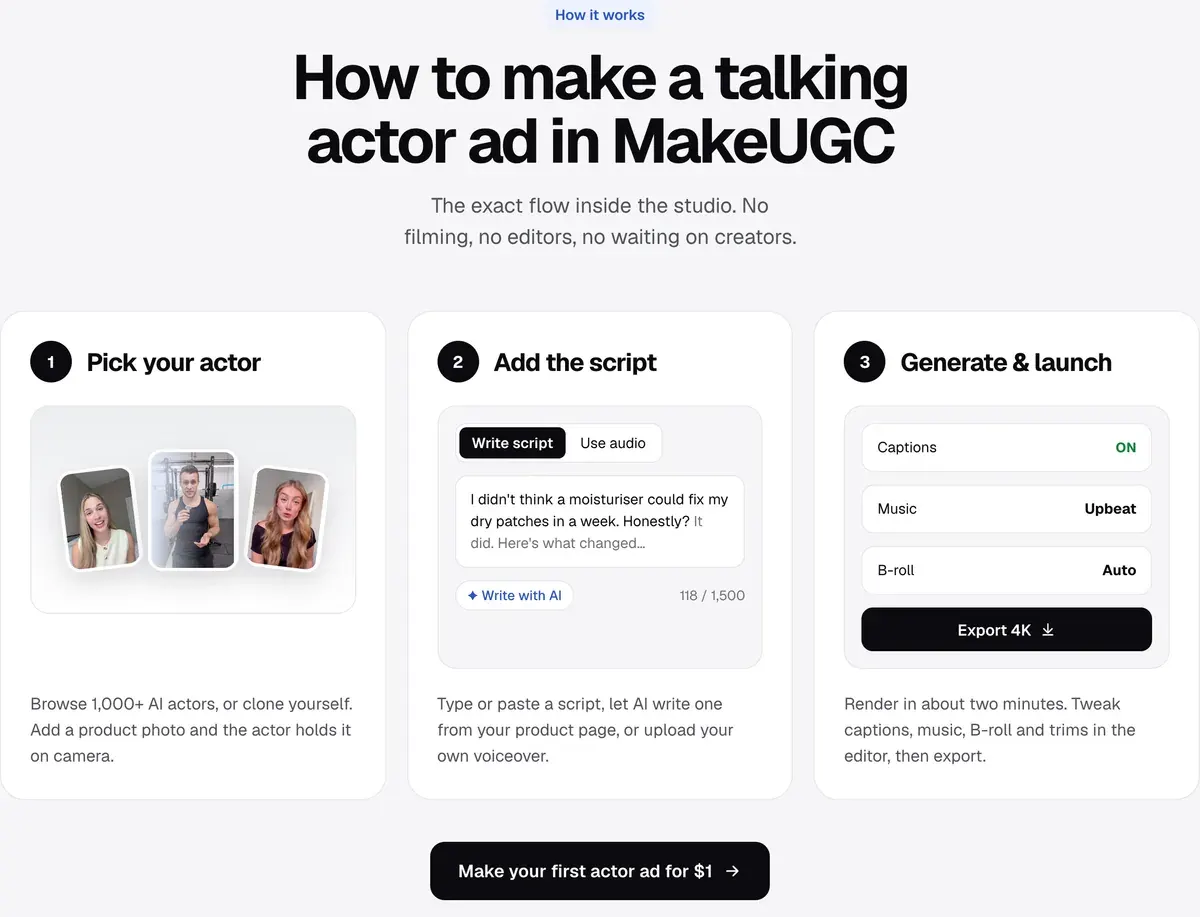
Plans start at $59 a month, prices checked (MakeUGC pricing).
Two things matter before you sell its output. MakeUGC’s terms page prints clause 3.2(a) three times and the copies disagree: two keep your ownership “after your Subscription ends”, the third is headed “Ownership Conditioned on an Active Subscription”. Clause 7.3 sits beside all three: “Termination does not affect your ownership rights to previously generated Output.”
So two copies and clause 7.3 keep your clips yours after you cancel, and one copy ties ownership to an active subscription. Put the clip’s usage terms in your client contract either way.
Billing is the top user complaint: charges that continue after cancelling (17 of 29 sources: Trustpilot, Trustpilot).
The MakeUGC profile has the full review synthesis. Other tools do the same job with different actor libraries and billing: AI actors for ads sets them side by side.
Questions new UGC creators ask
Do you need followers to be a UGC creator?
No. The brand posts the video from its own accounts, and Insense’s UGC-only path needs no posting on your own profiles.
Do UGC creators post the videos themselves?
Usually not. You deliver the file and the brand posts it. Whitelisting is the exception: the brand runs ads from your account, priced as a separate line.
How many videos does a UGC portfolio need?
Insense asks for at least six to twelve, across two product categories and two formats, with on-camera and voice-over clips.
More pages for MakeUGC users, sorted by job, in the MakeUGC hub
Sources
- Insense: UGC Creator Rates Explained (14 September 2026), Beginner, mid-level and premium per-video ranges from publicly available creator-economy pricing data; a base rate covers short-term organic use; whitelisting priced separately. Checked
- Insense: How to join Insense as a UGC-only creator, UGC-only creators join campaigns without posting on their own social accounts; apply in the app’s Account tab; portfolio of at least 6 to 12 videos, two product categories, two formats, on-camera and voice-over; good lighting, audio and editing, no filters or watermarks; reapply after 14 days; undated. Checked
- Trend: Trend pricing, Four packages from 550 dollars for up to 6 videos to 3,872 dollars for up to 56, per-video figures printed; 100% licensing and distribution rights; credits expire 12 months after purchase. Checked
- MakeUGC: Talking actors feature, 1,000+ AI actors, 50+ languages, three steps, render in about two minutes, six ad formats, 4K export. Checked
- MakeUGC: MakeUGC terms of service (effective 17 November 2025), Three copies of 3.2(a) on the same page: two keep ownership after the subscription ends, the third conditions it on an active subscription; 7.3 keeps ownership of earlier output after termination; 5(f) bars output where AI disclosure is legally required but left out. Checked

Alexandre S.
Alexandre S. is a creative ad strategist and copywriter with ten years' experience in digital marketing across multiple channels.
Related pages
-
 Guide How much do UGC creators cost?
UGC creator rates as marketplaces publish them, the fees on top and the usage rights each includes, beside AI’s cost per ad. Checked 2 October 2026.
-
 Guide How to make money with AI UGC
Which AI UGC tools’ terms let a client run the videos you make, clause by clause, and what happens to delivered ads if an account ends. Read 23-26 Sep 2026.
-
 Guide What is UGC content?
UGC content is anything customers or creators make about a brand. Its three kinds, five video formats, where it runs and the rights it needs.
-
 Best list UGC platforms for brands
Five UGC marketplaces priced per video beside three AI UGC tools: fees on top, delivery times and how long usage rights last. Checked 21 October 2026.


