What is UGC content?
UGC content is user-generated content: anything about a brand that people outside it make, from a photo review to a video. A customer filming an unboxing on their phone makes UGC. So does a creator a brand pays to film a review in a customer’s voice.
In ads, a “UGC video” is a vertical clip of one person talking to camera, shot handheld at home, whoever made it.
The phrase “UGC content” repeats itself (the C already stands for content), but it is how most people search for it. Three kinds share the name today, and the table shows what each needs before it runs as an ad.
| Kind | Who makes it | Who pays | Before it runs as an ad |
|---|---|---|---|
| Organic customer content | A customer, unprompted | Nobody | The customer’s permission: they own the footage |
| Paid creator UGC | A creator you brief | You, per video or bundle | Usage rights in the contract, plus a paid-partnership disclosure |
| AI UGC | An AI tool, from your script | You, through a subscription | The tool’s terms, plus the platform’s AI label where it asks for one |
Scroll sideways for all 4 columns

What does UGC mean in marketing?
In marketing, UGC means content whose maker is not the brand. The trade uses the word for two different things, and the two are easy to mix up.

The first is real customer content. A buyer posts a review, a photo of the product in use or a TikTok about it. Nobody paid for it, so it reads as an unpaid opinion.
The second is a style. Brands want ads that look like that customer post, so they pay creators to film in the same way. The footage is scripted and paid for, and it still gets called UGC. “UGC style” is the honest name for it: the look of a customer post, made to a brief.
The three kinds of UGC, one by one
Organic customer content is the original meaning. It costs nothing to make, and you get what was posted, at the length and quality it was posted. The catch is ownership. The US Copyright Office’s FAQ puts it plainly: “Copyright exists from the moment the work is created.”
The customer’s video is theirs the moment they film it, so reusing it in your ad means asking first.
Paid creator UGC is footage a brand commissions. A UGC creator films short videos for a fee, delivers the files and often does not post them on their own account.
What is a UGC creator covers how that job works, and UGC creator rates sets out what creators charge and the fees on top. Brands find them through marketplaces and agencies, compared in the best UGC platforms.
AI UGC replaces the creator with software. You write a script, pick an AI actor (a synthetic presenter, sometimes built from a real person’s footage) and the tool renders the video.
What is AI UGC? explains its two meanings and the vendor terms behind them.
Why brands use UGC: Emplifi’s survey and Meta’s lift studies
Brands use UGC because shoppers rate customer ratings and reviews as more authentic than social media ads. Emplifi’s 2026 consumer survey asked 1,650 social media users in the US and UK, in January 2026, how authentic different content feels. Emplifi sells review and UGC software.
The gap is wide. In Emplifi’s survey, 63 per cent rated user-generated ratings and reviews as authentic. For social media ads the figure was 38 per cent.
For influencer ratings and reviews, Emplifi gives 42 per cent. AI-generated content came last of the types listed, at 31 per cent.
In the same survey, 91 per cent of respondents expect brands to disclose AI use in marketing. That matters if you plan to swap creators for AI actors: the trust UGC borrows from real customers does not transfer by default.
On ad performance, Meta publishes its own figures. PPC Land (11 October 2026) reports Meta’s white paper of 7 October 2026.
The paper pools 20 conversion lift studies, tests that compare people shown the ads with a group kept from seeing them. Advertisers in Europe, the Middle East and Africa ran them from January to June 2025.
Partnership ads are creator posts run with the brand’s budget.
Where they made up at least 30 per cent of a campaign’s ads, PPC Land’s report gives a 45 per cent lower median “cost per incremental purchase”. Meta states that result at 92 per cent confidence, below the usual 95 per cent. It measures creator ads, and customer posts sit outside it.
For AI against human UGC, AI UGC vs human UGC: what the evidence says grades 12 public comparisons by how each was run.
What is a UGC video? The five formats you see most
A UGC video is a short clip filmed vertically on a phone, with one person speaking to camera as if to a friend. Five formats recur.
| Format | What happens on screen | The job it does |
|---|---|---|
| Testimonial | A person says what changed after using the product | Proof from someone like the viewer |
| Unboxing | First reactions while opening the package | Shows the product at its real size |
| Problem and solution | Names a frustration, then shows the product fixing it | Gives the viewer a reason to care in the first seconds |
| GRWM (“get ready with me”) | The product appears inside a morning or night routine | Shows the product as part of an ordinary day |
| Tutorial | Step by step: how to apply, set up or use it | Answers the questions that stop someone buying |
Scroll sideways for all 3 columns
The formats overlap. A tutorial often opens on a problem, and a testimonial often ends on an unboxing shot. What they share is the opening: the first two or three seconds are the hook. UGC video examples shows each format in real ads, and the UGC script template gives the beats to write one.
Where UGC content runs
UGC runs wherever short vertical video does, and in a few places it was never meant for.
On TikTok, a brand can put a creator’s or customer’s post behind ad spend. TikTok’s help page (last updated June 2026) calls this format Spark Ads.
It defines them as “a native ad format that allows you to leverage organic TikTok posts and their features in your advertising.” The creator authorises it with a code, and the code’s duration can be set to fit the campaign.
On Instagram Reels and Facebook, Meta’s version is partnership ads: the creator’s handle appears on an ad the brand pays for. Brands also run creator footage from their own account as a normal ad, which needs the usage rights in writing. UGC ads walks through both routes on each platform.
Off social, UGC fills product pages, where reviews with photos sit under the buy button, and shoppable video, where a clip carries a tap-to-buy link. Shoppable video ads covers where those run.
Rights and disclosure basics
Two questions come before any UGC runs as an ad. Do you have the right to use the footage? Does the viewer need to be told someone was paid?
For rights, the footage belongs to whoever filmed it until a contract says otherwise. A paid creator’s contract sets how long you can run the video, on which platforms and whether you can edit it. UGC ads lists the clauses to agree.
For disclosure in the US, the FTC’s Endorsement Guides set the rule (255.5(a), revised 26 July 2023). When a connection to the seller could change how much viewers trust the endorsement, and they would not expect it, it “must be disclosed clearly and conspicuously”.
The FTC’s guide for influencers (November 2019) sums it up in one line: “Disclose the relationship if you got anything of value to mention a product.” A free sample counts.
When to disclose
Relationship. Disclose when you have any financial, employment, personal, or family relationship with a brand.
Value. Disclose the relationship if you got anything of value to mention a product.
Placement. The disclosure should be placed with the endorsement message itself. Use simple and clear language.
A testimonial also has to be true. The FTC’s rule on fake reviews (465.2(a)) bars a business from creating a testimonial that materially misrepresents whether the speaker used the product.
That covers a paid creator who says they use a product they never tried, and an AI actor scripted to say the same. Are AI UGC ads legal? reads that rule against AI actors clause by clause.
How AI UGC fits
AI UGC is the third kind, and the newest. It answers two limits of creator UGC: each video costs a creator fee, and every new hook means a new shoot. An AI tool renders a fresh actor or a fresh opening line from text, so ten hooks cost credits from one plan. No second shoot is needed.
It also carries the weakest trust of the three. The actor is not a customer, so the ad cannot claim a use that never happened. And the Emplifi figures above show viewers rate AI content as the least authentic of the types surveyed. Given the 31 per cent figure, a first-person testimonial is the riskiest use of an AI actor.
MakeUGC is one AI UGC tool built for this job. Its talking actor page offers “1,000+ AI actors” (the Starter plan includes 300+) and a render “in about two minutes”. It lists six ad formats (read 21 October 2026): testimonial, unboxing, problem to solution, podcast clip, founder story and hook tests.
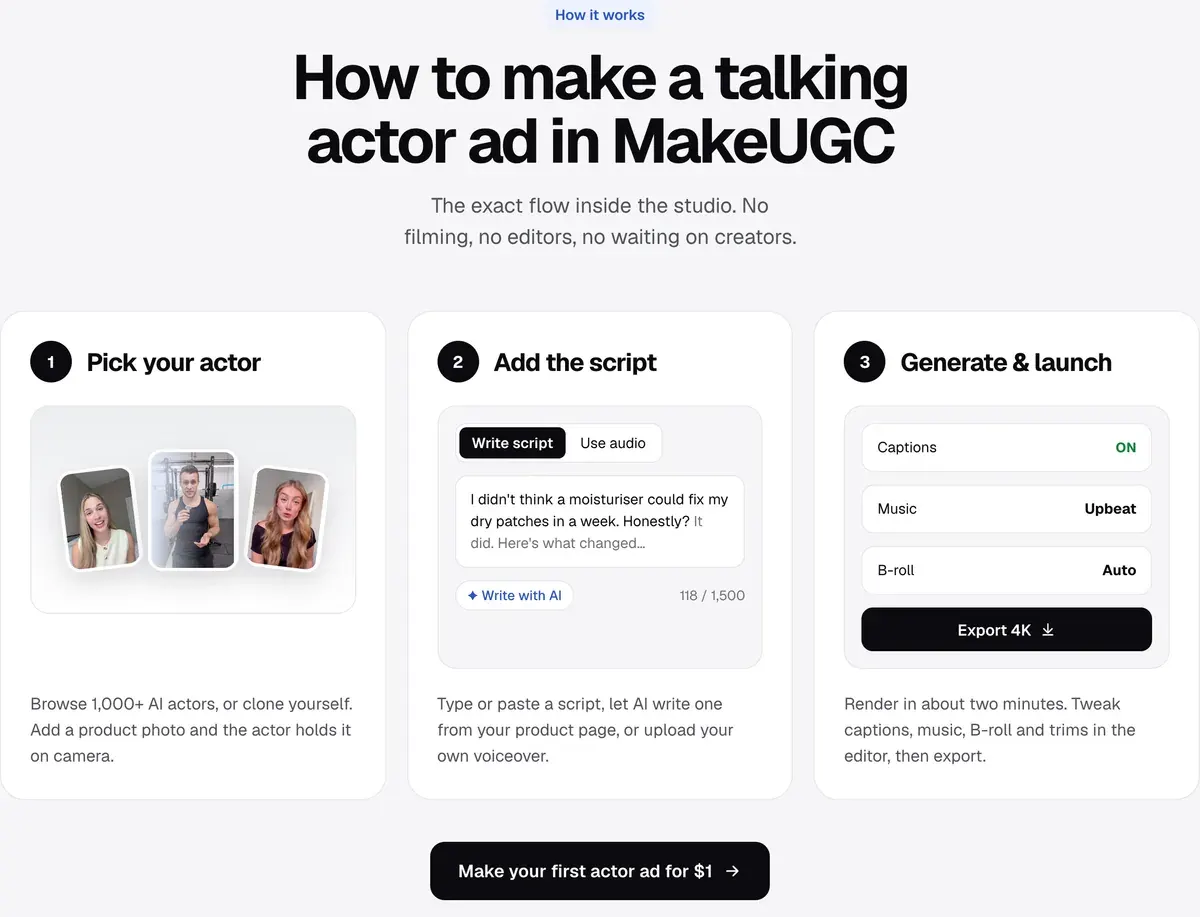
Its product in hand page turns one product photo into an actor holding it on camera.

The Starter plan costs $59 a month, prices checked . Reviewers’ main complaint is billing: charges after cancelling, and a $1 trial that rolls into a full plan. The MakeUGC profile has its terms and user reports, MakeUGC pricing every plan, and the MakeUGC hub its guides in one place.
The best AI actors for ads compares the tools that render a presenter from a script. Higgsfield vs MakeUGC sets two of them side by side.
Questions people ask about UGC content
Is UGC the same as influencer content?
No. An influencer is paid for their audience: the post goes out on their account, to their followers. A UGC creator is paid for the footage: the brand gets the files and runs them from its own account or as an ad. Some creators do both. A partnership ad blends the two, with the creator’s handle on a brand-funded ad.
Is UGC content free to use?
Only with permission. A customer’s post is free to make, and it still belongs to the customer, so a brand asks before it reposts or advertises with it. Paid creator UGC comes with the rights the contract lists. UGC creator rates shows how marketplaces price usage rights on top of the video fee.
Is AI UGC still UGC?
In name only. No user made it: a tool rendered it from a brand’s script. It borrows the look of UGC, and the rules still apply to it. The FTC’s fake-review rule bars a testimonial that materially misrepresents whether the speaker used the product, and an AI actor never has.
More pages for MakeUGC users, sorted by job, in the MakeUGC hub
Sources
- Emplifi: 2026 Consumer survey report: Digital authenticity in the age of AI, Online survey of 1,650 social media users in the US and UK, data collected January 2026; the authenticity ratings by content type and the AI disclosure figure; Emplifi sells ratings, reviews and UGC software. Checked
- PPC Land: Meta says partnership ads cut incremental purchase costs 45% in EMEA tests, Published 11 October 2026; reports Meta’s creator white paper of 7 October 2026, a meta-analysis of 20 conversion lift studies run from 1 January to 30 June 2025, at 92 per cent confidence. Checked
- US Copyright Office: Copyright, Frequently Asked Questions: When is my work protected?, Undated FAQ; the answer to When is my work protected?. Checked
- eCFR, US Government Publishing Office: 16 CFR Part 255, Guides Concerning the Use of Endorsements and Testimonials in Advertising, Section 255.5(a) on material connections, revised 26 July 2023. Checked
- Federal Trade Commission: Disclosures 101 for Social Media Influencers, Published November 2019; the section When to disclose. Checked
- eCFR, US Government Publishing Office: 16 CFR 465.2, Fake or false consumer reviews, consumer testimonials, or celebrity testimonials, Paragraph (a), with (1) and (2). Checked
- TikTok: Spark Ads, Last updated June 2026; the opening definition and the post authorisation line. Checked
- MakeUGC: Talking actor feature, Undated; the three steps, the 1,000+ actors line, a render in about two minutes and six ad formats. Checked
- MakeUGC: Product in hand feature, Undated; one product photo, background removed, the actor holds the product on camera. Checked

Alexandre S.
Alexandre S. is a creative ad strategist and copywriter with ten years' experience in digital marketing across multiple channels.
Related pages
-
 Category Best AI UGC generators for ads
16 AI UGC and avatar tools compared on list price per video and ad-use terms, checked 24 September 2026.
-
 Guide UGC script template for ads
A UGC ad script template to copy, 20 hooks by type and examples timed for 15, 30 and 45 seconds, for creators or AI actors. Checked 15 October 2026.
-
 Calculator UGC prompt generator
Type your product, who buys it and their main doubt to get a timed UGC script and a ready prompt for MakeUGC, Seedance 2.5 or Veo 3.1. Runs in your browser.
-
 Best list Video editors for UGC ads
UGC video editors for ads: auto captions, cuts, B-roll, free-plan watermarks and which music you may run in a Meta ad. Checked 21 October 2026.


