
Revid vs HeyGen
Verdict: Revid or HeyGen
Revid AI vs HeyGen: choose Revid to post videos on a schedule, HeyGen for presenter avatars (read ). A 30-second video costs $0.10 to $1.16 on HeyGen Creator and $0.78 to $1.56 on Revid Growth, if every credit is used. Revid makes new project pages public by default, and HeyGen’s terms bar Free-plan videos from ads (s.4).
Revid
- Best for
- Creators and small brands posting daily short-form videos who want scripting, voiceover, captions, publishing and Auto-Mode posting in one subscription.
- Not for
- Teams that need private drafts by default: new project pages are public until you change the setting (terms, Copyright and Content Ownership).
 HeyGen
- Best for
- Localising one ad script into many languages, cheap avatar minutes for talking-head ads, and founder or spokesperson clones on a paid plan.
- Not for
- Anyone planning to run ads made on the free plan, which the terms forbid, and advertisers of alcohol, online gambling or weapons, which the moderation policy bans.
| Revid | HeyGen | |
|---|---|---|
| Where they differ | ||
| Monthly from (USD) | $39 | $29 |
| Cost per output at list price | $0.78 to $1.56 per 30-second video with voiceover if every credit is used | $0.10 to $1.16 per 30-second video if every credit is used; pro rata |
| Free plan | No | Yes |
| What it makes | Whole short-form videos: script, voiceover, captions, render | Talking avatars, digital twins and video translation |
| Posting to social apps | TikTok, Instagram, YouTube and X on every plan; 3 Auto-Mode workers on Growth | None on the pricing page; Zapier, Make, n8n and HubSpot integrations |
| AI credits on the entry credit plan | 2,000 a month on Growth | 600 a month on Creator |
| Voice cloning | Ultra | From Creator |
| Project pages by default | Public, and may show in Revid’s galleries and search | No public-page setting in the terms |
| Free output in ads | No separate rule for free credits in the terms | Barred: no “advertising” on the Free plan (s.4) |
| Unused plan credits | Reset each month and never stack; Boost packs never expire | Roll over one month on monthly plans |
| Your content trains AI | No general-purpose training (privacy policy) | Allowed for HeyGen’s own models (s.3) |
| The same on both | ||
| API | Both: Yes | |
What each one makes for ads
Revid builds the whole short video and can post it for you. HeyGen builds the person who speaks in it.
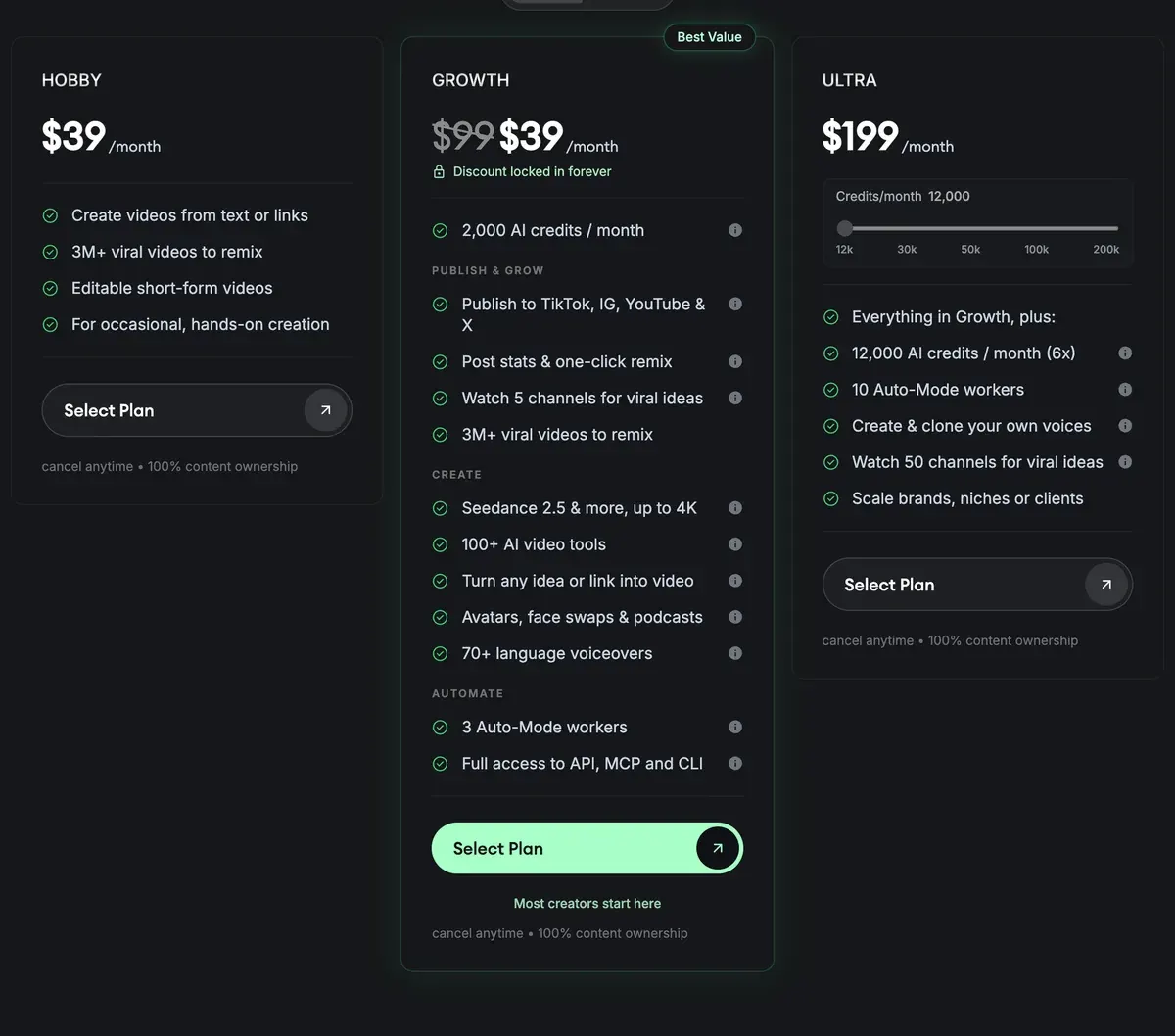
Revid turns a text or a link into a captioned video with a voiceover, then publishes it. Its pricing page says every plan includes publishing to TikTok, Instagram, YouTube and X, with post stats (pricing). An Auto-Mode worker is a scheduled job that makes and posts videos on its own. Growth has three; Ultra has ten.

HeyGen makes talking-avatar video: a stock presenter, a photo you animate, or a digital twin filmed from you. Its Creator plan lists 175+ languages and voice cloning. Six of 39 public user sources single out its translation and dubbing (YouTube, G2).

The two overlap more than their pitches suggest. Revid’s privacy policy (25 October 2026) names HeyGen first among the providers behind its “Talking avatars and lip sync”. Revid’s own comparison page puts its case in one line: “The video is the product, not the presenter.”
What a 30-second video costs
A 30-second video costs $0.10 on HeyGen’s Avatar III, about a tenth of Revid’s typical video. Avatar IV and Avatar V, at $0.75 and $1.16, overlap Revid’s $0.78 to $1.56.
HeyGen Creator lists $29 a month for 600 credits, and Revid Growth $39 a month for 2,000 (HeyGen pricing, Revid pricing, read ). HeyGen bills avatar video in credits a minute, by model (help centre). Revid’s FAQ puts “a typical 30-second video with Pro moving images and a voiceover” at about 40 to 80 credits.
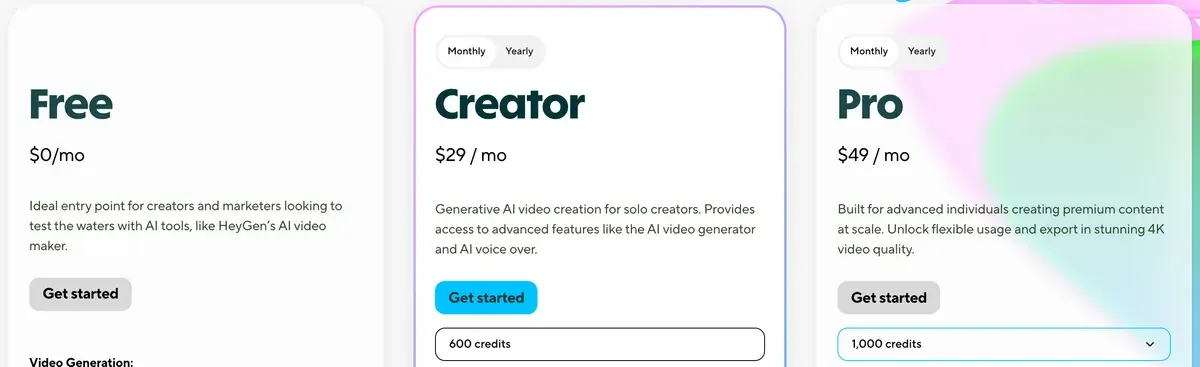
Each figure is the plan price over its credits, times the credits a 30-second video uses. HeyGen publishes no rounding rule, so its rows show the whole-minute case too. Yearly billing cuts each figure by about a sixth (HeyGen $24 against $29, Revid $32 against $39).
| Plan and model | Credits used | Monthly billing | Monthly, by the whole minute |
|---|---|---|---|
| HeyGen Creator, Avatar III video Look | 2 | $0.10 | $0.19 |
| HeyGen Creator, Avatar IV video Look | 15.5 | $0.75 | $1.50 |
| HeyGen Creator, Avatar V | 24 | $1.16 | $2.32 |
| Revid Growth, Pro moving images and voiceover | 40 to 80 | $0.78 to $1.56 | Billed per video |
Scroll sideways for all 4 columns
The rows leave out HeyGen’s photo Looks, at 7 credits a minute on Avatar III and 16 on Avatar IV. Revid’s full AI video models cost more per second, and its editor shows the cost before each render. Revid’s Hobby card, at the same $39 a month, names no AI credits (pricing).
HeyGen’s rates have moved before. Seven of 39 user sources report its per-minute costs rising in August and September 2026 without notice (Trustpilot, Trustpilot). Every HeyGen plan and tier: HeyGen pricing. Both beside every other tool: the price tracker.
Who owns the video and who can see it
You own the video on both, HeyGen only on a paid plan. Revid adds a visibility setting you have to change yourself.
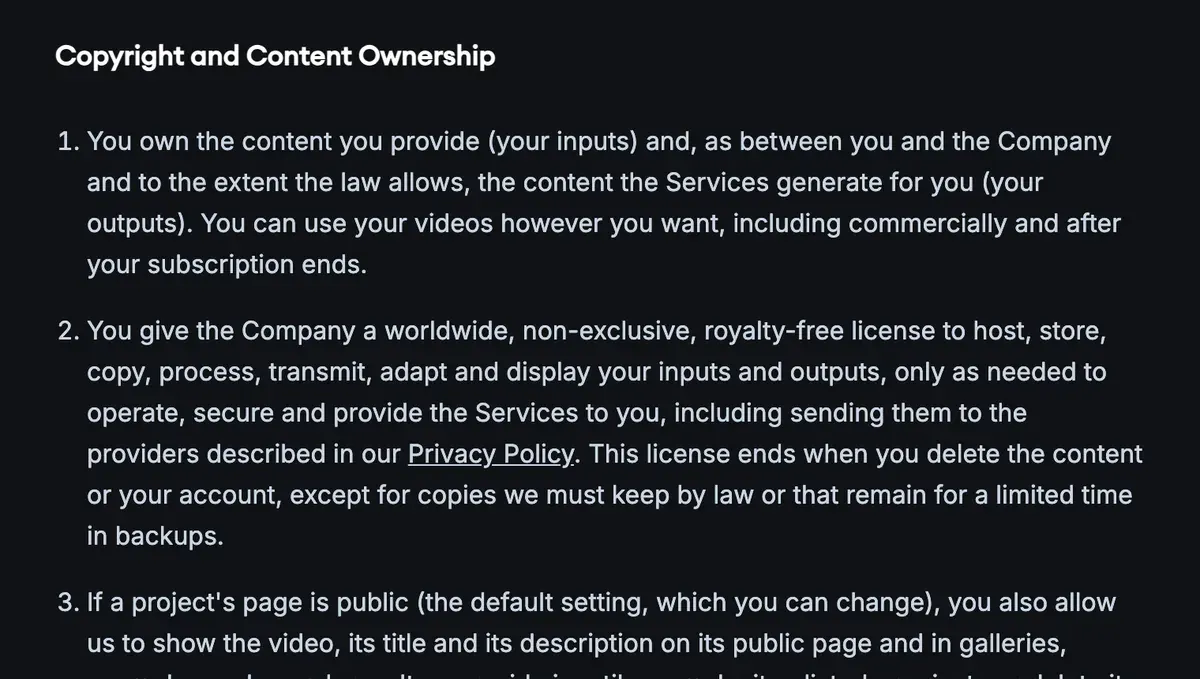
Revid’s terms (25 October 2026, Copyright and Content Ownership) say you “can use your videos however you want, including commercially and after your subscription ends”. The same section makes project pages public “(the default setting, which you can change)”.
While a page stays public, Revid may show the video and its title in its galleries and search results on revid.ai. Set unreleased ad creative to unlisted or private first.
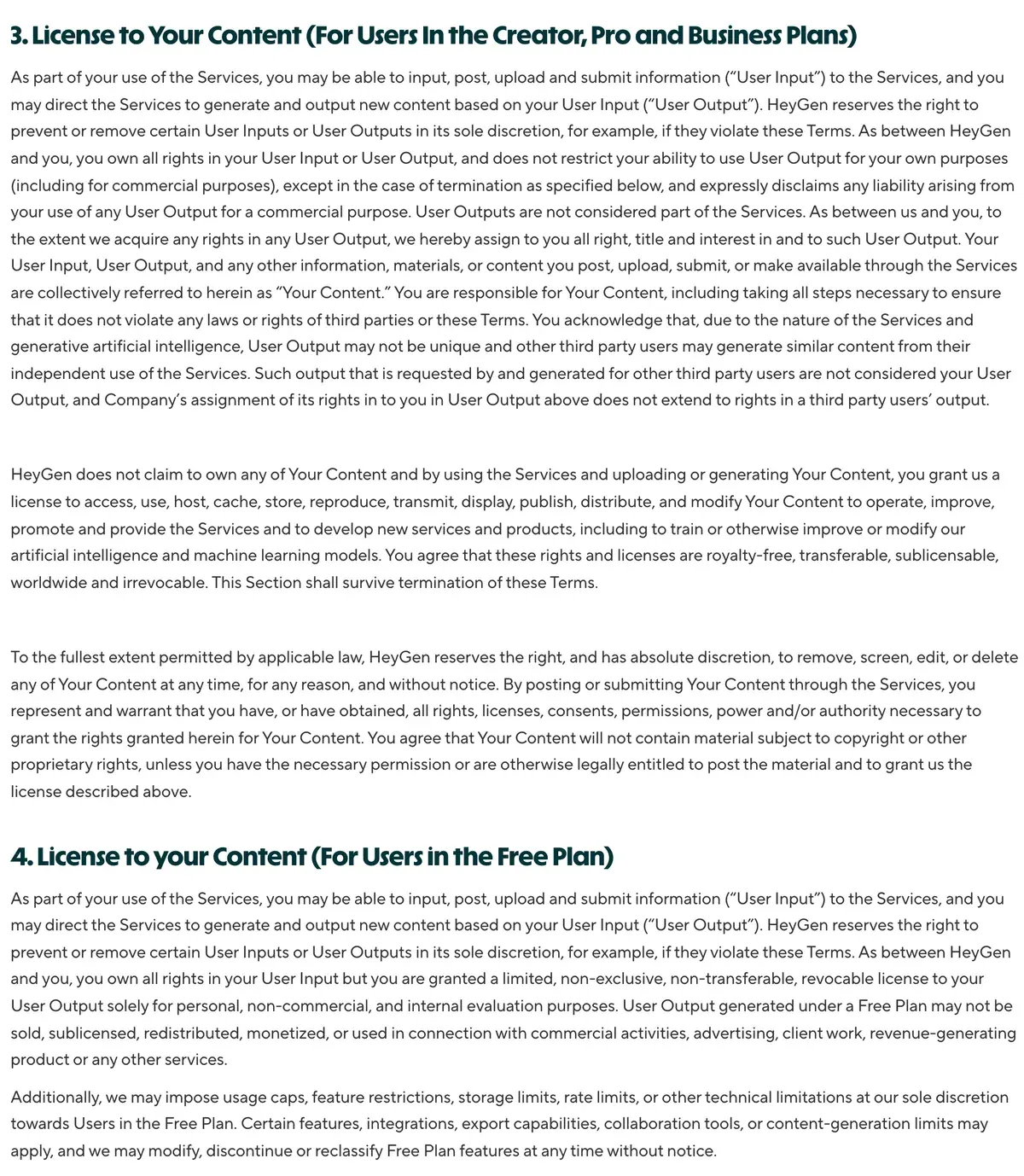
HeyGen’s terms (16 October 2026) give you ownership of output in section 3. Section 4 bars Free Plan output from use “in connection with commercial activities, advertising”. The same section 3 lets HeyGen use your content “to train or otherwise improve or modify” its models. Revid’s privacy policy says it does not use your content “to train general-purpose AI models”.
Both need a real person’s consent before you use their likeness. Revid’s terms ask for it before you use someone’s face or voice. HeyGen’s moderation policy asks for it before you build a custom avatar. Clause by clause: Revid and HeyGen in the AI commercial use matrix, and HeyGen’s terms for ads.
Revid posts for you; HeyGen hands you the file
Revid publishes to four social apps itself. HeyGen stops at the finished file, which you post or pass to an automation tool.
Revid’s terms (Automation and Publishing to Third-Party Platforms) say its tools “can run and publish while you are not signed in”. You stay responsible for each post and each platform’s rules. The terms also warn that a scheduled post can be delayed or fail when a platform is down or revokes access. Check that the important ones went out.
Every Revid plan includes the API, an MCP server and a CLI, its pricing FAQ says. An MCP server is a link that lets an AI assistant drive the tool. The terms tie all three to an active plan, with rate and daily limits.
HeyGen’s pricing page lists no social posting. It names Zapier, Make, n8n and HubSpot as integrations, and links its API to a separate pricing page.
HeyGen’s free videos are barred from ads
HeyGen’s free plan gives up to three watermarked videos a month, each up to a minute. Section 4 of its terms bars those videos from advertising, so a test ad needs Creator or above.
Revid has no free plan. New accounts get free credits without a card (pricing FAQ), and the terms set no separate ad rule for them.
Unused credits behave differently too. Revid’s plan credits reset each month and never stack; its Credit Boost packs never expire. HeyGen’s monthly plans roll unused credits over for one more month.
If neither fits
For avatar and product ads made from a URL, Creatify adds an ad agent that launches to Meta, Google Ads and TikTok in the same tool. For captioning and editing your own footage on a phone, with Mirage actors beside it, Captions fits.
Every HeyGen replacement by job: HeyGen alternatives. Presenter tools side by side: AI spokesperson video generators. Tools that turn a product link into a video, Revid’s other route in: URL to video AI tools. More head to head: Creatify vs HeyGen.
Questions buyers ask about Revid and HeyGen
Does Revid use HeyGen?
For some avatars. Revid’s privacy policy (25 October 2026) lists HeyGen, Hedra, Sync and Sieve as the providers behind its talking avatars and lip sync. It does not say which feature uses which provider.
Can Revid post to TikTok for you?
Yes. Revid’s pricing page says every plan includes publishing to TikTok, Instagram, YouTube and X. Growth adds three Auto-Mode workers, scheduled jobs that make and post videos on their own.
Is Revid free?
No. Every plan is paid, from $39 a month (pricing). New accounts get free credits to try generation, with no card at sign-up.
Sources
- Revid: Revid pricing, plan cards and FAQ: Growth’s 2,000 AI credits, 40 to 80 credits for a typical 30-second video, Auto-Mode workers, free credits without a card. Checked
- Revid: Revid Terms of Service, last updated 25 October 2026; Copyright and Content Ownership, Automation and Publishing to Third-Party Platforms, credits, refunds, API. Checked
- Revid: Revid Privacy Policy, last updated 25 October 2026; the providers behind talking avatars and lip sync, and the training line. Checked
- Revid: Revid vs HeyGen, the vendor’s own comparison, marked facts checked November 2026. Checked
- HeyGen: HeyGen pricing, Creator’s and Pro’s monthly prices and credits, the free plan’s limits, rollover, integrations and the separate API pricing page. Checked
- HeyGen: HeyGen Terms of Service, last updated 16 October 2026; sections 3 and 4. Checked
- HeyGen help centre: How to use credits on HeyGen, credits a minute by avatar model and Look. Checked

Alexandre S.
Alexandre S. is a creative ad strategist and copywriter with ten years' experience in digital marketing across multiple channels.
Related pages
-
 Category Best AI UGC generators for ads
15 AI UGC and avatar tools compared on list price per video and ad-use terms, checked 24 September 2026.
-
 Profile HeyGen for UGC ads
HeyGen’s free-plan videos may not be used in ads, and a 30-second video costs 2 to 24 credits by avatar model. Plans, terms and bans, checked 24 September 2026.
-
 Pricing HeyGen pricing
HeyGen Creator is $29 a month, so a 30-second ad costs $0.10 to $1.16 if all 600 credits are used. Free plan bars ads. Checked 24 September 2026.
-
 Alternatives HeyGen alternatives
Avatar tools that could replace HeyGen for ads, compared on cost per 30-second ad and whether paid social ads are allowed, prices checked 24 September 2026.
-
 Compare Captions AI vs HeyGen
Captions bars ad scripts that do not reflect your honest views; HeyGen bars passing output off as human-made. Cost per ad and terms, checked 2 October 2026.
-
 Compare Creatify vs HeyGen
A 30-second avatar ad costs $2.73 on Creatify Standard and $0.10 to $1.16 on HeyGen Creator, if every credit is used. Ad terms checked 2 October 2026.


