AI Video Bootcamp: what the Skool course teaches about AI ads
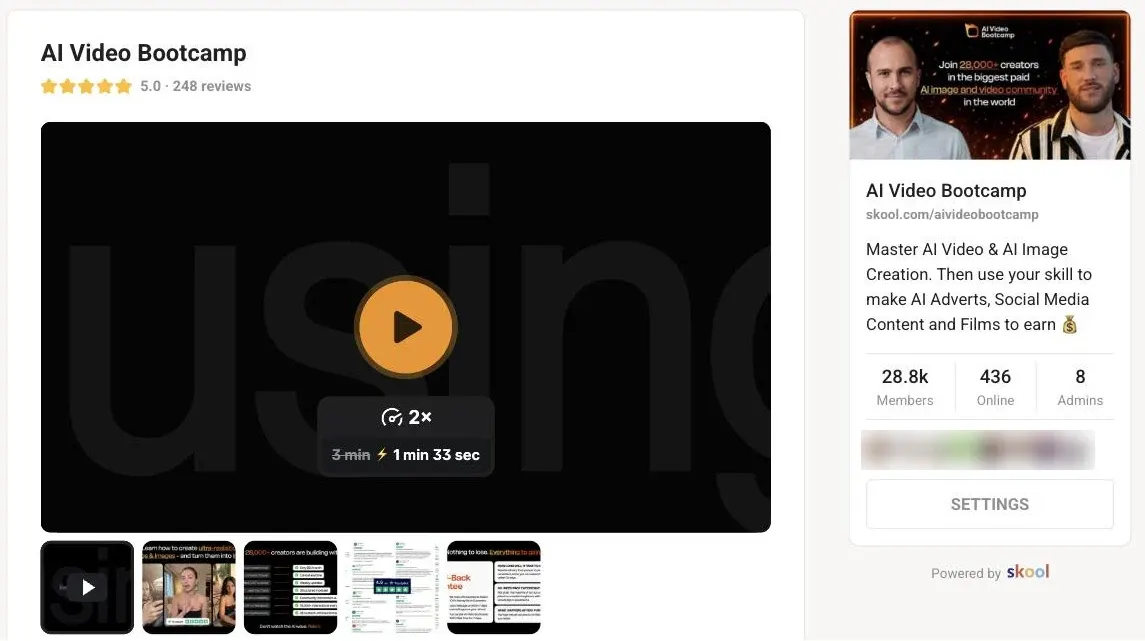
AI Video Bootcamp is worth $9 a month if you want a set route from AI images to finished AI ads, and less so if you already ship AI video ads every week. It is a paid Skool community run by Daniel Riley, with 11 phases, 122 lessons and 92 PDF guides in its classroom when we archived it on 30 September 2026.
New members pay $50 a month once the group reaches 28,900 members, the about page says, and members who join before then keep $9 “for life”. The group had 28.8k members on 2 October 2026, about 100 short of that line. On a recorded members’ call in February 2026, co-founder Matt said the team was “keeping that fifty dollar price point on the landing page” but did “not know if we will be raising the price”.
| Item | What the page shows |
|---|---|
| Price | $9 a month, cancel any time; $50 a month for new members from 28,900 members |
| Lifetime option | Golden Ticket, $89 once, “Lifetime Access To The Community”: the price of 9.9 months at $9 or 1.8 months at $50 |
| Members | 28.8k, 8 admins |
| Classroom | 11 phases, 122 lessons, 92 PDF guides, plus level courses 2 to 9 that unlock as members earn points |
| Main tools taught | Nano Banana Pro, GPT Image 2.0, Seedance 2.5, Kling 3.0, Veo 3.1, ElevenLabs, CapCut, mostly run through PromptWise |
| Member rating | 5.0 from 248 reviews on Skool; 4.8 from 82 on Trustpilot |
Scroll sideways for all 2 columns
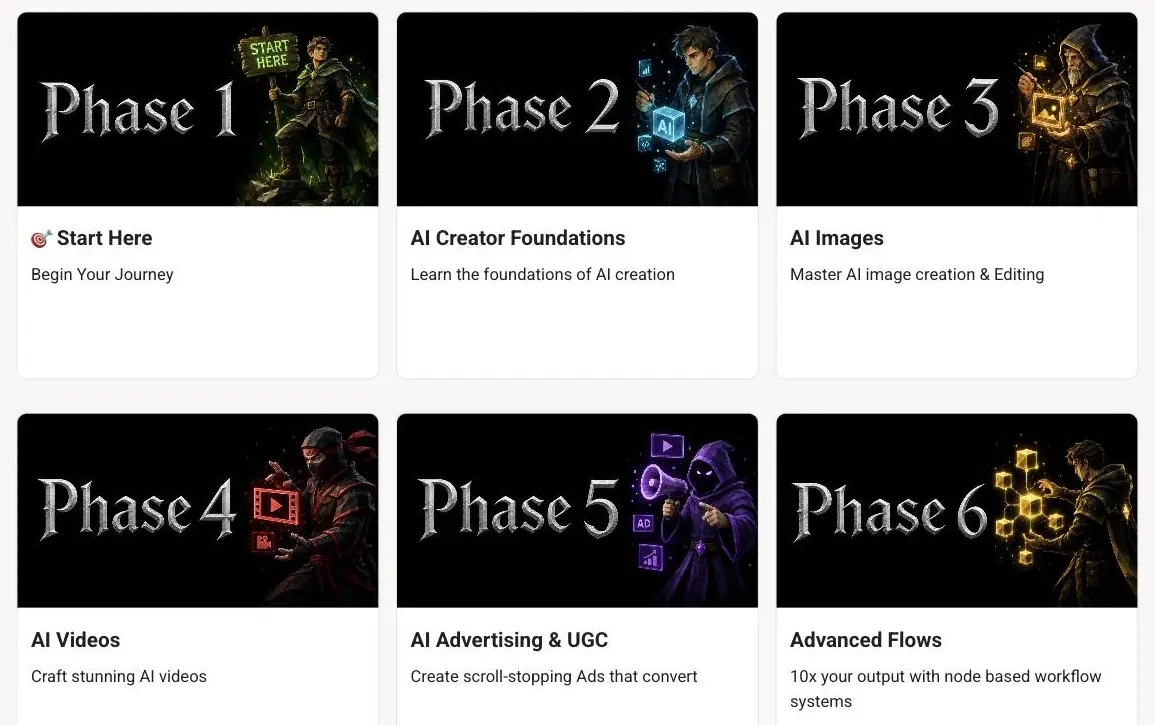

What does AI Video Bootcamp teach, phase by phase?
AI Video Bootcamp moves from still images to video to paid ads, then to social growth, short films, AI clones and client work. The table counts what Phases 2 to 11 held on 30 September 2026, when we saved every lesson page, transcript and attached PDF from a paying member account.
Phase 3 has the most PDF guides (25) and 115 example images across its lessons; Phase 7 has the most lessons (23). Phase 5 is the one for anyone making ads.
| Phase | What it covers | Lessons | PDF guides |
|---|---|---|---|
| 1. Start Here | Roadmap and where to begin | Not counted | Not counted |
| 2. AI Creator Foundations | Tools, credits, prompt structure, JSON prompts | 10 | 14 |
| 3. AI Images | AI avatars, realism, Nano Banana edits, lighting, camera angles, three prompt banks, 4K upscaling | 21 | 25 |
| 4. AI Videos | Video models, lip sync, voice, camera movement, CapCut editing, sound | 14 | 24 |
| 5. AI Advertising & UGC | Ad strategy, avatar ads, podcast ads, 2D animation and claymation ads, brand ads, static ads | 16 | 17 |
| 6. Advanced Flows | Node workflows, multi-shot video, MCP set-ups | 10 | 7 |
| 7. Social Media & Going Viral | Niche channels and formats, one niche per lesson | 23 | 5 |
| 8. AI Filmmaking | Scripts, shot lists and short films | 9 | 0 |
| 9. Clone Yourself | An AI twin of your face and voice | 12 | 0 |
| 10. “Live Calls + Monetization Extras” | Recorded calls on pricing AI work and starting an agency | 6 | 0 |
| 11. Earn Affiliate Commissions | The group’s referral link, 50% recurring commission | 1 | 0 |
Scroll sideways for all 4 columns
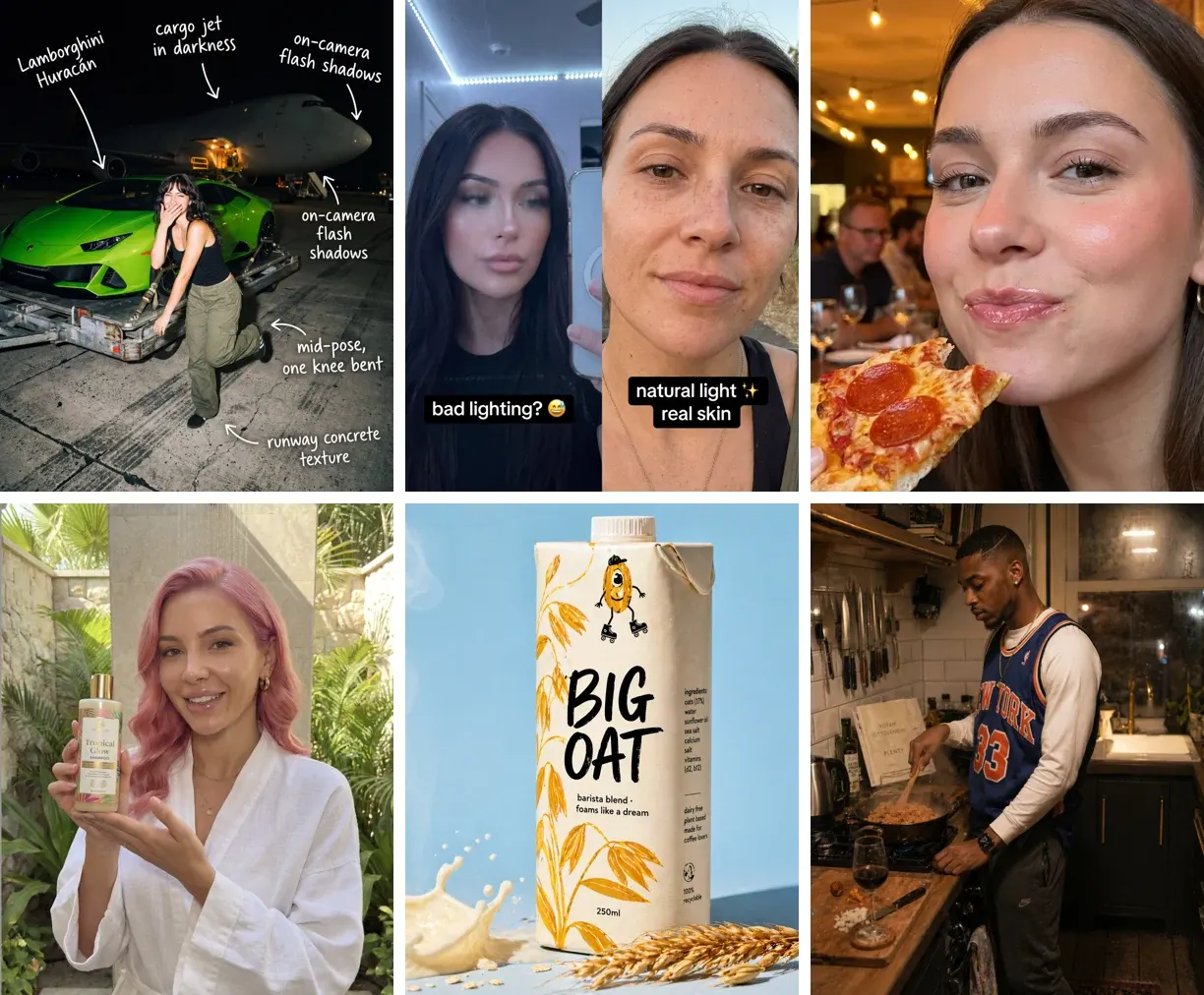
What the AI advertising phase teaches
Phase 5, “AI Advertising & UGC”, teaches a full avatar-ad pipeline in 16 lessons, from the brief to the CapCut edit. Its lessons include Insane Avatar Adverts, Avatar Ads on Autopilot, Podcast Ads and Claymation Ads. Two more build complete brand ads, one for Nike and one for a car.
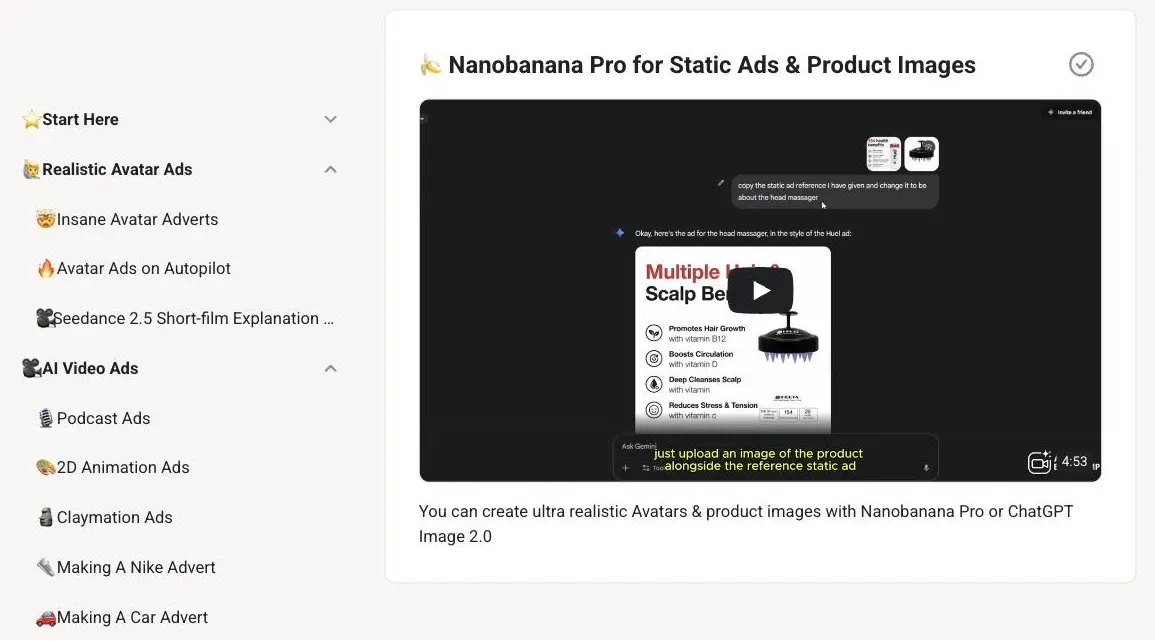
Five methods from Phase 5, as the lessons teach them:
- Strategy comes before prompts. Each ad starts from three answers: who it is for, what they already know, and what the ad must do (awareness, conversion or retargeting). One audience, one desire, one message per ad.
- The reference photo decides realism. The lessons call the avatar’s reference image “by far the most important thing”, and regenerate it until it no longer reads as AI before any video is made.
- An avatar ad takes four steps. Make the character image in GPT Image 2.0 or Nano Banana Pro. A chat model writes the Seedance prompt from a master prompt. Seedance 2.0 generates 15-second clips, and CapCut cuts out the glitches; a later lesson repeats the method on Seedance 2.5.
- Long ads are built from 15-second parts. A 30, 45 or 60-second ad is written as separate parts with one job each. The hook comes first, then the product in use, a proof or an objection, and last the payoff with a soft call to action.
- The script is sized to the clip. Veo 3.1 takes about 22 words per 8 seconds, and the premium voiceover in PromptWise’s UGC Factory 36 to 40 words per ad. Too many words and the voice speeds up; too few and the model fills the gap.
The podcast-ads lesson builds on what it calls “overheard authority”. The clip looks cut from the middle of a longer talk between a host and an expert, with fast cuts and one locked reference photo per speaker.
The phase’s UGC and B-roll master prompts close on the same list of musts. It asks for 9:16, a handheld phone, natural light, pores and skin texture, and the product kept exact. Music and on-screen text go in at the edit.
Phase 5 shows finished ads and no performance data. Every claim about what converts is the instructors’ view.
What the image and video phases teach
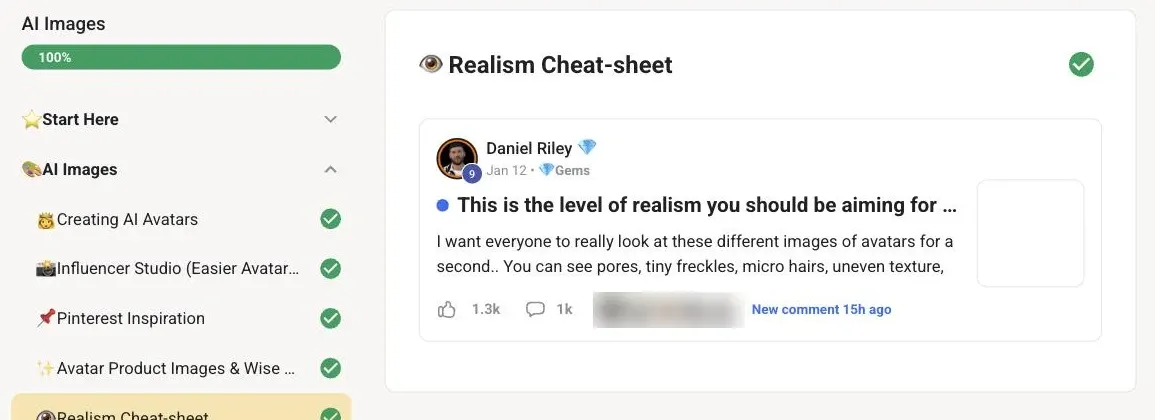
Phase 3 teaches photo-real AI people, the base of every avatar ad in the course. Its lessons cover AI avatars, product images held by avatars and a Realism Cheat-sheet. Then come edits in Nano Banana and Canva, lighting and camera angles, and three prompt banks, one of them for UGC avatars.
Phase 4 turns those stills into video. It compares video models and covers lip sync and voice changing in ElevenLabs. It gives a camera-movement vocabulary, then ends with editing and sound in CapCut.
Lessons carry update notes where a newer model replaces an older video. The archive mixes 2026 lessons on Seedance 2.5, Kling 3.0, GPT Image 2.0 and Nano Banana Pro with 2025 videos on Midjourney, Kling 1.6 and Hailuo. Phase 3 marks Midjourney as optional.
What the Phase 3 methods produce
The author of this page made the five images below after working through Phases 1 to 3, using the methods those lessons teach. Each prompt names who holds the camera and from how far, sets a place and a time of day, and names one light source with its direction.

- The car snapshot is written as a mother’s 35 mm photo from the driver’s seat of a car parked on the seafront at Bora Bora, French Polynesia, about a metre from the boy, dated 26 December 1998, which gives the date stamp, the film colour and the steering wheel soft in the corner.
- The farm walk is written as a family member’s phone photo in low sun, with the eyes, skin and hands of a six-year-old and a man in his nineties described feature by feature.
- The old man’s windblown hair was a second pass that edits one thing and keeps “every other pixel in the image kept exactly as it is”, the one-change edit pass the Phase 3 image-editing lessons teach.
- The grandmother is shot from the open doorway, lit only by a floor lamp and the television, with the room dated by her own furniture: a 1970s sideboard, a carriage clock, a riser-recliner.
- The boulderer is written as a sports photograph at the far point of a swing, both feet off the wall, every hand position placed hold by hold.
- The dim sum shot places the phone twenty centimetres above the table, the food in the lower two thirds and the street soft in the top third.
What do members say about AI Video Bootcamp on Skool and Trustpilot?
AI Video Bootcamp held 5.0 from 248 member reviews on its Skool about page on 2 October 2026. On Trustpilot it held 4.8 from 82 reviews, 94% of them five stars and 2% two stars.
Skool prints each reviewer’s membership length under the review. On 2 October the newest ones read “Still a paying member after 10 months”, “after 10 days” and “after 1 day”. One reviewer of 10 months wrote that they “LOVE how it stays up to date with the newest and latest model deployments”.
On Trustpilot, praise centres on how practical and active it is. A 24 July 2026 reviewer wrote “I don’t expect something this decent in this price”.
Two of the 82 Trustpilot reviews give two stars. The two (1 and 16 April 2026) call it basic and say similar material is free online.
What to know before you join
Three facts about AI Video Bootcamp shape what you get for the price.
- Many lessons run on PromptWise. The lessons present PromptWise as the team’s own platform, and its homepage links the bootcamp. The AI Insider Edge review places both under ZeroTen Media Inc. The methods carry over to Kling, Seedance or Veo bought direct. Tool picks and price comparisons in the lessons come from a company that sells one of the tools. Our PromptWise profile has its plans and terms.
- Some courses open by level. Courses for levels 2 to 9 stay locked until a member earns points from likes on posts and comments, the standard Skool mechanic.
- A few lessons are titles only. On 30 September 2026, three of the six Phase 10 lessons had no video or text: starting an agency, client acquisition and community ideas. Two Phase 7 niche lessons, Stadium Cam and Live Filmset, were empty too.
Is AI Video Bootcamp worth it?
AI Video Bootcamp suits someone who wants a set route from zero to finished AI ads. It gives prompts to copy and a community that answers questions, for less a month than PromptWise’s cheapest plan. Following the lessons inside PromptWise adds $19 a month a month on its Starter plan.
Best for:
- Media buyers and freelancers adding AI UGC and avatar ads to their offer, through Phase 5
- Beginners who want an order to learn in, from still images to video to ads
- Anyone choosing between Seedance, Kling and Veo who wants the trade-offs explained with examples
Skip it if:
- You already ship AI video ads every week: both two-star reviews call it basic and say similar material is free online
- You want performance data on AI ads: the course shows finished ads and no results
- You want nothing to do with PromptWise: much of the step-by-step is filmed inside it
Join AI Video Bootcamp on Skool Paid link at $9 a month while the group is under 28,900 members (28.8k on 2 October 2026).
Questions about AI Video Bootcamp
How much does AI Video Bootcamp cost?
$9 a month on 2 October 2026. Members who join before the group reaches 28,900 keep it “for life”; after that the about page says new members pay $50 a month. A Golden Ticket card in the classroom sells lifetime access for $89.
Who runs AI Video Bootcamp?
Daniel Riley, named as the owner on the Skool about page, with co-founder Matt hosting the recorded live calls in Phase 10. The group lists 8 admins.
Do you need to pay for AI tools as well?
Yes. The course teaches paid tools (Nano Banana Pro, Seedance, Kling, Veo, ElevenLabs), most of it inside PromptWise, whose plans start at $19 a month a month.
Is AI Video Bootcamp good for beginners?
Yes. Phase 2 starts with tools, credits and prompt structure, and Phase 3 builds AI avatars from there. The about page calls it “Perfect for complete beginners or experienced creators”; both two-star reviewers found it basic, so a working editor may find Phases 2 to 4 familiar.
Sources
- Skool: AI Video Bootcamp, about page, price, member count, the $50 a month threshold, the list of what is inside and 248 member reviews. Checked
- Skool: AI Video Bootcamp, classroom, members only; the phase cards, lesson lists, the Golden Ticket card and the level courses, read from a member account. Checked
- Trustpilot: AI Video Bootcamp reviews, 4.8 from 82 reviews, 94% five stars and 2% two stars, with the two-star reviews of 1 and 16 April 2026. Checked
- PromptWise: PromptWise homepage, the academy block that links AI Video Bootcamp. Checked
- AI Insider Edge: PromptWise review, places AI Video Bootcamp and PromptWise under one parent company, ZeroTen Media Inc. Checked
What changed on this page
- Page written, with five images the author made after the course.

Alexandre S.
Alexandre S. is a creative strategist and copywriter with ten years in content and SEO. He writes and edits short-form ads, works in English and French, and reads the pricing and terms pages behind every tool on this site before anything is written about it.
Related pages
- Category Best AI video generators for ads
23 AI video generators and model shops compared on cost per clip and ad-use terms, checked 25 September 2026.
- Profile PromptWise for ad video
PromptWise Starter: $19 a month for 36 Kling 3.0 clips, about $0.53 each if every credit is used. Pro’s IP cover excludes them. Prices checked 1 October 2026.
- Profile Seedance AI for ads
Dreamina’s general (non-US) terms bar Seedance clips in ads unless other terms allow it. Where to use Seedance 2.5, cost per second by route, user reports.
-
 Guide Skool for an AI course or community: Hobby or Pro?
Skool costs $9 a month plus 10% of sales, or $99 plus 2.9%, and 30 cents a payment on both. Pro costs less above $1,268 a month. Checked 2 Oct 2026.
- Guide AI UGC meaning: what is AI UGC?
AI UGC is ad video made or edited with AI to look like a customer or creator filmed it. Its two meanings, and vendor terms on passing it off as human.
- Guide Are AI UGC ads legal? FTC rules and likeness rights
The FTC’s fake-testimonial rule reaches an AI actor who claims to have used the product. That rule and US state and EU laws, quoted with dates.


