Amazon ACoS: what it is, how to work it out and your break-even figure
ACoS (advertising cost of sales) is the share of your ad-driven sales that you spend on the ads themselves. Amazon works it out as ad spend divided by the sales its ads bring in, times 100.
A 25% ACoS means you spent one dollar on ads for every four dollars of sales those ads produced. Whether that is good depends on one number: your profit margin before ads. When ACoS runs above that margin, each ad sale loses money.
| Metric | Formula | Answers |
|---|---|---|
| ACoS | Ad spend ÷ ad sales × 100 | What do my ads cost per dollar they sell? |
| TACoS | Ad spend ÷ total Amazon sales × 100 | What do ads cost the whole business? |
| ROAS | Ad sales ÷ ad spend | How many dollars come back per ad dollar? |
Scroll sideways for all 3 columns

What ACoS means on Amazon
Amazon’s own ACoS guide gives the formula as “ACOS = (ad spend ÷ ad revenue) x 100”. Its example: spend $50 and earn $100, and your ACoS is 50%.
What is advertising cost of sales (ACOS)?
Advertising cost of sales (ACOS) is a metric that measures ad spend and ad revenue.
Formula ACOS = (ad spend ÷ ad revenue) x 100
Example if you spent $50 on an ad campaign and earned $100 from it, your Amazon ACOS would be 50%.
Profit In order to maintain a profit, your Amazon ACOS needs to be lower than your profit margin.
Ad revenue here means sales Amazon credits to your ads, mostly after a click. On Sponsored Products and Sponsored Brands you pay per click (PPC, pay-per-click). Sales from shoppers who found you in normal search are left out.
ROAS (return on ad spend) is the same fraction turned upside down. Amazon calls it “the inverse of Amazon ACOS”. So 25% ACoS is a ROAS of 4, and 50% is a ROAS of 2.
The ACoS formula, worked in dollars
Take one month and three Sponsored Products campaigns for the same brand.
| Campaign | Ad spend | Ad sales | ACoS | ROAS |
|---|---|---|---|---|
| Brand keywords | $300 | $2,000 | 15% | 6.7 |
| Generic keywords | $1,500 | $5,000 | 30% | 3.3 |
| Automatic targeting | $800 | $1,600 | 50% | 2.0 |
| All three | $2,600 | $8,600 | 30.2% | 3.3 |
Scroll sideways for all 5 columns
The account reads 30.2%, close to the 28.4% median in Eva Commerce’s study below. The campaign rows tell a different story: the brand campaign earns, and automatic targeting spends half of what it brings in. That is why you read ACoS per campaign, and then per keyword.
Break-even ACoS: work it out from your margin
Amazon’s guide puts it plainly: “In order to maintain a profit, your Amazon ACOS needs to be lower than your profit margin.” Your break-even ACoS is your margin before ads, as a percentage of the selling price.
Say a product sells for $30. The product, Amazon’s referral fee and the FBA fee together cost $18. That leaves $12, or 40% of the price.
So 40% is your break-even ACoS. At 40%, each ad sale pays for its own click and nothing more. At 50%, every ad sale loses ten points of the price.

Your target ACoS is break-even minus the profit you want to keep. Want 15 points of profit on ad sales? Aim for 25%. In ROAS terms, the break-even is 1 divided by 0.40, a ROAS of 2.5.
Run this per product. A 40% margin item and a 20% margin item in one campaign cannot share one ACoS target.
What is a good ACoS on Amazon?
Below your break-even, first. Amazon’s guide says “There isn’t a definitive number for a good Amazon ACOS” and names industry, company size and campaign frequency as variables.
For a dated outside figure, Eva Commerce’s October 2026 study covers 150 US brand accounts it works with, from 27 July to 24 October 2026. That window includes Prime Big Deal Days. The median ACoS was 28.4%. The middle half of brands sat between 23.8% and 33.7%.
| Ad type | Accounts | Median ACoS |
|---|---|---|
| Sponsored Brands | 146 | 26.7% |
| Sponsored Products | 150 | 27.7% |
| DSP | 47 | 31.8% |
| Sponsored Display | 134 | 38.3% |
Scroll sideways for all 3 columns
Eva notes that DSP figures usually count view-through sales: a shopper saw the ad, did not click and bought later. So DSP ACoS does not compare directly with Sponsored Products.
Three things move what “good” means for you.
The first is margin. A 60% margin product carries a 45% ACoS at a profit; a 25% margin product cannot.
The second is the product’s stage. In a launch you often accept an ACoS above break-even to win sales history and rank, then pull it down as organic sales grow. That trade only shows up in TACoS, which divides the same spend by all your sales. The TACoS guide covers how the two move together.
The third is the keyword type. Amazon’s keyword guide separates branded keywords (your brand’s name in the search) from generic ones (broader category words). A shopper typing your brand already knows you; one typing “dining chairs” is comparing. Read the two apart: a blended figure lets a strong brand campaign cover a weak generic one.
How to lower your ACoS
Every lever either cuts spend that does not sell or lifts sales from the same spend.
- Block wasted terms. Download the search term report and add terms with clicks and no sales as negative keywords. Amazon’s Sponsored Products guide recommends negative targeting to “exclude keywords and products that are not relevant”.
- Move winners to exact match. Put search terms that sell into a manual campaign on exact match, which Amazon says is “well suited for helping drive conversions”, and bid on them there.
- Cut bids above break-even. Lower the bid on any keyword whose ACoS sits over your break-even after enough clicks to judge.
- Fix the listing. Every extra sale from the same clicks lowers ACoS, so any listing change that turns more clicks into orders lowers it too.
Raising your margin does not lower ACoS, but it lifts your break-even, which gives the same ACoS more room.
The weekly routine behind these steps, and who can run it for you, is in the Amazon PPC management guide.
Where software fits
Doing the steps above by hand works for a small catalogue. PPC tools apply the same steps as rules, every day, across every campaign.
BidX lets you write if-then rules that move bids and keywords towards a TACoS target, with dayparting. Its Sponsored Ads page lists the automations.
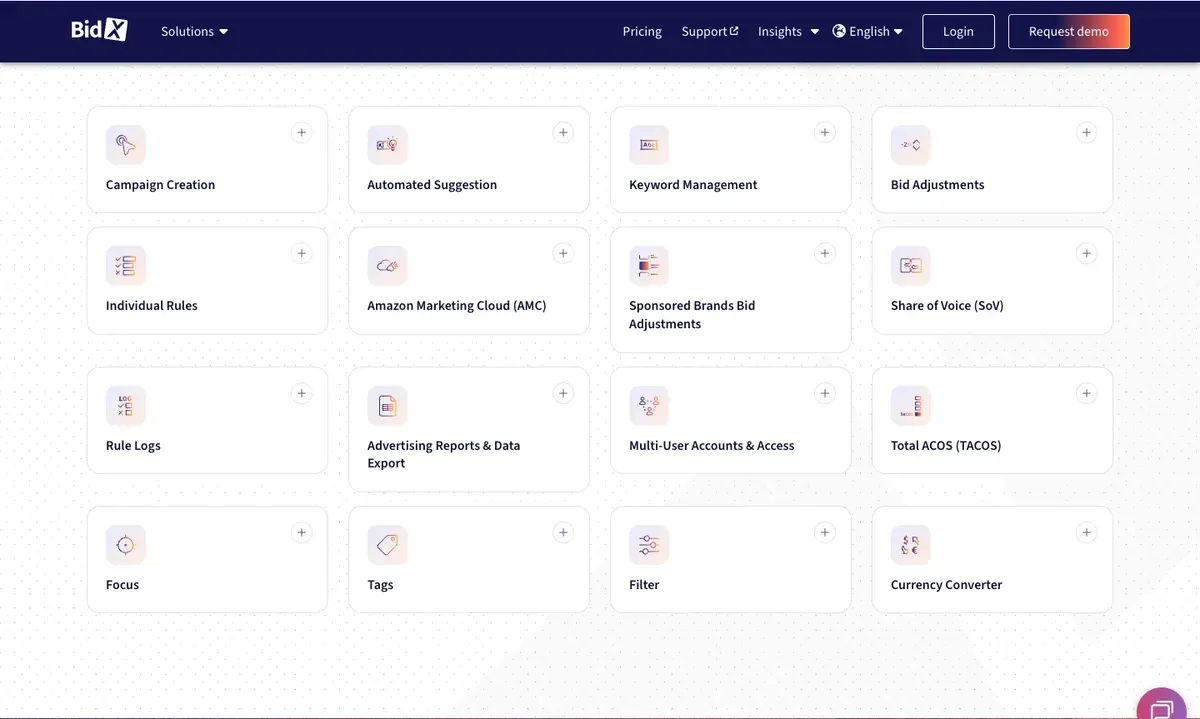
BidX fits sellers spending over $10,000 a month. The main plans run on a yearly commitment from $495 a month billed yearly plus a share of spend the pricing page leaves blank.
Want bid rules on a monthly bill? Helium 10 Ads runs rules-based and AI bidding on the Diamond plan at $359 a month plus 2% of all ad spend in each profile set to Managed. Under $10,000 a month, Teikametrics Essentials bids towards a goal for $179 a month billed monthly. The full price comparison is in Amazon PPC software.
Questions about Amazon ACoS
What is the ACoS formula?
ACoS = ad spend ÷ ad sales × 100. Spend $50 to sell $200 through ads and your ACoS is 25%.
What is a good ACoS on Amazon?
One below your margin before ads. In Eva Commerce’s October 2026 study of 150 US brands, the median was 28.4%, with the middle half between 23.8% and 33.7%.
How do I work out break-even ACoS?
Take the selling price, subtract product cost and Amazon fees, and divide what is left by the price. A $30 product with $18 of costs breaks even at 40%.
What is the difference between ACoS and TACoS?
ACoS divides ad spend by ad sales. TACoS divides it by all your Amazon sales, organic included, so it is never higher than ACoS.
Is a high ACoS always bad?
No. During a launch you may run above break-even on purpose to win rank. It is bad when it stays above break-even and total sales do not grow.
Sources
- Amazon Ads: What is advertising cost of sales (ACOS)?, Formula
ACOS = (ad spend ÷ ad revenue) x 100
, a 50 dollar spend on 100 dollars of sales giving 50%, ROAS as the inverse, break-even ACOS tied to profit margin, andThere isn’t a definitive number for a good Amazon ACOS
. Checked - Eva Commerce: The State of Amazon Ads for $1M to $20M Brands (October 2026), Published 26 October 2026. 150 Amazon US brand accounts Eva works with, 27 July to 24 October 2026; median ACoS 28.4% (25th percentile 23.8%, 75th 33.7%), median ROAS 3.53, medians by ad type and category. Checked
- Amazon Ads: Best practices for your Sponsored Products ads, Search term report, negative targeting to exclude terms that are not relevant, manual campaigns beside automatic ones. Checked
- Amazon Ads: How to start and improve your keyword strategy on Amazon Ads, Defines branded and generic keywords;
Exact match keywords are well suited for helping drive conversions
; no publication date shown. Checked - BidX: Amazon Sponsored Ads, BidX’s automation page for Sponsored Products, Brands and Display: bid, keyword and budget rules. Checked

Alexandre S.
Alexandre S. is a creative ad strategist and copywriter with ten years' experience in digital marketing across multiple channels.
Related pages
-
 Guide Amazon TACoS: how to work it out and what a healthy figure looks like
TACoS is your ad spend over total Amazon sales. The formula, a worked example, ACoS beside it and a 150-brand median of 10.6% (October 2026).
-
 Guide Amazon PPC management: the weekly work, and who should do it for you
Amazon PPC management done yourself, by software or by an agency: the weekly tasks, agency fees from two public price lists and a choice by monthly ad spend.
-
 Best list Best Amazon PPC software
Amazon PPC tools priced at two levels of monthly ad spend, flat fee or share of spend, beside Amazon’s free bid rules. Prices checked 9 November 2026.


