Creatify Ad Clone
Creatify Ad Clone takes an ad that already sells and rebuilds it for your product. You give it a link to the ad and a link to your product. It keeps the shape of the ad: the hook, the order of the scenes and the pace of the cuts.
Then it writes a new script and makes a new video with a new presenter.
Creatify publishes three different credit rules for the same feature. Its plan table lists Ad Clone on every paid plan, from Standard at $15 a month (read ).
What does Ad Clone keep and what does it change?
Ad Clone keeps the structure and replaces everything that belongs to the other brand. Creatify’s Ad Clone page says the agent “keeps its hook, beats and pacing and rebuilds it for your product, never their brand or lines”. A beat is one step of the ad, such as the problem, the demo or the offer.
Creatify’s help article was updated on 14 September 2026. It lists what the tool studies in the source ad. Those are the hooks and pacing, scene transitions, caption placement and voice-over timing, plus the visual story and how the product is shown.
| Part | What Creatify says |
|---|---|
| Source ad | A TikTok, Instagram or direct video link, or a file attached in Ad Agent. YouTube links don’t work |
| Your product | A product or app link, or a description of what you sell |
| Kept | Hook style, pacing, beat structure, call-to-action flow |
| Replaced | Brand, people, exact lines |
| Editable after | Product visuals, script, voice-over, branding and colours, music, captions, call to action |
Scroll sideways for all 2 columns
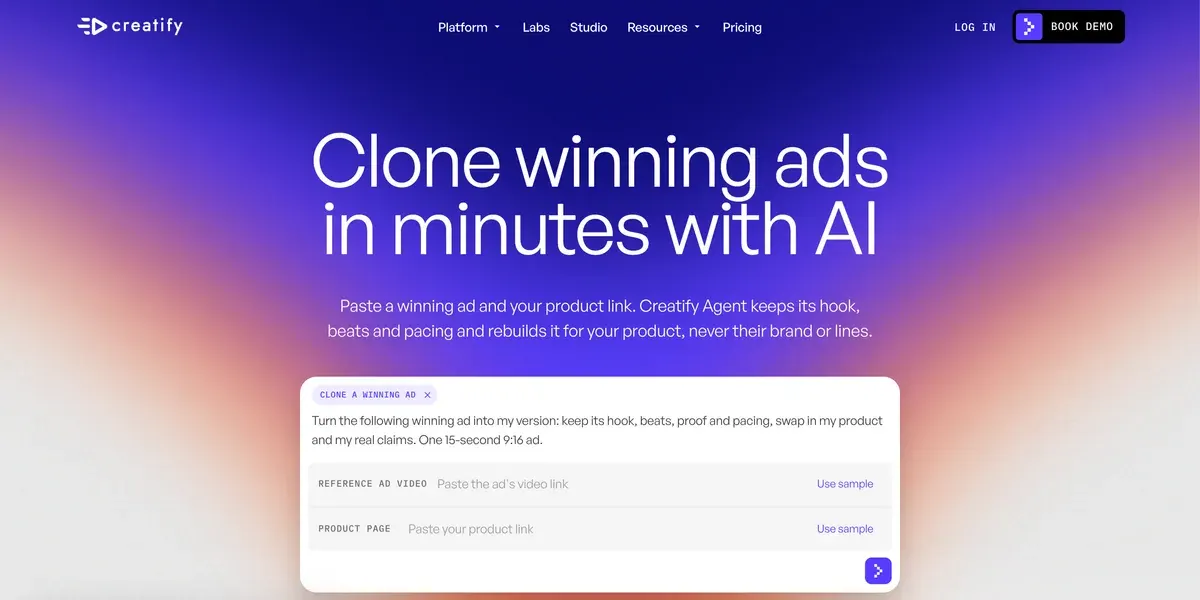
No source ad to hand? The Ad Clone page says the agent can search the Meta Ad Library for long-running ads itself. The same page lists vendor results under “Brands cloning their winning ads”, such as a 73% ROAS improvement for Designrr (Ad Clone page). Those are Creatify’s own numbers about its customers.
Which plan includes Ad Clone, and how many credits does it use?
The plan table lists Ad Clone under “All creation tools” on every paid plan, from Standard at $15 a month.
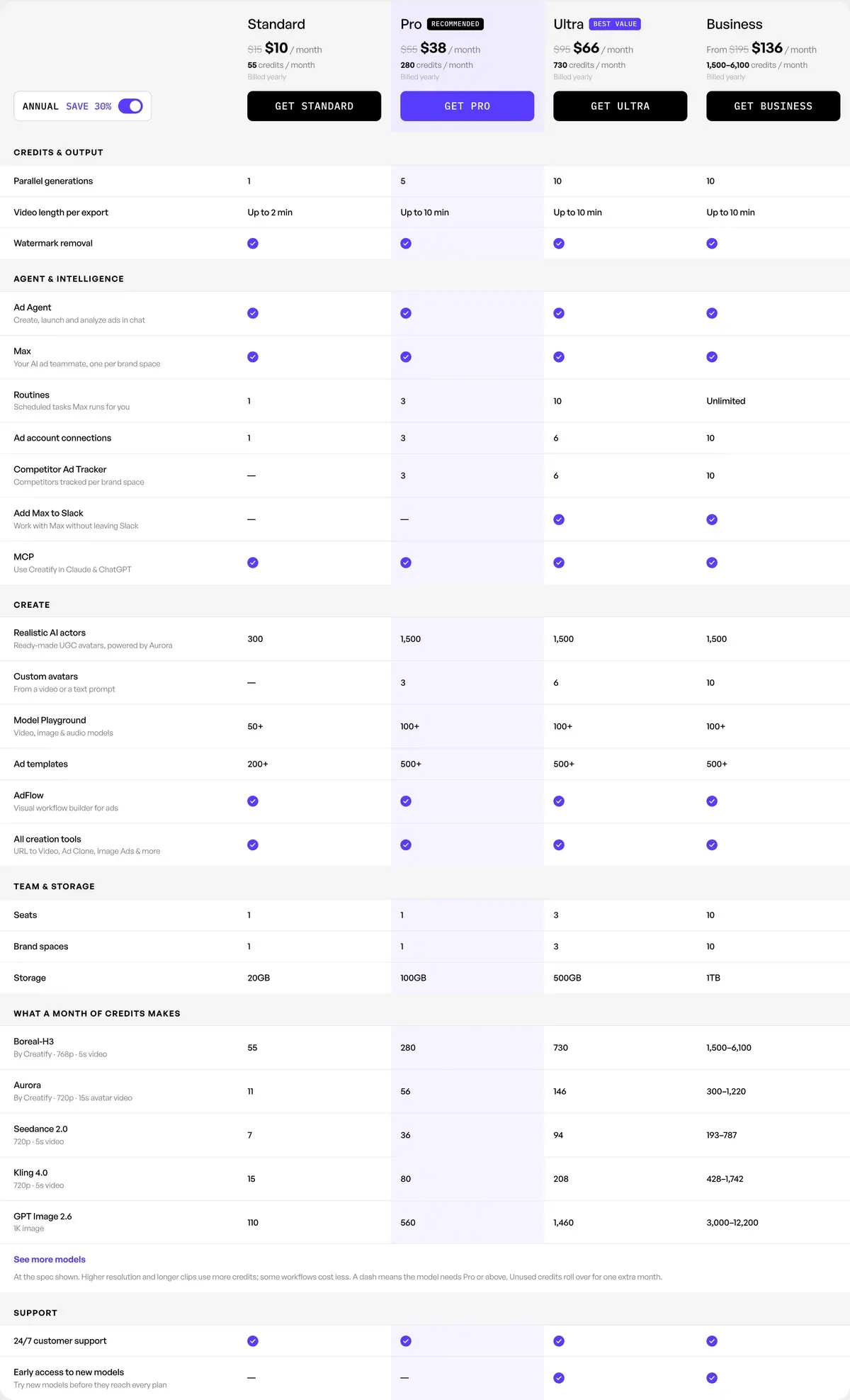
The plan table has no Free column. The Ad Clone page says the Free plan’s 10 credits are “enough for your first cloned video ad”, and free exports carry a watermark. At the FAQ’s rate of 1 credit a second, 10 credits cover a clone of up to 10 seconds.
Credits are the balance each plan refills every month, and every video spends some. Creatify’s pages give three rules for how many a clone spends. The FAQ is dated 20 September 2026, and the credit article was updated on 19 August 2026.
| Page | Rule | 30-second clone |
|---|---|---|
| Help centre FAQ | “1 credits for every second of video length” | 30 app credits, $5.89 on Pro |
| Credit article | Ad Clone follows the Agent, whose use “cannot be determined upfront” | No figure |
| API docs | 12 credits per 5 seconds of the reference video | 72 API credits, $14.26 on API Starter |
Scroll sideways for all 3 columns
Read the table this way. In the app, the per-second rule is the figure Creatify prints, and the credit article says the real draw moves with what the agent does. The help article agrees: “Credits consumption varies.” So a clone uses a number of credits you learn when it runs.
Users notice: 15 of 61 public sources say credits run out faster than the pricing suggests, with retries, failed renders and agent runs all billed (Trustpilot, Reddit).
The API is the route software uses to order videos without opening the app, on plans of its own from $99 a month. It bills by the length of the ad you copy, so a 15-second source costs half a 30-second one.
At 30 app credits a clone, Pro’s 280 monthly credits make nine clones with 10 credits left for a revision. That count assumes the FAQ rate holds. More on what each plan holds: Creatify pricing.
How to clone an ad with Creatify, step by step
- Find the source ad. The free Meta, TikTok and Google libraries show what any brand runs. An ad that has run for weeks is one its owner keeps paying for. How to see competitor ads covers each library. Your own best ad works too.
- Copy its link. A TikTok, Instagram or direct video link goes straight in. A YouTube find needs the video file, which you attach in Ad Agent.
- Open Ad Clone on any paid plan, or on Free for a first short clone. Creatify’s help pages name two routes in. The Ads Clone article (updated 14 September 2026) says cloning runs through AdFlow, its template workflow. The credit article (updated 19 August 2026) says Ad Clone opens the Agent.
- Add your product link, or describe the product in a sentence or two.
- Read the agent’s explanation and the new script. The page says the agent first works out why the ad works, then writes your script on the same structure. Check every product name and claim here, before you spend credits on the render.
- Ask for changes in the same chat: a new hook, another presenter, a different voice, captions or other sizes.
- Check what the export carries, using the next section, then export.
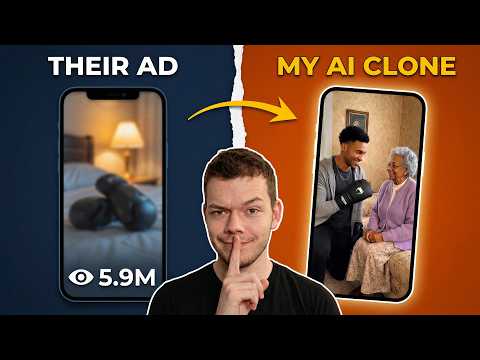
Step 5 matters because of what users report. The largest complaint about Creatify is output that misses the brief, such as wrong product details or a mismatched voice (17 of 61 sources: Trustpilot, Trustpilot).
What is safe to copy from another brand’s ad?
The idea behind an ad is free to reuse, and the material in it belongs to someone. The US Copyright Office’s Circular 33 quotes the law’s exclusion of “any idea, procedure, process, system, method of operation, concept, principle, or discovery”.
The UK government’s copyright page says the same in plainer words: “Copyright does not protect your ideas. It protects how you have expressed that idea in a fixed format.”
An ad’s structure, pacing and hook type are ideas and methods. The film, the music and the written script are the fixed format.
| Part | Reuse? | The rule |
|---|---|---|
| Beat order and pacing | Yes | A method; Circular 33 excludes methods and systems |
| Hook type (“I tried every…”) | Yes | A form of opening; short phrases are not registrable under Circular 33 |
| Footage and stills | No | Videos and recordings are covered by copyright (business.gov.uk) |
| Music | No | Meta asks for licences for the recording and the composition |
| Logo, product name, slogan | No | Circular 33 says names and slogans may be protected by trademark law; in the UK, a registered trade mark lets its owner act against anyone using the brand without permission |
| The exact script | No | Written words in a fixed format are covered by copyright |
| The actors’ faces and voices | No | Using a real person’s likeness or voice in an ad needs their consent under laws such as California’s Civil Code 3344, and they agreed to appear for that brand only: AI UGC and the law |
Scroll sideways for all 3 columns
Meta enforces its side. Its third-party infringement policy says ads “may not contain content that violates the intellectual property rights of any third party”. It adds: “If your ad contains music you are required to secure the necessary licenses”. Its copyright and trademark page says an ad can be rejected after a rights holder reports it.
Copyrights and Trademarks
Infringement Ads may not contain content that infringes upon or violates the intellectual property rights of any third party
Not allowed Advertisers can’t run ads that: Promote or sell counterfeits, knockoffs, or replicas of another company’s products. Are likely to confuse people about the source, sponsorship or affiliation of the goods or services.
Creatify’s own Moderation Policy bans “intellectual property violations”. Its terms (effective 23 September 2024) treat a breach of that policy as a breach of the licence (section 6.1). On a breach, “all rights granted to you shall revert to Creatify” (section 6.2).
So a clone that reuses another brand’s slogan puts your Creatify licence at risk, and the ad too.
Two checks before export, then. Replace any music that matches the source ad with a track you hold a licence for. And read the new script against the old one line by line: a sentence that survived word for word is the other brand’s.
Three ad structures worth cloning
The first is the talking-head problem and fix. A presenter names a daily annoyance in the first seconds, shows the product solving it, then gives the offer. It clones well because each beat maps to one line of your own product’s story.
The second is the numbered list: “three reasons I switched”, one reason per cut. The beats are equal in length and self-contained, so the agent can swap each reason for one of yours without breaking the rhythm.
The third is the side-by-side: the old way on the left, your product on the right, or a before and after. It works when your product has a visible result. When it has none, the clone shows two shots that look the same.
Here is the first structure carried from one product to another, beat by beat. A stain-spray ad becomes a lint-roller ad. The timing and the order of proof move across; every word and every shot is new.
| Seconds | Source ad (stain spray) | Clone (lint roller) |
|---|---|---|
| 0 to 3 | Presenter holds up a stained white shirt: “This was ruined. Watch.” | Presenter holds up black jeans covered in dog hair: “One walk with my dog. Watch.” |
| 3 to 10 | Two cheaper sprays leave the stain | A sticky roller tears and clogs |
| 10 to 22 | One spray, one wipe, a close-up of the clean shirt | Three strokes, a close-up of the clean jeans |
| 22 to 30 | The offer and the link | The offer and the link |
Scroll sideways for all 3 columns
The hook line keeps the source ad’s length, so the demo lands at the same second.
Each of these has worked examples in UGC video examples, which breaks real ads down by hook and beat.
How to test the clone against the original
You can’t run a competitor’s ad in your account, so the test is the clone against your own current ad. Use your platform’s split test, or put both in the same ad set. Keep the budget, audience and offer the same, so the creative is the one thing that differs.
Creative testing tools shows how each platform runs that split for free.
When the source is your own winner, run the original and two or three clones side by side. That tells you whether the structure was doing the work or the particular presenter was.
Hook rate is the share of impressions where someone watches the first three seconds (3-second plays divided by impressions). Judge each pair on hook rate and cost per result only once both ads have had the spend the budget maths sets for a read. A clone that wins still tires: Creative fatigue shows how Meta flags it and how often to refresh.
When is Ad Clone the wrong tool?
Ad Clone needs a source ad whose structure fits your product, which rules out two cases.
The first is a product in a new category. When the ad libraries show nothing close to what you sell, there is no proven shape to borrow. A clone of an ad for something else carries that product’s logic.
Start from your product page instead: Creatify’s Video Ad tool turns a product link into a script and video, at $2.73 per video on Standard.
The second is an ad whose power is a real person. A founder’s story or a real customer’s result is the proof, and a generated presenter reading new lines removes it. Film it yourself, or brief a creator from a UGC script template.
If you are still choosing which ads to study, ad spy tools compares the paid trackers with the free libraries.
Questions about Creatify Ad Clone
Is it legal to clone a competitor’s ad?
Yes, for its shape: copyright excludes ideas and methods, so the structure and pacing are free to reuse. The footage, music, exact script, logo and actors belong to the brand, so leave them all out.
Can Ad Clone copy a YouTube ad?
Not from a link. Creatify’s page says YouTube links don’t work, so attach the video file in Ad Agent or write the beats down yourself.
Does Ad Clone work for apps and services?
Yes. The FAQ on Creatify’s Ad Clone page names SaaS, apps, services and lead generation.
Can I try Ad Clone free?
Yes, for one short clone. Creatify’s Ad Clone page says the Free plan’s 10 credits cover a first cloned ad, and free exports carry a watermark. At 1 credit a second, that is a clone of up to 10 seconds. Every paid plan includes Ad Clone, from Standard at $15 a month.
Every Creatify guide, sorted by the ad you want to make, is in the Creatify hub
Sources
- Creatify: Ad Clone, keeps the hook, beats and pacing; drops the reference’s brand, people and exact lines; TikTok, Instagram and direct video links, YouTube links refused; Free plan’s 10 credits
enough for your first cloned video ad
; vendor results list. Checked - Creatify help centre: Ads Clone, what the tool analyses and what you can change;
AD CLONING now goes thru via AdFlow
;Credits consumption varies
; updated 14 September 2026. Checked - Creatify help centre: FAQs,
Ad Clone takes 1 credits for every second of video length
; dated 20 September 2026. Checked - Creatify help centre: Credit usage, billing and validity, Agent, Ad Flow and Ad Clone credit use
is variable and cannot be determined upfront
;AdClone redirects to the Agent tool
; updated 19 August 2026. Checked - Creatify API docs: Ad Clone API, inputs are a product link and a reference video URL; 12 credits per 5 seconds of reference video, 72 credits for 30 seconds. Checked
- Creatify: Creatify pricing, the plan table lists Ad Clone under All creation tools on Standard, Pro, Ultra and Business. Checked
- Creatify: Moderation Policy, prohibits
Fraudulent, deceptive practices, including scams, spam, or intellectual property violations
; undated. Checked - Creatify: Terms of Service, effective 23 September 2024; section 6.1 treats a Moderation Policy breach as a breach of the licences; section 6.2: on a breach
all rights granted to you shall revert to Creatify
. Checked - U.S. Copyright Office: Circular 33: Works Not Protected by Copyright, ideas, methods and systems excluded from copyright; names, titles, short phrases and slogans not registrable, though trademark law may protect them; revised March 2021. Checked
- UK Government (business.gov.uk): Using copyright to protect creative work,
Copyright does not protect your ideas. It protects how you have expressed that idea in a fixed format
; videos, recordings, music and audio covered. Checked - GOV.UK (applications handled by the Intellectual Property Office): Register a trade mark, a trade mark protects a brand,
for example the name of your product or service
; registering lets youtake legal action against anyone who uses your brand without your permission
; undated. Checked - Meta Transparency Center: Third-party infringement, Today block: ads may not violate a third party’s intellectual property; music in an ad needs licences for the sound recording and/or the composition. Checked
- Meta Transparency Center: Copyrights and trademarks,
Ads may not contain content that infringes upon or violates the intellectual property rights of any third party
; no adslikely to confuse people about the source, sponsorship or affiliation
; ads may be rejected after a report from a rights holder. Checked

Alexandre S.
Alexandre S. is a creative ad strategist and copywriter with ten years' experience in digital marketing across multiple channels.
Related pages
-
 Guide How to see competitor ads for free
See competitor ads free in four public libraries, read how long each has run, and learn what you can reuse. Steps for each, checked 7 November 2026.
-
 Best list Ad spy tools compared
Foreplay, Atria, Minea, AdSpy and Creatify’s free AI Ad Spy beside the free ad libraries: price, what each reads, who keeps stopped ads. Checked 7 Nov 2026.
-
 Guide UGC video examples
Eight UGC video ad formats, from testimonial to duet: the first three seconds, the structure, video examples, and which ones an AI actor can make.
-
 Best list Creative testing tools
The split is free inside Meta, TikTok and Google. Creatify, Atria, Superads, Madgicx and Motion priced by what each adds at your spend. Checked 7 Nov 2026.
-
 Guide Creative fatigue on Meta ads and the Andromeda update
How to spot creative fatigue in Meta Ads Manager, why Andromeda rewards many distinct creatives, and how AI tools make that volume. Checked 15 Oct 2026.


