Dental ads
A dental ad is any paid message that asks local people to book with your practice, from a Google result to a short Facebook video. Two rules shape it more than the design does. A practice that bills insurance needs a patient’s signed authorisation before that patient appears. And Meta rejects a hook that implies the viewer has a condition.
Plenty of ads avoid both. A new-patient offer, a dentist intro, a first-visit walk-through and an insurance FAQ need no patient on screen.
Creatify says its agent builds all four from your website and office photos. Its avatar and Video Ad tools bill 10 credits for 30 seconds, so four use 40 of the 55 credits on Standard at $15 a month. The agent has no fixed rate.
Four lines break these rules, and each has a replacement.
| Line in the ad | Rule it meets | Replacement |
|---|---|---|
| “Do you have missing teeth?” | Meta’s personal attributes rule | “Dental implants available in Northgate” |
| A real patient’s smile, no paperwork | HIPAA marketing rule | The same clip with a signed authorisation |
| AI actor in scrubs: “As a dentist, I recommend…” | FTC expert endorsement guide | Your real dentist, or a narrator who claims no title |
| AI actor: “Best dentist I’ve ever had” | FTC fake testimonial rule | A real patient, authorisation signed |
Scroll sideways for all 3 columns

Can a dentist use a patient in an ad?
Yes, once the patient has signed a marketing authorisation. HIPAA, the US health privacy law, binds a “covered entity”, which includes a provider who sends health information electronically for transactions such as insurance claims. A practice that files insurance claims electronically fits that description.
The rule itself is short. A covered entity “must obtain an authorization” for any use of protected health information for marketing, section 164.508(a)(3) says. Two exceptions exist: a face-to-face conversation and a promotional gift of small value. An ad in a Facebook feed is neither.
Authorization required: Marketing
a covered entity must obtain an authorization for any use or disclosure of protected health information for marketing, except if the communication is in the form of: (A) A face-to-face communication made by a covered entity to an individual; or (B) A promotional gift of nominal value provided by the covered entity.
So a friendly yes in the chair falls short. The form needs these parts:
- What you use, such as the video, the name and the treatment described.
- Who uses it and who receives it, which covers your practice and the platforms.
- The purpose, written as advertising.
- An expiry date or event.
- The patient’s signature and the date.
- The right to revoke in writing, and how to do it.
- Whether care depends on signing. It should not.
- A warning that whoever receives the video can pass it on, outside HIPAA’s protection.
If a third party pays you for the ad, the form says so.
The cost of skipping it is on record. In September 2025 the US health department settled with Cadia Healthcare Facilities, five affiliated care providers, for $182,000. A patient’s name, photo and care details had appeared in a website “success story” with no valid written authorisation. The investigators found about 150 more patients posted the same way.
That matters when you open an AI tool, too. Creatify’s dental page does not mention HIPAA, and neither do its terms or privacy policy. Keep patient names, chart details and patient photos out of every prompt and upload. Feed the tool your rooms and your services instead.
Your staff need a say as well. Creatify’s page tells you to “get your team’s consent before they appear in one”.
What do Meta’s rules ban in dentist Facebook ads?
Meta bans any ad that “asserts or implies personal attributes”, and its list includes “physical or mental health (including medical conditions)”. “New diabetes treatment available” passes. “Do you have diabetes?” fails.
No exemption for dentists appears on that page. A hook built on the second pattern, such as “Is your gum disease getting worse?”, points at the viewer’s own mouth.
The fix is to name the service and leave the viewer’s health out of the sentence. “Dental implants available in Northgate” says what you sell and assumes nothing about the person reading it.
Cosmetic dentistry meets a second page. Meta’s health and wellness policy requires cosmetic procedures to target people aged 18 or over. Dental products such as whitening kits are exempt from that age rule.
The page names no dental procedure, which leaves veneers and aligners to its “General cosmetic” line. That line allows a before-and-after for people aged 18 or over, and the same page bars “statements of inferiority about physical appearance”. “Ashamed of your smile?” reads as exactly that kind of statement, however good the photo is.
A real before-and-after still needs the patient’s authorisation. It also sits outside what Creatify’s agent makes: the dental page promises “no results or cure claims, no before-and-after, no patient reviews”.
Can an AI actor play a dentist or a patient?
No. An AI actor cannot pose as either one in a US ad, for two separate reasons.
Playing the dentist runs into the FTC’s expert endorsement guide. If an ad presents someone as an expert, their “qualifications must in fact give the endorser the expertise” shown. A generated face in scrubs has no qualifications at all. Scrubs and a clinic backdrop imply the title even when the script never says it.
Playing the patient runs into the FTC’s fake testimonial rule, which bars a testimonial that misrepresents “that the testimonialist exists” or that they used the service. Are AI UGC ads legal? walks through both rules with the FTC’s examples.
How does Section 465.2 apply to marketing that uses AI stock avatars?
The rule has no blanket prohibition on the use of AI-generated avatars in marketing.
For a practice, the line is simple. A presenter may read facts about your hours and your insurance. First-person praise is off limits.
Three more lines apply to a practice:
- Influencer posts. If your dentist promotes a vendor’s product online, the ADA’s Advisory Opinion 5.F.7 applies. It holds the post to the standard on misleading statements and asks for the partnership to be disclosed.
- Licensing boards. Creatify’s page tells you to check “your local and licensing-board rules before you post”.
- AI labels. An AI presenter can trigger a label: AI ad disclosure rules covers New York’s synthetic performer law and each platform’s own.
Creatify adds a line of its own. Its moderation policy lists “Unauthorized legal, medical, or financial advice” as prohibited content. A script that tells a viewer which treatment they need crosses it, and booking facts do not. Breach it and clause 6.2 of the terms takes back your right to use the ad.
Which dental videos should you make first?
Start with the four videos that answer what a new patient asks before calling. Each one runs on practice facts, so it needs no patient and no claim about results.
| Video | Its job | On screen |
|---|---|---|
| New-patient offer | Gives a reason to book this month | Front desk, offer, address |
| Dentist intro | Puts a face to the practice | The real dentist, from one photo with their consent |
| First-visit walk-through | Calms the nervous caller | Waiting room, treatment room |
| Insurance FAQ | Answers the question before the call | Front desk, list of accepted plans |
Scroll sideways for all 3 columns
Dental video marketing needs one shape per placement. Creatify’s dental page lists 9:16 for Reels and TikTok, 16:9 for YouTube and your website, and 1:1 for feeds.
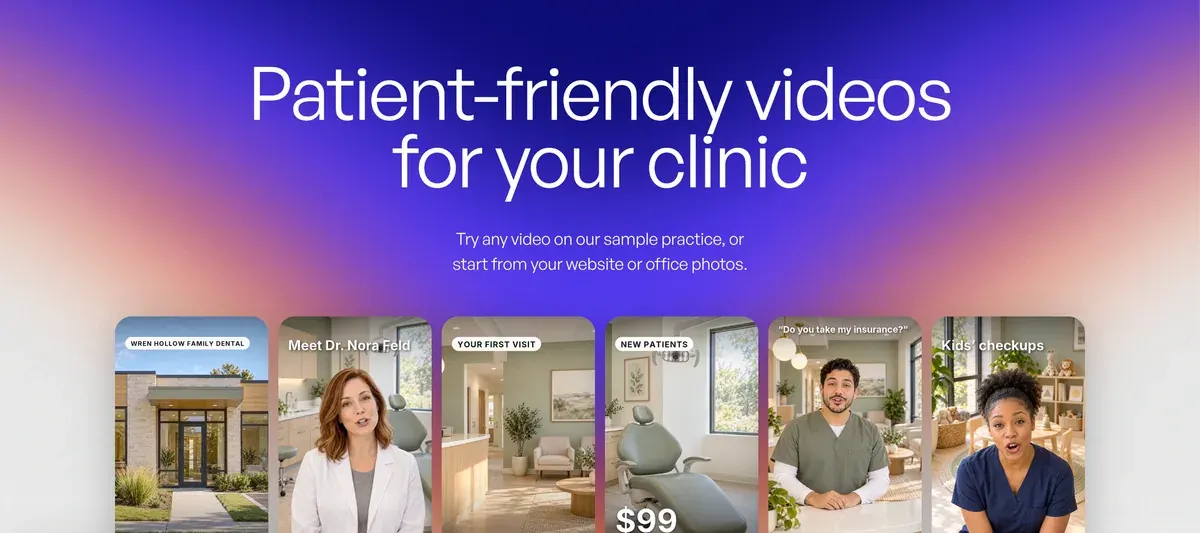
The agent animates your photos and says it “never changes your rooms, your equipment or your team”. It can show your dentist from one photo, which keeps the real person in the ad with their real title.
Here is a 15-second new-patient script for a made-up practice. A narrator reads it, so nobody on screen claims to be the dentist, and every sentence is a fact the front desk can confirm.
- 0 to 3 seconds: photo of the front desk, caption on screen. “New to Northgate? We’re taking new patients.”
- 3 to 11 seconds: treatment room, then Dr Lee’s own headshot. “Dr Lee sees new patients on weekday mornings and Saturdays. The front desk checks your insurance before you arrive.”
- 11 to 15 seconds: end card, no voice, with the practice name, phone number and booking address.
What does a dental video cost to make?
On Standard, a 30-second avatar video works out at $2.73 and a 15-second one at $1.36, if every credit is used. The credit article bills 5 credits per 15 seconds, rounded up, so going one second over 15 doubles the bill. Creatify’s prices were last read on .
The agent is different: the same article says its use is “variable and cannot be determined upfront”, so check the balance after your first video.
In the avatar and Video Ad tools, four 30-second videos use 40 of Standard’s 55 credits. The 15 left cover two full revisions at 3 credits per 15 seconds. The dental page offers your first 15-second practice video free. Free exports carry a watermark, so a paid plan makes the version you run.
Budget for retries. Users say credits go faster than the pricing suggests (15 of 61 sources: Trustpilot, r/FacebookAds). They also say outputs miss the brief on lip sync or details (17 of 61 sources: Trustpilot, Trustpilot). A wrong insurer’s name in a caption is the kind of slip to catch before upload.
Creatify’s dental page quotes results such as a 73% improvement in return on ad spend for Designrr. Those are vendor numbers, and none of the named brands is a dental practice.
When should a dental practice skip Creatify?
Skip it when the ad’s proof is a real mouth or a real person. A smile makeover needs the actual patient, filmed on a phone with the form signed, and no AI tool improves on that.
It also falls short when patients choose you for your dentist. Users say avatar ads share a templated look that weakens on a close look (6 of 61 sources: r/PPC, r/FacebookAds). A patient choosing who works in their mouth looks closely.
Film your dentist for a minute at the chairside. If a camera is hard to schedule, a clone of the real dentist, made with their consent, is the middle route:
- Creatify Pro at $55 a month includes three custom avatars.
- HeyGen Creator at $29 a month includes one custom digital twin.
- Synthesia Starter at $19 a month suits a personal avatar only, since its policy bars stock avatars from paid social ads without its written consent.
Video is the wrong format for a toothache tonight. That patient searches, and a search ad catches them at that moment. Keep video for people who have not picked a dentist yet, such as new arrivals in town.
Attorney ads on video cover bar rules and AI presenters for another regulated service.
HVAC ads, plumber ads and roofing ads on video cover licence rules for local trades.
Questions about dental ads
Can a dentist show before-and-after photos in an ad?
Yes on Meta, read under its general cosmetic line, with an adult audience, no statements of inferiority and the patient’s signed authorisation. Creatify’s page also points you to your licensing board, so check its rules first.
Does a verbal yes from a patient count?
No. A valid HIPAA authorisation carries the patient’s signature and the date, under section 164.508(c)(1). Keep the signed form on file with its expiry date.
Does an AI dental ad need a label?
It depends on the platform and the state. AI ad disclosure rules quotes each rule.
More pages for Creatify users, sorted by job, in the Creatify hub
Sources
- Legal Information Institute, Cornell Law School: 45 CFR 164.508, Uses and disclosures for which an authorization is required, (a)(3) marketing, with its two exceptions and the statement on third-party payment; (c)(1) core elements, signature and date among them; (c)(2) required statements. Checked
- Legal Information Institute, Cornell Law School: 45 CFR 160.103, Definitions, covered entity: a health plan, a clearinghouse, or a provider who transmits health information electronically in a covered transaction. Checked
- Hunton Andrews Kurth: OCR reaches HIPAA settlement with Cadia Healthcare Facilities, announced 30 September 2025; 182,000 dollars; a patient’s name, photo and treatment details in a website success story; about 150 other patients. Checked
- Meta Transparency Center: Privacy violations and personal attributes, the rule, the health attribute, and the examples
Do you have diabetes?
andNew diabetes treatment available
. Checked - Meta Transparency Center: Health and wellness, from the Today text in its change log: cosmetic procedures target 18 and over; dental products such as teeth whitening exempt; general cosmetic before-and-after allowed; statements of inferiority barred. Checked
- Legal Information Institute, Cornell Law School: 16 CFR 255.3, Expert endorsements, (a) an endorser represented as an expert must have that expertise. Checked
- Legal Information Institute, Cornell Law School: 16 CFR 465.2, Fake or false consumer reviews, consumer testimonials, or celebrity testimonials, (a)(1) that the testimonialist exists; (a)(2) that they used the service. Checked
- ADA News: ADA Code updates address ethical concerns with social media influencers, Advisory Opinion 5.F.7 extends the false-or-misleading standard to influencers and asks them to disclose paid partnerships with vendors. Checked
- Creatify: Video ads for dentists and clinics, built from website and office photos; six video types; 9:16, 16:9 and 1:1; what the agent avoids; first 15-second video free; no mention of HIPAA. Checked
- Creatify: Moderation policy,
Unauthorized legal, medical, or financial advice
listed as prohibited content. Checked - Creatify: Terms of service, effective 23 September 2024; clause 6.2 on breach; no mention of HIPAA in the terms or the privacy policy. Checked
- Creatify: Creatify pricing, plans and credits, from src/data/tools.json. Checked
- Creatify help centre: Credit usage, billing and validity, Video Ad, Avatar Video and AI Shorts 5 credits per 15 seconds, rounded up; revisions 3 credits per 15 seconds; agent use
variable and cannot be determined upfront
. Checked - Reddit, Trustpilot, G2 and others: Public user reviews of Creatify, 61 sources: 17 say outputs miss the brief, 15 name fast credit use, 6 name a templated look. Checked

Alexandre S.
Alexandre S. is a creative ad strategist and copywriter with ten years' experience in digital marketing across multiple channels.
Related pages
-
 Profile Creatify for UGC ads
Creatify bills avatar video in 15-second blocks, so a 30-second ad uses 10 credits. Its ad terms and 20 latest Trustpilot reviews, read 24 September 2026.
-
 Guide Are AI UGC ads legal? FTC rules and likeness rights
The FTC’s fake-testimonial rule reaches an AI actor who claims to have used the product. That rule and US state and EU laws, quoted with dates.
-
 Guide AI disclosure in advertising, platform by platform
Where a platform or a law asks you to disclose AI in an ad, each rule quoted with its date. Meta, TikTok, YouTube, New York, California and the EU.
-
 Guide Med spa ads
Meta bars Botox side-by-sides in its 22 July 2026 version and has no such line in its Today text. Drug-name rules, FDA and FTC lines, video cost, 7 Nov 2026.
-
 Guide How to use Creatify
A 30-second Creatify ad uses 10 credits, and the agent’s cost is unknown until it finishes. Eight steps to a first ad, with what each spends, 5 November 2026.


