Med spa ads
A med spa ad promotes treatments such as wrinkle injections and laser sessions to people nearby. Review runs stricter than for a salon, because some of what you sell is prescription medicine.
If your Botox ad came back rejected, check the hook and the drug name first. Meta’s health policy bars a side-by-side for wrinkle treatments in its 22 July 2026 version and in an undated foot note. Its “Today” text has no such line, so skip the split screen.
The drug name matters since Meta and Google both restrict prescription drug promotion. Ads that sell the visit avoid most of this.
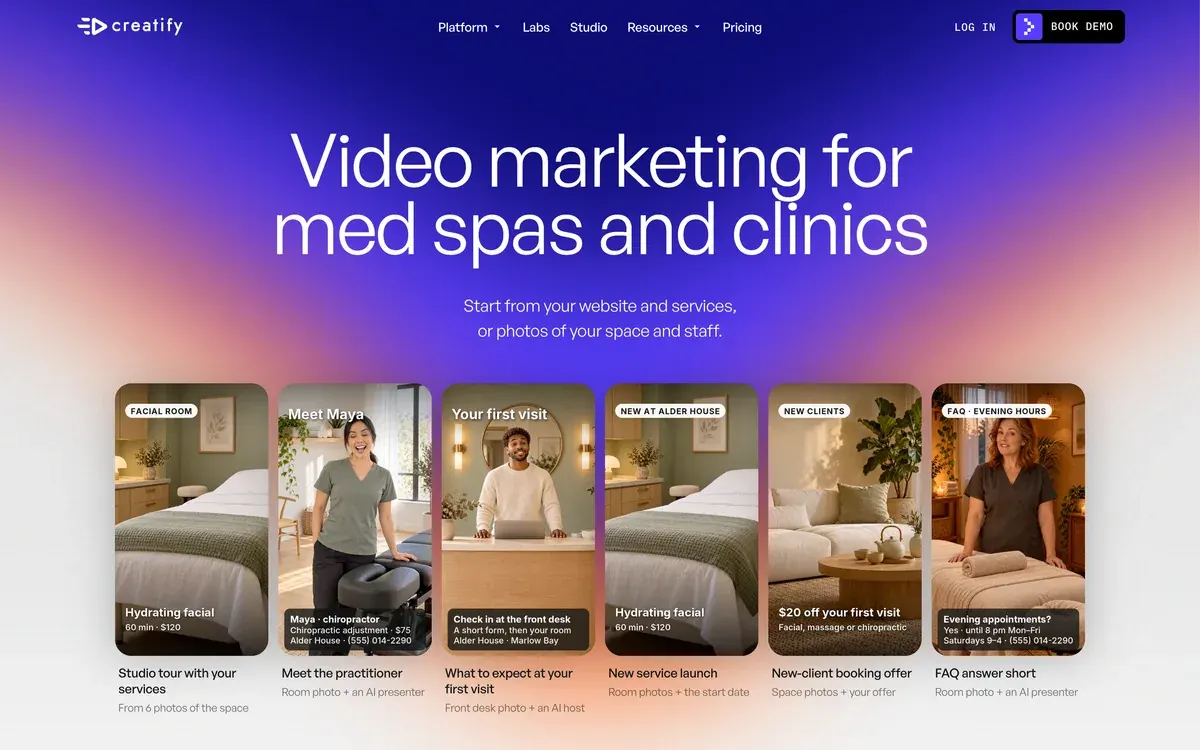
Creatify says its agent makes a studio tour or a first-visit guide from your website and photos. Its avatar and Video Ad tools bill $2.73 for 30 seconds on Standard at $15 a month, if every credit is used. The agent has no fixed rate.
Meta keeps older versions of this policy in a change log, so a rule you read elsewhere can be a dated one.
| Treatment | Live text | 22 July 2026 version |
|---|---|---|
| Botox, fillers, other anti-ageing | No side-by-side rule; fillers and injectables allowed for adults | Side-by-side barred; close-ups allowed, showing “realistic outcomes over time” |
| Weight loss | No side-by-side rule; a close-up pinching fat barred | Side-by-side barred, with an exception for fitness classes; pinching barred |
| General cosmetic procedures and surgery | Before-and-after allowed for adults | Allowed with no negative self-perception tactics |
| Creams, makeup, hair products | Exempt from the age rule | Outside the before-and-after rules |
Scroll sideways for all 3 columns

Why did Meta reject your Botox ad?
Check the hook and the drug name first, since the Today text has no line on split screens. The change log on Meta’s health and wellness policy opens on “Today”, the live text. The bar on a side-by-side comparison “for wrinkles treatment” sits in the version dated 22 July 2026.
Today’s text does not name Botox and carries no date. The page does not say which block is newer, so treat the split screen as barred.
Today’s text lists “dermal fillers, skin rejuvenation treatments, injectable treatments” among procedures allowed for people aged 18 or over. It allows “General cosmetic products, procedures, surgeries depicting before and after transformation”.
An undated note at the foot of the page permits “skin anti-aging products or services, including treatments like Botox injectables” to use close-ups of the treated skin, and says those images should not include side-by-side comparisons.
Health and Wellness
Age gate. Ads promoting or marketing cosmetic products, procedures or surgeries must be targeted to people aged at least 18 years or older.
Ads can’t Promote weight loss or weight gain products and services, or cosmetic products or procedures that: Contains statements of inferiority about physical appearance (i.e. terms, descriptions or questions that are negative and attack an individual’s appearance, specific body parts or hygiene).
Allowed at 18+. Cosmetic products, procedures or surgeries such as: Breast augmentation, breast reduction, abdominoplasty, blepharoplasty, rhinoplasty, rhytidectomy, labiaplasty, hair restoration surgery, dermal fillers, skin rejuvenation treatments, injectable treatments, chemical peels, micro-needling, non-ablative laser treatments, laser or light treatments or micropigmentation. General cosmetic products, procedures, operations depicting before-and-after transformation.
Three lines in the live text catch aesthetics ads:
- The tone rule. Ads can’t carry “statements of inferiority about physical appearance”, meaning words or questions that attack someone’s looks. A hook like “Tired of looking old?” fits that description.
- The age rule. Cosmetic procedures must target people aged 18 or over.
- The clickbait rule. The page bars “promises of specific outcomes within a set time frame without disclaimers or qualifiers”. An invented hook such as “Ten years younger by Friday” has that shape.
A hook that names the viewer’s condition adds a separate problem, covered under Meta’s personal attributes rule in our dental ads guide. A side-by-side that clears all of this still meets the drug-name rules and the FDA and FTC limits below.
Can you say Botox or Ozempic in an ad?
You can say neither freely, and the safest headline sells the consultation and leaves the brand name out. Botox and Ozempic are prescription drugs, so each platform’s drug rules come into play.
| Platform | The rule | What it leaves open |
|---|---|---|
| Meta | Prescription drug ads need Meta’s authorisation; online pharmacies and telehealth need LegitScript | Whether an in-person clinic naming Botox needs it |
| Restricts drug terms “in ads, landing pages, and keywords” | Names neither Botox nor semaglutide | |
| TikTok | Cosmetic clinics allowed for adults, fillers named as an example; prescription medicine needs proof of approval from local regulators | Whether a clinic that names Botox counts as a prescription medicine ad |
Scroll sideways for all 3 columns
Meta’s two pages do not line up neatly. Its health page allows injectable treatments for adults, and its foot note names Botox injectables. Its drugs page requires authorisation for prescription drug ads and exempts only education and awareness. Neither says which one governs a clinic’s service ad.
LegitScript is a third-party certification for healthcare sellers. Meta and Google ask it of telehealth providers and online pharmacies, so a spa that treats clients in person sits outside those two labels.
GLP-1 weight-loss drugs sit in the harder category. Meta sends prescription weight-loss products to its drugs policy, with geo-targeting and written permission. Google allows US telemedicine ads only from LegitScript-accredited providers that Google has certified. If you lack those, no creative fixes the ad, so promote the consultation with your clinician and keep the drug out of it.
How do Google Ads work for a med spa?
Google Ads puts a text ad in front of someone already searching, such as “med spa near me”. Two rules shape a med spa’s account there.
The first is the drug-term rule above, which reaches your landing page as well as the ad. Fixing the headline does nothing if the page says Botox in every paragraph. Send the ad to a consultation page that leads with the visit.
The second limits who you can follow around the web. Google’s health policy counts “Invasive medical procedures, including cosmetic surgery, surgical procedures, or injections” as sensitive. In that category, advertiser-curated audiences cannot be used, which rules out a list you build yourself for injectables. Predefined Google audiences stay open.
Video fits around this. A studio tour on YouTube or Reels reaches people before they search, and search catches them when they do. Creatify makes the first part. It has no bearing on your keywords or search copy.
What can you claim about results?
You can claim only what you can back with evidence, and in a clinic that bar sits high. The FTC’s health products guidance asks for “competent and reliable scientific evidence” behind a health benefit. A client’s rave does not meet it, and the guide says a “Results not typical” footnote does not rescue a dramatic testimonial.
Two recent cases show how far enforcement reaches, from results to labels:
- In July 2025 the FTC took action against telemedicine firm NextMed over alleged fake testimonials and “deceptive before and after photos of people who were not their customers”. The settlement came to $150,000.
- In June 2026 the FDA sent a warning letter to Mint Med, a med spa. Its website showed labels for compounded semaglutide and tirzepatide, meaning drugs mixed by a pharmacy for a patient, with its own name on them. The FDA objected because Mint Med did not make the drugs.
The FDA says plainly: “Compounded drug products are not FDA-approved.” Keep “FDA-approved” and any brand comparison away from a compounded product in your copy.
An AI actor saying “my lines disappeared in a week” describes an experience nobody had, and the FTC’s fake testimonial rule covers a testimonialist who does not exist.
An AI-made “after” face goes one step past the NextMed photos, since that person never existed at all. Are AI UGC ads legal? covers this at length.
Paying a client or a creator for a video adds a disclosure. The FTC’s Endorsement Guides Q&A puts it on the brand as well as the presenter.
FTC’s Endorsement Guides: What People Are Asking
Responsibility for clearly and conspicuously disclosing a material connection rests with the influencer and the brand.
Your company is ultimately responsible for what others do on your behalf.
Do you need HIPAA sign-off for client footage?
It depends on how you bill, and the safe answer is a signed form either way. HIPAA, the US health privacy law, applies to a provider who sends health information electronically in transactions such as insurance claims. A cash-only med spa can fall outside that definition, while one that bills insurers for medical visits falls inside it.
If you are inside it, a client’s marketing authorisation has required parts, and the dental ads guide lists them.
If you are outside it, you still want the same paper. A signed form settles any later dispute over whether a client agreed to appear. TikTok’s health guide also asks you to “Obtain clear, written consent before featuring individuals.”
Which formats stay clear of these rules?
Formats that show the place and the person stay clear, because they make no result claim and need no client. Creatify’s med spa page lists six types, and three of them need no client and make no result claim:
- A studio tour shows the rooms and the front door, which answers “is this place real?”.
- A practitioner intro says who treats you and what licence they hold. Use the real person, from one headshot. Creatify’s sample for this format uses an AI presenter, so swap it out.
- A first-visit guide explains what happens at a consultation and when you see the price. Creatify’s sample uses an AI host, which can read the steps and claims no title.
Here is a 15-second first-visit ad for a made-up spa. A narrator reads it over photos, for a viewer who has never had a treatment and is nervous about pressure to buy.
- 0 to 3 seconds: photo of the consultation room. “This is where your first visit at Lumen happens.”
- 3 to 11 seconds: Dana’s own headshot, then the consultation chair. “Dana, our nurse practitioner, goes through your options and the price first. Nothing happens unless you say so.”
- 11 to 15 seconds: end card, no voice, with the spa’s name, address and “Book a consultation”.
The script names no drug, shows no treated skin and promises no result. The page says the agent “never adds equipment, people or claims”, which suits this kind of ad, and it tells you to “Review every video before you post”.
What does a med spa video cost?
In Creatify’s avatar and Video Ad tools, a 15-second video costs $1.36 on Standard, if every credit is used. Its credit rule takes 5 credits for each started block of 15 seconds. Creatify’s prices were last read on .
The same article says agent use is “variable and cannot be determined upfront”, so make one video and read your balance before you plan six.
In those two tools, all six video types at 15 seconds use 30 credits and fit inside Standard’s 55. At 30 seconds they use 60, which is 5 credits over. Pro at $55 a month holds 280 credits, or $1.96 for 30 seconds if you use them all. Your first 15-second clinic video is free, with a watermark on free exports.
Two user complaints belong in that budget. Retries and failed renders eat credits (15 of 61 sources: Trustpilot, r/FacebookAds). Cancelling is hard, with charges reported after people cancelled (9 of 61 sources: Trustpilot, Trustpilot).
The results on Creatify’s med spa page, such as a 28% drop in cost per lead for Zerorez, are vendor figures. None of its named stories is a med spa.
What should a med spa use in place of Creatify?
Use real footage when your best proof is a real result. Creatify’s page says the agent keeps results and before-and-after shots out. A surgeon’s portfolio needs real photos from a consenting client, placed under the Meta rules in the table above.
A few other cases point elsewhere:
- Your injector is the brand. Clients book a person, so film them with a phone. A consented digital twin on HeyGen Creator at $29 a month covers the weeks they cannot shoot.
- You sell a retail skincare line. A product demo fits better, and Tagshop Starter at $29 a month makes avatars holding the product at $5.80 a video at best.
- You sell GLP-1 programmes online. The block is certification, and no video tool lifts it.
Supplement ads cover the claims that pass FDA, FTC, Meta and TikTok rules.
Attorney ads on video cover bar rules and AI presenters for another regulated service.
AI ad disclosure rules quotes each rule on labelling AI-made ads.
Questions about med spa ads
Can a med spa run Botox ads on Facebook?
Yes, with limits. Target adults, avoid any hook that attacks the viewer’s looks and promise no result by a set date. Selling the consultation leaves the drug name out of the ad.
Does a med spa need LegitScript?
Meta and Google ask for active certification from telehealth providers and online pharmacies. An in-person consultation ad falls outside those two categories.
Can an AI model show the result of a treatment?
No. A generated face showing a result is a person who never had the treatment. Section 465.2(a)(1) bars a testimonial that misrepresents that the person exists, and the image has no evidence behind it.
More pages for Creatify users, sorted by job, in the Creatify hub
Sources
- Meta Transparency Center: Health and wellness, Today text in its change log: fillers, injectables and general cosmetic before-and-after allowed at 18; statements of inferiority and pinching close-ups barred; no side-by-side rule. Version of 22 July 2026: side-by-side barred for wrinkle treatments and weight loss. Undated foot note: Botox close-ups allowed, side-by-side not. Checked
- Meta Transparency Center: Drugs and pharmaceuticals, prescription drug ads need authorisation; online pharmacies and telehealth providers certified with LegitScript; US, Canada or New Zealand, adults only; education exempt. Checked
- Google Ads Help: Healthcare and medicines,
Google restricts the use of prescription drug terms in ads, landing pages, and keywords
; US telemedicine needs LegitScript and Google certification; names neither Botox nor semaglutide. Checked - Google Ads Help: Personal health content in personalized advertising,
Invasive medical procedures, including cosmetic surgery, surgical procedures, or injections
count as sensitive; advertiser-curated audiences cannot be used. Checked - TikTok Business Help Center: Healthcare and pharmaceuticals, United States: cosmetic clinics allowed with conditions, adults only, fillers and microdermabrasion as examples; prescription medicine needs proof of approval and certification from local regulators, adults only; Botox not named; updated September 2026. Checked
- TikTok for Business: Health advertising guide,
Obtain clear, written consent before featuring individuals.
. Checked - Federal Trade Commission: Health products compliance guidance, competent and reliable scientific evidence;
Results not typical
does not cure a misleading testimonial; a clear statement of typical results is needed. Checked - Federal Trade Commission: FTC’s Endorsement Guides: What People Are Asking, disclosing a material connection rests with the influencer and the brand. Checked
- Federal Trade Commission: FTC takes action against telemedicine firm NextMed, 14 July 2025; 150,000 dollars; alleged fake testimonials and before-and-after photos of people who were not customers. Checked
- US Food and Drug Administration: Warning letter to Glow Medispa, LLC dba Mint Med, 8 June 2026; labels showing the spa’s name implied it compounded the drugs; sections 502(a) and 502(bb). Checked
- US Food and Drug Administration: Warning letter to Cosmo Medical Spa, 9 September 2025;
Compounded drug products are not FDA-approved.
. Checked - Legal Information Institute, Cornell Law School: 45 CFR 160.103, Definitions, covered entity: a provider who transmits health information electronically in a covered transaction. Checked
- Legal Information Institute, Cornell Law School: 16 CFR 465.2, Fake or false consumer reviews, consumer testimonials, or celebrity testimonials, (a)(1) that the testimonialist exists; (a)(3) their experience. Checked
- Creatify: Video ads for med spas and clinics, six video types, with an AI presenter or host in the practitioner and first-visit samples; built from website, services or photos;
It never adds equipment, people or claims
; first 15-second clinic video free. Checked - Creatify: Creatify pricing, plans and credits, from src/data/tools.json. Checked
- Creatify help centre: Credit usage, billing and validity, Video Ad, Avatar Video and AI Shorts 5 credits per 15 seconds, rounded up; agent use
variable and cannot be determined upfront
. Checked - Reddit, Trustpilot, G2 and others: Public user reviews of Creatify, 61 sources: 15 name fast credit use, 9 say cancelling is hard. Checked

Alexandre S.
Alexandre S. is a creative ad strategist and copywriter with ten years' experience in digital marketing across multiple channels.
Related pages
-
 Profile Creatify for UGC ads
Creatify bills avatar video in 15-second blocks, so a 30-second ad uses 10 credits. Its ad terms and 20 latest Trustpilot reviews, read 24 September 2026.
-
 Guide Dental ads
A practice billing insurance electronically needs a signed HIPAA form to show a patient, and Meta rejects hooks that imply a condition. Rules read 7 Nov 2026.
-
 Guide Are AI UGC ads legal? FTC rules and likeness rights
The FTC’s fake-testimonial rule reaches an AI actor who claims to have used the product. That rule and US state and EU laws, quoted with dates.
-
 Best list Best AI tools for Meta ads
AI tools for Facebook and Instagram ads, split into making the ad and running the campaign, with prices and ad terms checked 23 to 26 September 2026.
-
 Guide Is Creatify free?
Yes: Creatify’s free plan gives 10 credits a month for two watermarked 15-second ads. No trial and no promo code. What each video costs, 6 November 2026.


