Attorney ads on video
Attorney ads are paid messages that offer a lawyer’s services, and each state’s bar rules decide what yours can say. In video the danger sits with the person on screen, because a viewer takes them for your lawyer.
For a small firm, the attorney on camera is usually the right route, filmed on a phone or with a crew for a day. Rule out two choices: a stock AI presenter speaking as a lawyer, and an AI “client”. California’s statute bars the first with no disclosure that cures it.
Software earns its place around the attorney, on captions and narrated tips. Creatify makes a 15-second presenter ad for $1.36 on Standard if every credit is used, at prices read on .

What do the ABA rules say about attorney ads?
The American Bar Association writes model rules, and each state adopts its own version. Two matter for a video ad.
Rule 7.1 says a lawyer “shall not make a false or misleading communication about the lawyer or the lawyer’s services”.
Rule 7.1: Communications Concerning a Lawyer’s Services
A lawyer shall not make a false or misleading communication about the lawyer or the lawyer’s services.
That reaches a true statement too, if it leaves out a fact the viewer needs. Rule 7.2(d) says the ad must carry the name and contact information of at least one lawyer or firm responsible for it.
So every video needs a name and a way to reach you on screen. Everything else in the script has to survive one question: would a reasonable viewer come away believing something untrue?
How do attorney ad rules differ by state?
States add their own rules on top, and four of them show how far apart the bars sit. Check your own state before you shoot.
| State | What it adds for video | Review or filing |
|---|---|---|
| New York | Close to the ABA text: no false or misleading statements, plus a responsible lawyer’s name and contact details | The old filing of solicitations is gone |
| California | Bans impersonating a lawyer. A client impersonation or a dramatisation needs a disclosure. A spokesperson’s title must be shown. One licensed lawyer and an office city must be named | A misled consumer can sue after a complaint and a State Bar finding: $5,000 to $100,000 an ad, or three times actual damages if larger |
| Florida | Past results only if objectively verifiable. Limits on testimonials. A voice or image can’t pass as your lawyer, and a dramatisation must read as one | Unless exempt, file 20 days before first airing: $250 an ad, $750 if late |
| Texas | An actor playing a lawyer misleads if viewers take them for the lawyer offering the service. Credit for a result only with a substantial role | Unless exempt, file within ten days after first use: $100 |
Scroll sideways for all 3 columns
New York is the recent change. Its courts moved to the ABA’s approach on 1 June 2026. The “Attorney Advertising” label and the line “Prior results do not guarantee a similar outcome” are no longer required. The State Bar’s summary still suggests that line as protection.
California sets the biggest sum of the four. Its statute lets a misled consumer sue on three conditions. They have filed a complaint, the State Bar finds substantial evidence, and the ad stays up or runs again after withdrawal. Damages are the table’s band or three times actual damages, whichever is larger.
Can a law firm use an AI presenter in an ad?
Yes, as long as nobody takes the presenter for a lawyer or a client.
California’s wording is the clearest. An ad can’t contain an impersonation of the “electronic image of any person other than the lawyer”, “directly or implicitly purporting to be that of a lawyer”. A stock avatar introducing itself as your attorney fits those words.
The disclosure exception sits only in the next clause, on clients and dramatisations. So a small “AI presenter” caption doesn’t rescue the lawyer version.
Florida takes a softer line. Rule 4-7.13(b)(5) treats such a voice or image as deceptive unless a “clear and conspicuous disclaimer” says the person is not a firm employee or member. Texas’s comment 3 says whether a disclaimer works “depends on a careful assessment of the relevant facts and circumstances”, including how conspicuous and clear it is.
Neither California’s section nor the New York summary mentions AI. They don’t need to, because the tests ask what the viewer believes. Florida’s Opinion 24-1 reached the point for chatbots: Hinshaw’s summary says prospects must be told they are talking to an AI.
| Presenter | Position | Say on screen |
|---|---|---|
| The real attorney | Safest route, and the one a viewer can meet at the consultation | Name, firm, contact |
| A custom avatar of that attorney | Middle route, with the attorney’s consent and review of every word | Name, firm, contact, plus “AI-generated video of [name]” if your bar expects it |
| A stock avatar as a narrator | Workable where a disclaimer is accepted, and for general information | “AI presenter. Not a lawyer or client of this firm” |
| A stock avatar as a lawyer | Barred in California, risky in Florida and Texas | Don’t make it |
| An AI “client” telling their story | California asks for a disclosure, and the federal fake-testimonial rule still applies | Don’t make it |
Scroll sideways for all 3 columns
Say more than the minimum. A plain line costs nothing, and it answers the question a grievance would ask. The AI UGC legal guide covers the federal rule on fake testimonials.
Synthesia, another presenter tool, lists Starter at $19 a month, and its Acceptable Use Policy asks for its written consent before stock avatars run in paid social ads.
Why does a real attorney often beat an avatar?
A law firm sells trust in a specific person, who answers the phone when something has gone wrong. A viewer who sees that person in the ad arrives at the consultation already knowing the face.
An avatar breaks that link, and it adds a second problem. Users say Creatify’s avatar ads share a recognisable, templated look (6 of 61 sources: Reddit, Reddit). That passes at scroll speed for a phone case. It reads worse when the buyer is choosing someone to handle a divorce.
Florida’s filing form puts the issue in one field. The transcript has to identify every speaker as a lawyer or a nonlawyer.
A custom avatar is the honest middle route when the attorney has no time to film language or practice-area versions. Creatify’s Pro plan at $55 a month lists 3 custom avatars. You record a video of yourself, and it is typically ready in 1 to 2 business days. Creatify’s API reference asks for a consent video.
One trap sits inside that route. California’s Rule 7.1 comment 5 bars implying you can provide services in another language unless you can, or the ad gives that speaker’s job title. An AI dub of an English-only attorney speaking Spanish implies exactly that.
A 15-second attorney intro to shoot today
The attorney sits at their own desk with a phone on a small tripod at eye level. They read from notes taped just under the lens. Nobody else appears. The script stays general, so no case is discussed.
- 0 to 3 seconds. The attorney looks into the lens: “After a crash, the insurer’s offer comes fast.” Text: the same words.
- 3 to 9 seconds. “I’m Dana Reyes. You can talk to me first, before you sign anything.” Text: “Dana Reyes, attorney”.
- 9 to 13 seconds. “Bring the offer. We’ll read it together.”
- 13 to 15 seconds. End card: firm name, phone number, office city.
Dana Reyes is an invented name, so use your own. Nothing here promises a result, and the end card carries the name and contact details the rules ask for.
Which lines get attorney ads in trouble?
Each of these lines sounds harmless in a script. Personal injury lawyer ads need the closest look, since California’s statute names quick settlements and contingent-fee costs. Run yours against this list before you film.
| Line | Problem | Rule | Try instead |
|---|---|---|---|
| “We’ll get you what you deserve” | A guarantee of a result | California comment 2 | “We’ll explain your options” |
| “Millions recovered” | Past results | Florida (b)(2), Texas comment 10 | State the verifiable figure with its context, where your state allows it |
| “No fee unless we win” | Silent on costs | California comment 3 and section (a)(4) | Add whether the client owes costs |
| “Quick cash settlements” | Barred outright | California section (a)(2) | “We start the same week” if true |
| A client saying “they got me everything” | A testimonial that sets expectations | California comment 4, Florida (b)(9) | Show what happens at the first meeting |
Scroll sideways for all 4 columns
What does Meta add to attorney Facebook ads?
Meta bars ads that assert or imply a person’s attributes, and its list includes criminal record, health and vulnerable financial status. “Are you bankrupt? Check out our services.” is one of Meta’s own examples of an ad it refuses.
That shape is the obvious hook for lawyer Facebook ads, so rewrite before you upload. “Arrested for DUI?” turns into “DUI defence, first call free”. “Are you drowning in debt?” turns into “How Chapter 7 bankruptcy works”. The ad names the service and never tells the viewer what is true of them.
What does law firm video production cost?
A crew costs thousands. A 15-second AI ad costs $1.36 on Creatify Standard if every credit is used.
The figures below are list prices and one studio’s published tiers for commercials in general.
| Route | Price | You still need |
|---|---|---|
| Phone, tripod, your own edit | Your time | A quiet room and an hour |
| Creatify Standard, 15-second AI ad | $1.36 if every credit is used | Attorney review of every word |
| Creatify Studio, made for you | $100 to $200 a video | A signed-off brief |
| Starter production | $1,500 to $3,000 | A shoot date |
| Mid-range production | $3,000 to $6,000 | A shoot date and a script |
Scroll sideways for all 3 columns
The Broadcast2World tiers cover production only, with media on top. Hiring an AI video agency covers the Studio route in more depth.
The surprise is the filing fee. In Florida each non-exempt ad costs $250 to file, so ten variations cost $2,500 before anyone sees them. Cheap variants lose their main advantage where every version is reviewed, and one good film with the attorney goes further. Where no filing applies, the cost is the attorney’s review time.
What Creatify does for law firms, and when to skip it
Creatify’s law firm page is its pitch for law firm video marketing. It builds short videos from your site, your photos and your practice areas. It lists attorney intros, know-your-rights tips, practice-area explainers and FAQ answers, in 9:16, 16:9 and 1:1.
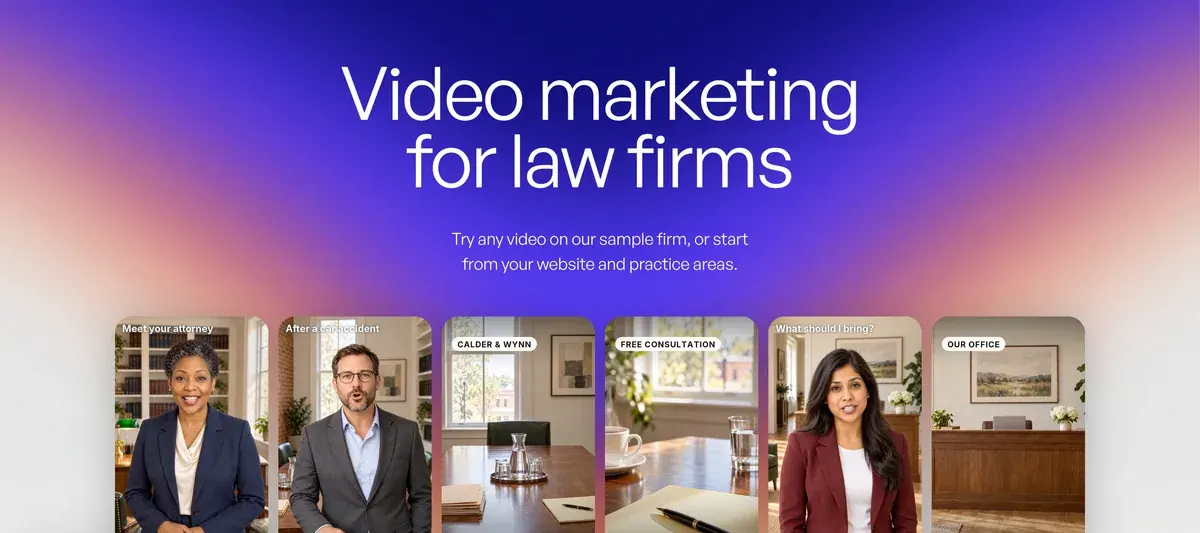
It says the agent “never adds results, awards or people”, leaves out testimonials and adds an “Attorney advertising” label.
That label is a default to check. New York no longer asks for it, and the page itself says bar rules “vary by state” and tells you to “review every video before you post”. Your first 15-second video is free with a watermark, and the Creatify free plan explains what that means for running it.
The customer numbers on that page are Creatify’s own, and none comes from a law firm. Check every output too, as users report details that miss the brief (17 of 61 sources: Trustpilot, Trustpilot). A wrong practice area in a legal ad is a bigger problem than a wrong colour on a phone case.
Tips need one extra look. Creatify’s Moderation Policy bans “Unauthorized legal, medical, or financial advice” and doesn’t define the phrase. Section 6.1 of its terms makes a breach of that policy a breach of your licence. Keep tips general, as the law firm page does, and send case-specific questions to the consultation.
Skip Creatify’s variants if your state charges a filing fee per ad and your ads aren’t exempt. Skip Creatify too if your practice rests on one known name in town. In those cases, film the attorney and use a plain editor such as CapCut.
Dental ads cover patient sign-off and Meta’s rules for another regulated service.
Med spa ads cover why Botox ads get rejected and what to run instead.
B2B video ads cover where AI presenters hurt trust when the buyer is a business.
Questions about attorney ads
Do attorney ads need a disclaimer?
Not in every state. New York dropped its “Attorney Advertising” label and prior-results line, while Florida and California still expect disclosures in set cases.
Can a lawyer use an AI avatar in an ad?
Yes, if nobody takes it for a lawyer or client. California bars an impersonation that purports to be a lawyer, and a disclosure doesn’t cure that clause.
Do lawyers have to file video ads with the bar?
Some do. Unless the ad is exempt, Florida asks for filing 20 days before first airing, and Texas within ten days after first use. Check your own bar’s page.
Are testimonials allowed in attorney ads?
Rules vary. California says a testimonial may mislead if it sets an unjustified expectation, and Florida limits testimonials that don’t reflect what clients generally experience.
More pages for Creatify users, sorted by job, in the Creatify hub
Sources
- American Bar Association: Rule 7.1: Communications Concerning a Lawyer’s Services, false or misleading communications, and omitted facts. Checked
- American Bar Association: Rule 7.2: Communications Concerning a Lawyer’s Services: Specific Rules, paragraph (d), name and contact information of a responsible lawyer or firm. Checked
- New York State Bar Association: The Amendments to the Advertising Rules, by Marjorie E. Gross; effective 1 June 2026; the label and prior-results line eliminated; rules on actors and fictional events replaced by the false or misleading test. Checked
- State Bar of California: Rules of Professional Conduct, Chapter 7, Rule 7.1 comments 2 to 5 on guarantees, no fee without recovery, testimonials and languages. Checked
- Public.Law: Business and Professions Code section 6157.2, copy of the code updated 1 January 2026; impersonation, spokesperson, quick settlements, costs on contingent fees, private claims. Checked
- Supreme Court of Florida: In re: Amendments to Rules Regulating The Florida Bar, Subchapter 4-7, SC2022-1294, 22 June 2023, effective 21 August 2023; Rule 4-7.13(b) on past results, voice or image, dramatisation and testimonials. Checked
- The Florida Bar: Coversheet for social media and video sharing advertisements, filing fee, late fee, 20 days before first airing, transcript naming each speaker as lawyer or nonlawyer. Checked
- Hinshaw & Culbertson: Florida Bar Advisory Opinion 24-1 gives green light to generative AI use by lawyers, summary of the opinion’s advertising section on chatbots. Checked
- Texas Center for Legal Ethics: Rule 7.01: Communications Concerning a Lawyer’s Services, comment 3 on actors, comment 5 on results, comment 10 on claiming credit for a result. Checked
- Texas Center for Legal Ethics: Rule 7.04: Filing Requirements for Advertisements and Solicitation Communications, filing within ten days after dissemination; voluntary pre-approval thirty days before. Checked
- State Bar of Texas: Advertising Review, application fee, fine and review fee for unfiled ads, preapproval optional. Checked
- Meta: Privacy Violations and Personal Attributes, attributes include criminal record, health and vulnerable financial status; the bankruptcy example is Meta’s own. Checked
- Creatify: Video marketing for law firms, what the agent leaves out, the label, presenter from a headshot, formats; the customer numbers are vendor figures and none is a law firm. Checked
- Creatify: Create Custom Avatars, updated 22 January 2026; text, image and video routes; ready in 1 to 2 business days; slots by plan. Checked
- Creatify: Custom avatar API, lipsync video and consent video fields. Checked
- Creatify: Moderation Policy, undated; bans unauthorised legal, medical or financial advice. Checked
- Creatify: Terms of Service, effective 23 September 2024; section 6.1 ties the licences to the Moderation Policy. Checked
- Creatify: Creatify credit usage, billing and validity, updated 19 August 2026; 5 credits per 15 seconds, rounded up. Checked
- Creatify: Creatify Studio, price per video and 48-hour turnaround. Checked
- Broadcast2World: 30-Second Commercial Video Cost in 2026, 3 November 2025; a studio’s own price tiers for production only, media excluded. Checked
- Synthesia: Synthesia Acceptable Use Policy, stock avatars in paid social advertising need written consent. Checked

Alexandre S.
Alexandre S. is a creative ad strategist and copywriter with ten years' experience in digital marketing across multiple channels.
Related pages
-
 Guide Dental ads
A practice billing insurance electronically needs a signed HIPAA form to show a patient, and Meta rejects hooks that imply a condition. Rules read 7 Nov 2026.
-
 Guide Med spa ads
Meta bars Botox side-by-sides in its 22 July 2026 version and has no such line in its Today text. Drug-name rules, FDA and FTC lines, video cost, 7 Nov 2026.
-
 Guide Real estate ads on video
Meta strips ZIP, age, gender and lookalike targeting from real estate ads. Five listing videos, the rule each must meet and the cost. 7 November 2026.
-
 Guide Creative fatigue on Meta ads and the Andromeda update
How to spot creative fatigue in Meta Ads Manager, why Andromeda rewards many distinct creatives, and how AI tools make that volume. Checked 15 Oct 2026.


