Supplement ads
A supplement ad can say what an ingredient does in the body. It cannot say the product treats or prevents a disease, outside the health claims the FDA has authorised. That line, from US food and drug law, decides whether a claim survives.
“Supports healthy joints” sits on the safe side, if you hold the evidence. “Beats arthritis pain” does not. Once the wording is right, volume comes next: Creatify bills ten 15-second video ads 50 of the 55 credits on its Standard plan at $15 a month.
This table puts common hooks through the rules. The last two lines depend on who is speaking, which is the catch with AI actors.
| Claim in the ad | Rule it meets | Rewrite |
|---|---|---|
| “Reduces the pain of arthritis” | FDA disease claim | “Supports healthy joints” |
| “Lowers your cholesterol” | FDA disease claim; Meta personal attributes | “Helps maintain cholesterol already in the normal range” |
| “Works like your prescription” | FDA: substitute for a therapy | Drop it |
| AI actor: “I lost 16 pounds” | FTC fake testimonial rule | Drop it, or use a real customer with typical results |
| AI actor: “My doctor told me to take this” | FTC fake testimonial rule | A presenter reading the label facts |
Scroll sideways for all 3 columns

What is the difference between a structure-function claim and a disease claim?
A structure-function claim describes how a nutrient affects the normal body. A disease claim says the product acts on an illness. The first is allowed on a supplement, under 21 CFR 101.93(f). The second puts the product under the FDA’s drug rules, unless it is an FDA-authorised health claim the product qualifies for.
The rule defines disease as “damage to an organ, part, structure, or system of the body such that it does not function properly”. It then lists ten ways a claim crosses over, in paragraph (g)(2). The ones that catch ad writers are these:
- It names a disease, or a sign or symptom that points to one.
- It says the product “Is a substitute for a product that is a therapy for a disease”.
- It says the product “Augments a particular therapy or drug action”.
- It uses a phrase that “Otherwise suggests an effect on a disease or diseases”.
The FDA’s compliance guide, dated January 2002, shows how fine the line gets. “Maintain cholesterol levels that are already in the normal range” passes, and “reduces cholesterol” fails. “Mild memory loss associated with aging” passes, and a claim about Alzheimer’s fails.
Two pieces of admin go with a structure-function claim. You notify the FDA within 30 days of first marketing the product, and the label carries the disclaimer: “This statement has not been evaluated by the Food and Drug Administration. This product is not intended to diagnose, treat, cure, or prevent any disease.”
Structure/Function Claims
What is allowed. Structure/function claims “may describe the role of a nutrient or dietary ingredient” in the body.
What is not. The product must be “not intended to diagnose, treat, cure or prevent any disease.”
Disclaimer. The label carries a disclaimer stating that “FDA has not evaluated the claim.”
Notice. The maker notifies FDA of the claim text “no later than 30 days after marketing the dietary supplement.”
That rule covers labels and labelling, such as pamphlets and catalogues. TikTok’s health guide gives “These statements have not been evaluated by the FDA” as an example disclaimer for health ads.
A food supplement ad in the UK faces a tighter version. The ASA’s advice under CAP Code rule 15.6.2 says claims to “prevent, treat or cure human disease” are not acceptable, and a claim to “help with” a condition likely counts as one.
What evidence does the FTC expect behind an ad?
The FDA polices the label, and the FTC polices the ad. Its health products guidance replaced its 1998 supplement guide. A health benefit claim needs “competent and reliable scientific evidence”, which it says generally means “randomized, controlled human clinical testing”.
Health Products Compliance Guidance
Evidence. Health claims “require substantiation in the form of competent and reliable scientific evidence.”
Testimonials. “It’s not enough that a testimonial represents the honest opinion or experience of an endorser.”
Results. “Testimonials that report results more dramatic than users can generally expect are likely to be deceptive.”
So a claim that clears the FDA’s wording test still fails if you hold no study on your own product or dose. “Supports healthy joints” is a safe sentence and an unsafe ad if nothing stands behind it.
The guidance’s Example 41 has a woman saying she lost 16 pounds in eight weeks, with a fine-print “not typical” note. The trial average was four pounds over placebo, so the note does not fix it: the ad has to say what buyers can expect.
The same document says disclosures on social media should be unavoidable, and that “disclosures made through hyperlinks are avoidable”. A disclaimer tucked behind “see more” falls short.
What do Meta and TikTok allow in supplement ads?
Meta and TikTok both accept supplement ads, with different limits on weight claims. TikTok is the stricter of the two, since it bars weight and muscle claims outright.
| Rule | Meta | TikTok |
|---|---|---|
| Audience | 18 and over | Adults, for supplements with no weight claims |
| Weight-loss pills | Allowed; the ad may state the time to noticeable results | Not permitted |
| Muscle gain | Not named; weight gain products are 18 and over | Not permitted |
| Body images | A close-up pinching fat is barred; no side-by-side line in the Today text | Not stated |
| Disease cure claims | Barred for a listed set of diseases | “Accurate and evidence-based” claims only |
| Unsafe ingredients | Barred at Meta’s “sole discretion” | Follows local regulations |
Scroll sideways for all 3 columns
Supplement ads on Facebook meet four separate tests in the live text of Meta’s health policy:
- No “statements of inferiority about physical appearance”: “Still carrying that belly?” fails.
- No cure claim for a listed disease such as diabetes or cancer.
- No close-up that pinches fat on a body area.
- No clickbait, such as a result promised by a deadline with no qualifier.
Health and Wellness advertising standard
Age. Ads promoting dietary, health, or weight loss or weight gain products “must be targeted to people at least 18 years or older.”
Images. Ads can’t include a “Close up on specific body area by pinching fat.”
Claims. Ads may not employ “clickbait tactics” in a health context or “sensational language with exaggerated or extreme claims.”
A side-by-side ban on weight-loss images sits in the change-log versions dated 22 July 2026 and 26 December 2024. The Today text has no such line. Skip the split screen anyway.
The personal attributes rule is the one that catches hooks. “Do you have diabetes?” is Meta’s own failing example, so “your blood sugar” and “your thyroid” invite the same reading. Ask about the routine and leave the condition out.
Passing Meta’s review does not clear you with the FDA or the FTC. Meta’s page allows an ad to state the time to noticeable results, and the FTC still expects evidence for that number.
TikTok’s minors page, updated October 2026, says ads for weight loss, weight gain or muscle gain products “are not permitted on TikTok”. Supplements “like protein powder” with no such claims “must target adults”. Its health guide answers yes for supplements that follow its policy, and asks that “All claims must be accurate and evidence-based.”
Can an AI actor say a supplement worked for them?
No. An AI actor has never swallowed a capsule, so a first-person result is a fake testimonial. The FTC’s rule bars a testimonial that misrepresents “That the reviewer or testimonialist exists”, that they used the product, or what their experience was. It reaches the brand that runs the ad as well as whoever wrote it.
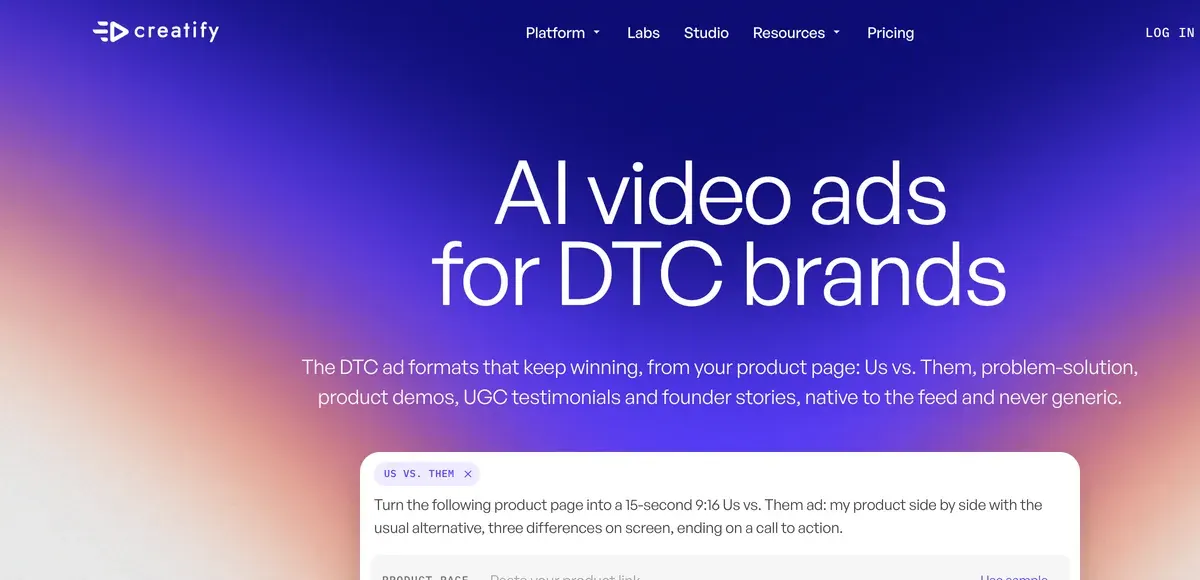
This is the main trap on Creatify. Its DTC page lists “UGC testimonial” among its formats, and a founder story with an AI presenter. Put “I sleep through the night now” in either script and you are inside that rule, with a health claim on top.
The page says its Us vs Them format “uses only your claims”, which leaves the evidence with you. Creatify’s moderation policy also lists “Unauthorized legal, medical, or financial advice” as prohibited, so a script telling viewers what to take for a symptom crosses that line too.
An AI presenter can still carry a supplement ad, as long as it reads product facts and never speaks as a user. Are AI UGC ads legal? gives the FTC’s scripted-actor example (255.0).
Consumer Reviews and Testimonials Rule: Questions and Answers
Avatars. “The rule has no blanket prohibition on the use of AI-generated avatars in marketing.”
Testimonials. An avatar’s use “might be considered a testimonial” under the rule, and “that would be prohibited under the rule only if the underlying testimonials were fake or false.”
Experience. The rule addresses misrepresenting a reviewer’s “experience” with a product, “what actually happened when they used or otherwise experienced it.”
Real customer words voiced by an AI actor need a disclosure. Section 255.2(c) asks for actual consumers “in both the audio and video”, or a clear disclosure that they are not.
Which hooks stay claim-safe?
Hooks stay safe when they describe the product, the routine or the proof, and leave the viewer’s body out. Here are three for a made-up magnesium powder called Stillwater. A narrator reads each over product shots, so nobody on screen claims to take it.
The first is an ingredient hook. The tub sits on a kitchen counter in morning light, and a scoop goes into a glass of water. “Two things in this scoop: magnesium glycinate and a little lemon.” The rest of the ad reads the label.
The second is a routine hook. The same counter at night, with the tub beside a mug and the kettle on. “This is what two scoops before bed looks like.” Nothing is said about sleep, and “my evening routine” stays out, since that would claim use.
The third is a proof hook. The screen shows the batch certificate beside the tub. “Every batch of Stillwater goes to an outside lab. Here’s the latest certificate.” It only works if that is true, and if you can show the document.
None of these names a symptom or needs an “I”. Change the first three seconds three ways on each hook, using a new shot or caption, and you have nine variants. A second end card on your favourite makes ten.
What do ten supplement ad variants cost?
Ten 15-second variants fit on Creatify’s Standard plan at $15 a month. Its credit article bills video ads and avatar videos 5 credits per 15 seconds, rounded up. Ten use 50 of the 55 credits, or $13.64 of the plan. Its agent has no fixed rate. Creatify’s prices were last read on .
Length changes the plan. Ten 30-second variants use 100 credits, more than Standard holds. Pro at $55 a month carries 280 credits, so those ten come to $19.64 of the plan. Keep each script to 15 seconds, since a 16-second cut bills as 30.
Users rate the speed. Turning a product link into many variations is Creatify’s most named strength (15 of 61 sources: r/PPC, G2). They also say credits drain quickly, as failed renders bill too (15 of 61 sources: Trustpilot, r/FacebookAds). Plan on fewer than ten finals from 50 credits.
The results on Creatify’s DTC page, such as a 27% lower cost per new customer for eFavormart, are vendor numbers from other categories of brand.
When is Creatify the wrong pick for a supplement brand?
Creatify is the wrong pick when your ad depends on a personal story. A real customer’s account, with typical results stated, is the testimonial these rules leave open, so hire real people. UGC platforms compares where to find them, and a paid creator must disclose the payment.
Compare it with MakeUGC if you want an actor holding the tub in every variant. Keep that actor to label facts, for the reasons above. MakeUGC lists Batch Mode and product-in-hand video on Starter at $59 a month, or $11.80 per talking-actor video through its API if every credit is used. Clause 2.3 of its terms leaves advertising-law compliance with you.
Users also say avatar ads share a recognisable look (6 of 61 sources: r/PPC, r/FacebookAds). Keep avatars for early variants and put a real face on the ad that takes most of your budget. If you sell through TikTok Shop, read AI UGC for TikTok Shop first.
Med spa ads cover why Botox ads get rejected and what to run instead.
AI ad disclosure rules quotes each rule on labelling AI-made ads.
Are AI UGC ads legal? covers the FTC line on fake testimonials.
Questions about supplement ads
Does a supplement need FDA approval before you advertise it?
No. 21 CFR 101.93 sets a notice, with no approval step. You notify the FDA of a structure-function claim within 30 days of first marketing, and you hold the evidence yourself.
Does the FDA disclaimer make a claim safe?
No. It belongs beside a structure-function claim. A disease claim stays a disease claim with the disclaimer attached, and the FTC’s evidence test still applies.
Are supplement ads allowed on Facebook?
Yes, for adults, if Meta does not class the product as unsafe. The ad must also avoid cure claims, close-ups that pinch fat and hooks about the viewer’s health.
More pages for Creatify users, sorted by job, in the Creatify hub
Sources
- Legal Information Institute, Cornell Law School: 21 CFR 101.93, Certain types of statements for dietary supplements, (a) notice within 30 days of first marketing; (c) disclaimer wording; (d) labels and labelling such as pamphlets and catalogs; (f) structure-function statements, and a disease claim makes the product a drug unless it is an authorised health claim; (g) disease definition and ten criteria. Checked
- US Food and Drug Administration: Small entity compliance guide: structure/function claims, 9 January 2002; examples on cholesterol, arthritis and memory on either side of the line. Checked
- Federal Trade Commission: Health products compliance guidance, competent and reliable scientific evidence; randomised, controlled human clinical testing; Example 41, the 16-pound testimonial; Example 40, a paid blogger; disclosures through hyperlinks are avoidable. Checked
- Legal Information Institute, Cornell Law School: 16 CFR 465.2, Fake or false consumer reviews, consumer testimonials, or celebrity testimonials, (a)(1) to (a)(3): that the testimonialist exists, used the product, and their experience; (b) the business that disseminates one. Checked
- Legal Information Institute, Cornell Law School: 16 CFR 255.2, Consumer endorsements, (c) actual consumers in both the audio and video, or a clear disclosure. Checked
- Meta Transparency Center: Health and wellness, Today text in its change log: dietary and weight-loss products target 18 and over; time to results allowed; statements of inferiority and pinching close-ups barred; no cure claim for a listed disease; clickbait barred. Side-by-side weight-loss ban in the versions dated 22 July 2026 and 26 December 2024 only. Checked
- Meta Transparency Center: Drugs and pharmaceuticals, bars
illicit, recreational, or other potentially unsafe drugs, products or supplements
at its sole discretion. Checked - Meta Transparency Center: Privacy violations and personal attributes,
Do you have diabetes?
as a non-compliant example. Checked - TikTok Business Help Center: Protecting minors on TikTok, updated October 2026; weight loss, weight gain and muscle gain products not permitted; supplements such as protein powder without those claims must target adults. Checked
- TikTok for Business: Health advertising guide, supplements allowed if they follow policy and local rules; evidence-based claims; gives
These statements have not been evaluated by the FDA
as an example disclaimer. Checked - Advertising Standards Authority and CAP: Food: Disease prevention and treatment claims, 3 September 2024; rule 15.6.2; disease claims barred for food products;
help with
a condition likely counts as a treatment claim. Checked - Creatify: DTC ads, formats include UGC testimonial and founder story;
uses only your claims
; no mention of supplements. Checked - Creatify: Moderation policy,
Unauthorized legal, medical, or financial advice
listed as prohibited content. Checked - Creatify: Creatify pricing, plans and credits, from src/data/tools.json. Checked
- Creatify help centre: Credit usage, billing and validity, Video Ad, Avatar Video and AI Shorts 5 credits per 15 seconds, rounded up; agent use
variable and cannot be determined upfront
. Checked - MakeUGC: Terms of service, effective 22 October 2026; 2.3 you carry advertising-law, platform and AI-disclosure compliance. Checked
- Reddit, Trustpilot, G2 and others: Public user reviews of Creatify, 61 sources: 15 name fast credit use, 6 name a templated look, 15 praise fast variations. Checked

Alexandre S.
Alexandre S. is a creative ad strategist and copywriter with ten years' experience in digital marketing across multiple channels.
Related pages
-
 Profile Creatify for UGC ads
Creatify bills avatar video in 15-second blocks, so a 30-second ad uses 10 credits. Its ad terms and 20 latest Trustpilot reviews, read 24 September 2026.
-
 Guide Are AI UGC ads legal? FTC rules and likeness rights
The FTC’s fake-testimonial rule reaches an AI actor who claims to have used the product. That rule and US state and EU laws, quoted with dates.
-
 Guide AI UGC for TikTok Shop
TikTok Shop’s quality rules, as PYMNTS reported on 8 June 2026, bar AI voices from LIVEs and ask shoppable videos for a creator’s face with the product.
-
 Best list UGC platforms for brands
Five UGC marketplaces priced per video beside three AI UGC tools: fees on top, delivery times and how long usage rights last. Checked 21 October 2026.
-
 Best list Best AI tools for Meta ads
AI tools for Facebook and Instagram ads, split into making the ad and running the campaign, with prices and ad terms checked 23 to 26 September 2026.


