Real estate ads on video
Real estate ads are paid posts that sell a home or the agent listing it. On Facebook and Instagram, Meta runs them under its housing rules, which take away ZIP code, age and gender targeting and lookalike audiences. You can no longer pick the viewer, so the video has to do that in its first line.
You can now make that video yourself. Creatify takes 3 to 20 listing photos per video. A 15-second tour of three clips costs from $0.41 on its Standard plan, if every credit is used. The fuller 8 to 15 photo walkthrough uses more clips. The costs are in the section below.
An agent needs five videos, and each has its own thing to check.
| Video | What goes in | Its job | Rule to check |
|---|---|---|---|
| Just listed | 8 to 15 listing photos, price, beds and baths | Reach buyers in the first week | Any staged photo needs a label |
| Open house | 3 photos, date and address | Fill one room for one afternoon | Stop the ad when the day has passed |
| Neighbourhood | Your own footage of streets, shops and parks | Win buyers new to the area | Describe the place and leave out the people |
| Agent intro | One headshot, or your phone | Win the next seller | Licence number and firm name |
| Sold | One exterior photo and the result | Prove the track record | State only figures you can show |
Scroll sideways for all 4 columns

What does Meta remove from real estate ads?
Meta’s housing category removes almost every setting agents once used to narrow an audience. A Special Ad Category is a label you tick when you create a campaign, and it locks the targeting options. Advertisers in or aiming at the US, Canada and parts of Europe must tick it for housing ads.
| Setting | Ordinary ad | Housing ad |
|---|---|---|
| Age | Any range | Fixed at 18 to 65+ |
| Gender | Any | All genders |
| Location | ZIP code or a small radius | 15-mile radius or larger in the US, no ZIP codes |
| Lookalike audiences | Available | Unavailable |
| Saved audiences | Available | Removed |
| Interests | Full list | A short approved list, no behaviours or demographics |
| Exclusions | Available | No location, interest or detailed exclusions |
| Custom audiences | Available | Kept, including your site visitors and your own lists |
Scroll sideways for all 3 columns
The category reaches further than listings. Meta’s wording, reproduced by Jon Loomer, also names mortgage loans, homeowners insurance and appraisal services. Older guides recommend Special Ad Audiences as a stand-in for lookalikes, but Meta ended those in 2022.
Meta’s list does not name agent intros. An intro that offers to sell someone’s home sits close to it, so run it in the same category.
How does a video do the targeting now?
The first three seconds do it, because a 15-mile circle holds plenty of people with no interest in your street. Say the area, the home’s size and the price in the first three seconds, spoken and on screen. Someone looking for a two-bedroom flat downtown scrolls past a four-bedroom house in the suburbs, which is what you want.
Here is that opening as a 15-second just-listed video, with your own voice over the listing photos. The area, price and details are made up.
- 0 to 3 seconds: front of the house, with your licence number and broker’s name as a first-frame caption. “Three bedrooms in Cedar Hill, $640,000.” The price sits on screen too.
- 3 to 11 seconds: kitchen, living room, then the garden. “The kitchen opens straight onto a south-facing garden, and the roof is two years old.”
- 11 to 15 seconds: end card with your name, firm and web address. “Open Saturday from one till three.”
Custom audiences then do the second round. Meta keeps them in the housing category, so people who watched the video or visited the listing page can see the open house invite next.
What can a real estate video say and show?
A real estate video can describe the home in any detail, and the danger starts when it describes the buyer. The Fair Housing Act, at paragraph (c), bars any housing ad that shows a preference. The grounds are race, colour, religion, sex, disability, family status and national origin.
Words are the familiar trap. “Perfect for young families” points at family status, and “three bedrooms and a fenced garden” says the same thing about the house. California adds further protected groups, age and sexual orientation among them, in its advertising guidelines.
AI casting is the newer trap. The federal regulation, 24 CFR 100.75, covers photographs and illustrations as well as words. Paragraph (c)(3) adds choosing media or locations that keep a group from hearing about a home.
An AI presenter is a picture of a person. Swapping the avatar to match who lives in each neighbourhood fits that wording, so pick one presenter and use it everywhere. Better still, use yourself.
Do you have to label a virtually staged home in a video?
In California, yes. A state law, AB 723, has required it since 1 January 2026 for images whose alteration changes how the property looks. The San Diego MLS guide spells out what agents must do, and an MLS is the shared listings database agents publish to.
- AI staging counts, and so do added or removed furniture, changed landscaping and altered views.
- A label alone falls short, because buyers must also be able to see the original photo.
- Ordinary edits stay exempt: brightness, colour correction, cropping and sharpening need no disclosure.
- The rule reaches beyond the MLS: the guide says it covers real estate advertising and other marketing.
The guide speaks of images and never mentions video. A staged photo inside a listing video is still that image. Put “Digitally altered” on screen while it shows, and link the original in the ad text.
Outside California, your listing board or broker sets the line. Members of the National Association of Realtors also answer to Article 12, which asks for a “true picture” in advertising.
AI motion adds a risk of its own. Creatify’s page says its agent animates your photos and never adds or removes rooms, finishes or views. Users report outputs that miss the brief on other jobs (17 of 61 sources: G2, r/FacebookAds).
So watch every second before you post. A window that appears from nowhere is an altered image you never meant to make.
Where does the licence number go in a video?
In California it goes on the first frame, with your broker’s name. Other states set their own rule, so check yours. California’s guidelines name video directly. First-contact material includes the opening section of streaming video, and it must show your licence number and your responsible broker’s name. Social media is held to the same standard.
An end card comes too late. Add both as a caption on the first frame, in type no smaller than the smallest text in the video.
Realtors in every state have a shorter duty. Standard of Practice 12-5 of Article 12 asks ads to show the firm’s name clearly.
What does an AI real estate video editor or generator do?
An AI real estate video editor or generator takes still photos and adds camera movement, captions, music and a voice. Creatify’s real estate page takes 3 to 20 photos with the price and your contact details. It exports in 9:16, 16:9 and 1:1, and its sample tour uses 8 photos.
Beyond tours, it lists open house invites, market updates, rental promos and teasers from a developer’s renders.
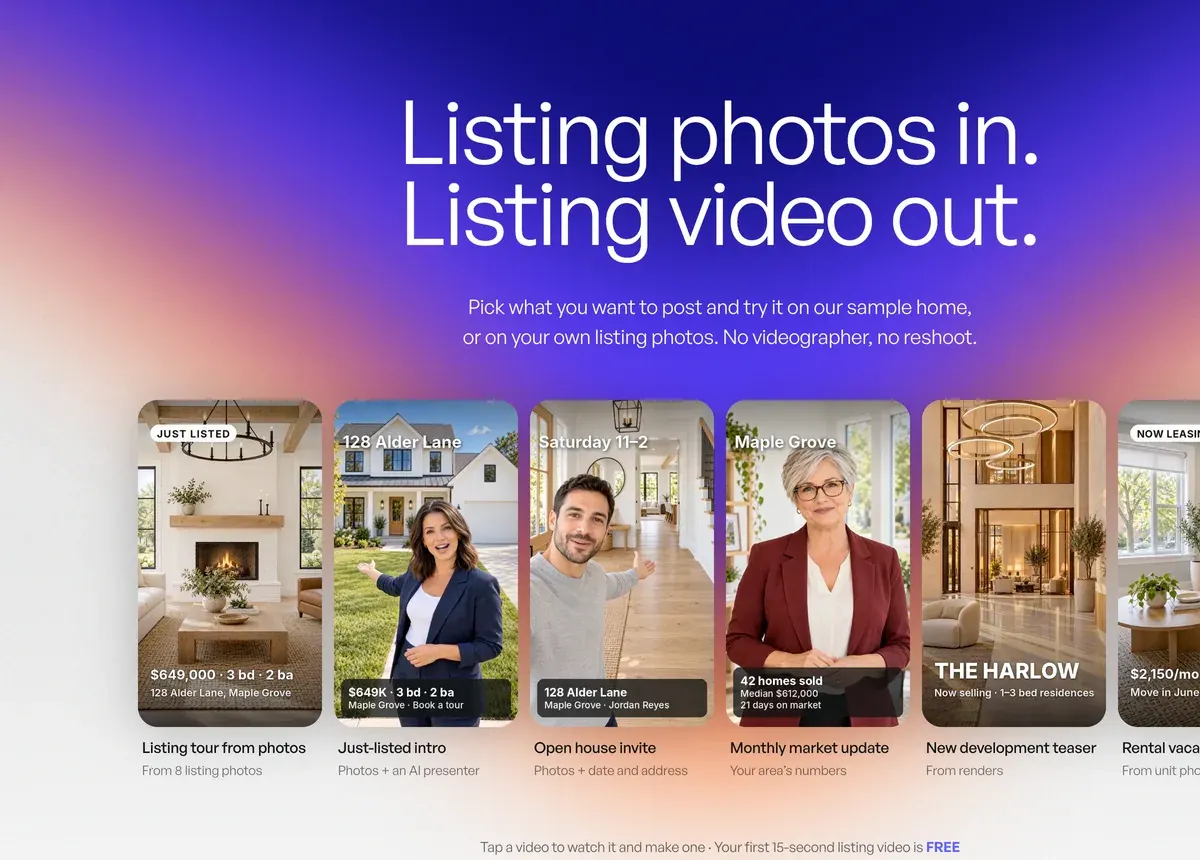
One headshot lets a presenter speak as you, or you can pick an AI presenter. The customer results on that page are Creatify’s own figures, and none comes from a named estate agency.
What does a listing video cost?
A listing video costs what its model charges, and the gap between models is wide. Creatify’s plan cards count the videos each plan buys. A 15-second tour made of three 5-second clips works out as below, if every credit is used. Credits are the units Creatify bills in, and they expire after two months.
| Model and shape | Credits | Standard | Pro |
|---|---|---|---|
| Boreal, three 5-second clips | 1.5 | $0.41 | $0.29 |
| Aurora, 15 seconds of a presenter | 5 | $1.36 | $0.98 |
| Seedance 2.0, three 5-second clips | About 24 | $6.43 | $4.58 |
Scroll sideways for all 4 columns
Three of the five videos change with each listing: just listed, open house and sold. Put those three through the presenter rate and one listing costs 15 credits. That is $4.09 on Standard at $15 a month, which covers three listings a month.
On Pro at $55 a month it is $2.95, and the plan covers 18 listings, if every credit is used. Creatify’s prices were last read on .
Team size changes the plan. Standard and Pro have one seat each, and Max has three. A brokerage with several agents needs Business at $195 a month for 10 seats on a shared credit pool.
Three catches sit behind those sums:
- The table is a floor for agent runs. Creatify’s real estate page works through its agent. Its credit article says agent runs use a variable number of credits that cannot be known upfront. Check your balance after the first listing. Users name credits running out faster than expected (15 of 61 sources: Trustpilot, G2).
- Billing rounds up, so a 16-second presenter video costs the same as a 30-second one.
- The free plan suits a look, and little else. Its 10 credits export with a watermark, and Creatify’s terms leave a free user’s rights “limited” without listing them. Keep free exports out of paid ads.
When is Creatify the wrong pick for a listing?
Creatify is the wrong pick when a buyer needs to understand how the home flows. Animated photos cannot show the walk from the hall to the kitchen, and a large or unusual house sells on that. Film a slow walk-through on your phone and cut it in CapCut’s free plan.
It is also the wrong pick for your own introduction. Sellers hire a person, and users say avatar ads have a recognisable, templated look on a close view (6 of 61 sources: r/PPC, r/FacebookAds). Record the agent intro yourself and keep AI for the listing tours.
If virtual staging is the main job, a property-only tool fits better. AutoReel bundles staging and photo edits with its videos, and its 7-day trial gives three videos with no watermark. Paid plans sell 20, 50 or 100 videos a year, and the smallest costs $124 a quarter.
Creatify earns its fee when you want the same listing in three shapes and several ad types in one sitting.
Car dealer ads cover another big-ticket local sale and what its video can say.
HVAC ads, plumber ads and roofing ads on video cover licence rules and peak timing for local trades.
Questions about real estate ads
Do real estate Facebook ads have to use the housing category?
Yes, in the US, for ads about homes for sale or rent. Meta’s standards require you to declare them, and the same rule covers mortgage loans and homeowners insurance.
Can I target one ZIP code with a listing ad?
No. Housing campaigns drop ZIP codes and need a radius of at least 15 miles in the US. Name the neighbourhood in the video’s first line instead.
Do I have to say a real estate video was made with AI?
That depends on the state and the platform. AI ad disclosure rules quotes New York’s law on synthetic performers and each platform’s own rule. Staged photos fall under the separate rules above.
How long should a listing video be?
Make 15 seconds for Reels and Stories. Creatify’s Standard plan allows videos of up to 2 minutes, but a longer video is better filmed on a phone.
More pages for Creatify users, sorted by job, in the Creatify hub
Sources
- Meta for Developers: Special Ad Categories, age fixed at 18 to 65+, all genders, no ZIP or neighbourhood targeting, 15-mile or 25-kilometre radius, no lookalikes, no exclusions, saved audiences removed, custom audiences kept. Checked
- Meta Advertising Standards: Discriminatory practices, advertisers in or targeting the United States, Canada and parts of Europe must declare housing ads and use approved targeting. Checked
- Jon Loomer Digital: Special Ad Categories: A guide for Meta ads, reproduces Meta’s list of what counts as housing, including listings, mortgage loans and homeowners insurance; Special Ad Audiences ended in 2022. Checked
- Cornell Legal Information Institute: 42 U.S. Code 3604, paragraph (c), notices, statements and advertisements. Checked
- Cornell Legal Information Institute: 24 CFR 100.75, (c)(1) words, phrases, photographs, illustrations, symbols; (c)(3) selective media or locations. Checked
- San Diego MLS: AB 723 digitally altered images FAQ, California Business and Professions Code 10140.8, effective 1 January 2026; label plus original; AI staging counts; brightness, colour and cropping do not; covers marketing beyond the MLS. Checked
- National Association of Realtors: Article 12, updated 2014, true picture in advertising; Standard of Practice 12-5 on naming the firm. Checked
- California Department of Real Estate: Real Estate Advertising Guidelines, RE 27, August 2020; first point of contact covers the opening section of streaming video; licence number and responsible broker’s name; social media held to the same rule; extra protected classes. Checked
- Creatify: AI real estate video maker, 3 to 20 photos, three formats, six video types; the agent animates your photos and never adds or removes rooms, finishes or views; customer figures are Creatify’s own. Checked
- Creatify: Creatify pricing, plan cards count 5-second Boreal, 15-second Aurora and 5-second Seedance 2.0 videos per plan. Checked
- Creatify help centre: Credit usage, billing and validity, 5 credits per 15 seconds, rounded up; Agent credit use varies and cannot be known upfront. Checked
- AutoReel: AutoReel pricing, 7-day trial with 3 videos and no watermark; paid plans of 20, 50 or 100 videos a year, the smallest at 124 dollars a quarter in the page’s plan data; virtual staging included. Checked
- Reddit and others, as counted in our reviews file: Public user reviews of Creatify, 61 sources: 17 name outputs that miss the brief, 15 credits draining faster than expected, 6 a recognisable look. Checked

Alexandre S.
Alexandre S. is a creative ad strategist and copywriter with ten years' experience in digital marketing across multiple channels.
Related pages
-
 Profile Creatify for UGC ads
Creatify bills avatar video in 15-second blocks, so a 30-second ad uses 10 credits. Its ad terms and 20 latest Trustpilot reviews, read 24 September 2026.
-
 Guide How to use Creatify
A 30-second Creatify ad uses 10 credits, and the agent’s cost is unknown until it finishes. Eight steps to a first ad, with what each spends, 5 November 2026.
-
 Best list URL to video AI tools
URL to video AI: eight tools that turn a product page link into a video ad, compared on stores read, 30-second ad cost and free plans. Checked 6 Nov 2026.
-
 Guide Facebook ad specs and Instagram ad sizes
Facebook and Instagram ad sizes, ratios, video lengths and text limits from Meta’s Ads Guide, plus the AI tools that export each ratio. Checked 15 Oct 2026.
-
 Guide Attorney ads on video
Attorney ads on video: the rules in four states, where an AI presenter breaks them, and crew prices against software. Checked 7 November 2026.
-
 Guide Connected TV ads for small business
Connected TV ads start at $100 on Universal Ads and $500 on Roku. Six platforms, the file each wants and the cost of a 15-second AI spot. 7 November 2026.


